
Wealth rarely stays simple, and for business owners it usually gets complicated inside the company first. The controller pays the property taxes on the lake house. The office manager keeps the trust paperwork in a drawer. Every spring, your CPA asks questions your estate attorney already asked in the fall, and you're the only one who knows both answers.
That setup can hold for years. Then a buyer calls, or your daughter asks about taking over, and the gaps show. In our experience, most owners reach this point well before they'd describe themselves as wealthy enough for a Family Office, and that's usually the right moment to look at coordinated Family Office services.
Complexity, more than net worth, is the signal to watch. Once your wealth outgrows what one advisor or one company bookkeeper can hold together, a Family Office brings your tax, estate, investment, and family decisions under one plan with a single point of contact. Your advisors start working from shared context instead of relaying everything through you. For most owners, establishing one has nothing to do with hiring staff or leasing office space. It means choosing the right structure for the complexity you already carry.
TL;DR Quick Answers
Family Office Services
Family Office services bring a family's investments, taxes, estate plans, governance, philanthropy, and day-to-day administration under one coordinated plan, managed by one team with a single point of contact. For business owners, the biggest value comes from getting every advisor to work from that same plan.
What's included: Personal CFO oversight, tax strategy, estate and wealth transfer coordination, family governance, philanthropy, reporting, and administrative support.
How it works: Your Family Office coordinates your existing CPA, attorneys, and bankers instead of replacing them.
Who it's for: Business owners, executives, and multi-generational families whose wealth has outgrown what one advisor can manage.
When to start: Before a sale, succession, or other liquidity event, while your planning options are still open.
Typical fit: Around $10 million and up, with complexity mattering more than net worth.
Most common model: A boutique multi-family office, which delivers single-family-office coordination without the cost of building one.
Top Takeaways
Complexity tells you more than any net worth figure about whether it's time for a Family Office.
If your company's staff already handles personal finances, you have an informal Family Office that probably needs structure.
Most business owners establish a Family Office by joining a multi-family office.
A dedicated single-family office generally pencils out only at roughly $200 million or more.
Act before a sale, recapitalization, or succession gets underway, while you still control the timeline.
Clean books and a current estate plan come first.
What Counts as a Family Office (and What Doesn't)
A Family Office manages a family's entire financial life under one plan, from investments and taxes to estate planning, governance, philanthropy, and the administrative work that ties it all together. The family office model has existed for well over a century. Today it ranges from a single household's private staff to boutique firms that serve a select group of families.
If your company's finance team already pays personal bills, tracks family real estate, or keeps the trust paperwork, you're running an informal Family Office right now. It sits inside the business with nobody formally in charge of it. The useful question, then, is whether the setup you have can support where your wealth is headed.
For a closer look at the day-to-day work, our companion guide on what a family office actually does for a privately held business owner covers it in detail.
Signs It's Time to Consider Family Office Services
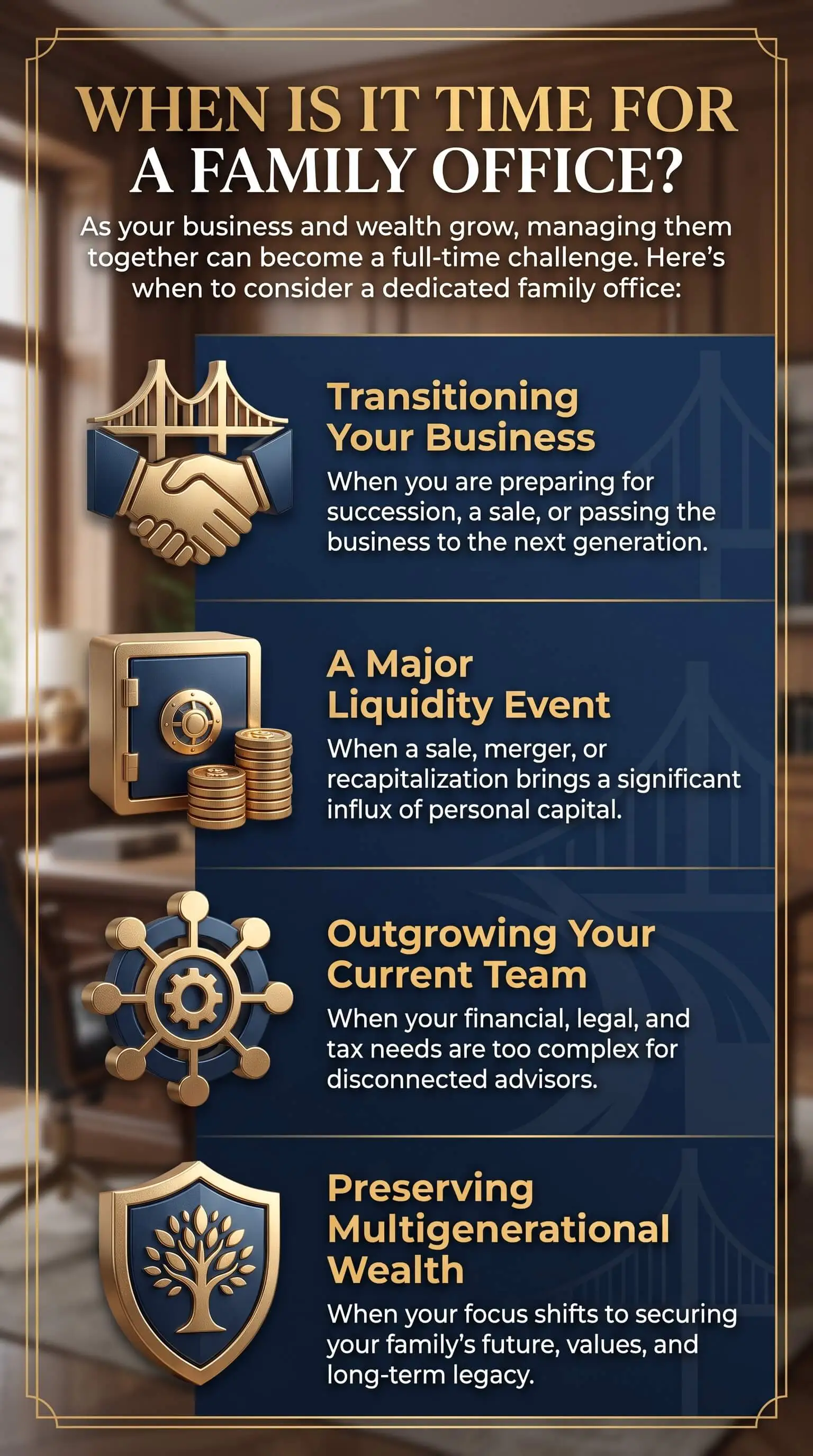
Start looking at Family Office services when coordinating your wealth takes more of your attention than growing it. Owners rarely describe one dramatic moment. They describe a slow pile-up that tends to look like this:
A buyer, private equity group, or family successor has opened a serious conversation.
Personal bills, property taxes, or family accounts still run through the company's finance team.
You work with three or more advisors who have never joined the same call.
You signed your estate documents when the business was worth a fraction of today's value.
You own real estate, holding companies, or trusts outside the main operating company.
Adult children are approaching ownership or leadership roles, and nobody has put a plan in writing.
Your charitable giving has outgrown year-end checks.
You or your spouse spend hours every week coordinating money instead of running the business or enjoying your life.
Three or more of these is reason enough to start the conversation. At five or more, the missing structure is probably costing you already, through missed planning windows, overlapping fees, or decisions made on someone else's deadline.
How Much Wealth Do You Need for a Family Office?
Complexity decides this far more than any number does. An owner with $15 million, a pending sale, two trusts, and three adult children usually needs more coordination than a retiree with $40 million in a simple, liquid portfolio. Ranges still help set expectations:
Roughly $10 million to $25 million: Coordinated support tends to pay off when a sale, concentrated business ownership, trusts, or multiple generations come into play. A strong wealth manager and CPA may serve simpler, liquid situations well.
Roughly $25 million to $100 million: Coordinated planning across tax, estate, investments, and family governance becomes the norm, especially around a business transition.
Roughly $200 million and up: A dedicated single-family office starts to make economic sense, because the family can spread its fixed costs across enough assets.
That top threshold exists because building your own office costs a great deal. In J.P. Morgan's 2026 Global Family Office Report, even the smallest offices surveyed, those overseeing $250 million or less, spent about $875,000 a year to operate. An owner with $30 million would watch that overhead absorb a large share of annual returns before it delivered anything.
Build It or Join It: Family Office Models Compared
Most business owners establish a Family Office by joining one rather than building one. Each model balances control, customization, and cost in its own way:
Embedded: Company staff handle personal and family finances alongside business work. This suits owners still running an active company. It costs little, but personal and corporate finances blur together.
Virtual: A small coordinator directs outside tax, legal, and investment specialists. Families comfortable managing several vendors tend to like it, and it's only as strong as the person holding it together.
Boutique multi-family office: One firm serves a select number of families with a dedicated team. Owners with roughly $10 million to several hundred million get a single-family-office experience without the overhead, though capacity is limited.
Institutional multi-family office: A large bank or trust platform serves many families with standardized services. You gain broad resources and give up some personal attention.
Single-family office: The family owns and staffs a private firm, usually at roughly $200 million or more. It offers full control and privacy at the highest fixed cost.
The embedded model deserves a closer look, since most trade and service business owners start there. It works fine until a transaction arrives. Once the controller who pays your personal bills is also closing the books for a buyer's diligence team, the line between company and family gets thin fast. Separating the two before a sale is one of the most practical reasons to formalize.
When the Answer Is "Not Yet"
Some owners don't need Family Office services yet, and a good advisor will tell them so. Your current setup may be enough for now if your assets are mostly liquid, your estate plan is current, no sale or succession is coming, and your wealth manager already works closely with your CPA.
Messy books are the most common reason we tell an owner to wait. Numbers you can't trust slow every planning decision down and push its cost up. Our guide to finding a reliable remote QuickBooks bookkeeper is a practical place to start.
What Establishing a Family Office Looks Like in the First 90 Days
Spend the first 90 days on structure and save investment decisions for later. This sequence holds up well:
Inventory everything. List every account, entity, trust, property, insurance policy, and advisor, and note who holds which documents.
Define the job. Decide what the Family Office should handle and for whom, whether that's you and your spouse or adult children and future generations too.
Choose the model. Match the structure to your complexity and budget.
Name a single point of contact. A Personal CFO or lead advisor keeps your CPA, attorneys, and bankers working from the same plan.
Set the rhythm. Put a tax calendar, consolidated reporting, and a standing decision meeting on the books.
Bring the family in. Explain the purpose to your spouse and the next generation before any decision affects them.
Qualified legal and tax counsel should review any trusts, entity changes, or tax strategies that come up along the way. Your Family Office coordinates that work alongside your attorney and CPA.
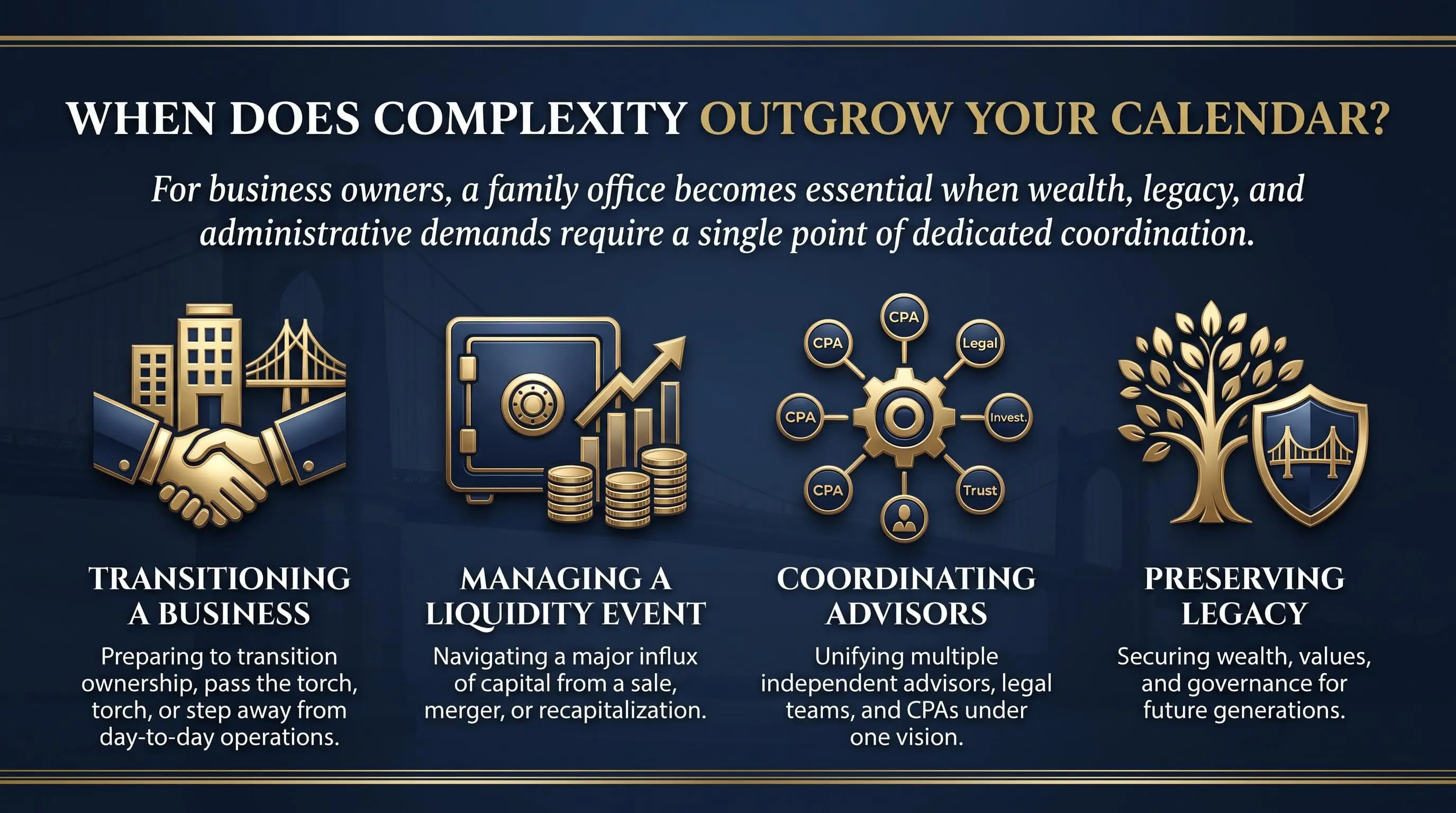
"Owners usually ask me for a number. They want to hear that at $20 million, or $50 million, it's officially time. I stopped answering that way years ago, because the number almost never tells me much. The calendar does. When an owner and I trace where last month's hours went, the pattern is hard to miss: an afternoon chasing a K-1, a weekend sorting out insurance on the lake house, two calls spent relaying the same question between the CPA and the estate attorney. That's when it's time. The families who handle this well don't wait for a buyer to force the issue. They build the structure while the business is running smoothly, so when something big happens, the decisions are already organized and the people around the table already know each other."
7 Essential Resources
We opened each link below and confirmed it goes straight to the page described.
A neutral overview of what family offices do and how single-family and multi-family structures differ. It gives you a shared vocabulary before your first advisor meeting.
Professor Matthew Allen argues that most business families already run an informal family office, then offers five sharper questions about purpose, cost, structure, and family alignment. Read it if you're stuck on a simple yes or no.
BNY explains why the strongest family offices start well before a sale or generational transfer, and why a phased launch that outsources specialized work keeps early costs manageable.
Deloitte tracks how fast family offices are growing, who they serve, and how many are moving out of the operating business into independent structures.
Survey data from 333 single-family offices on operating costs, governance, outsourcing, and the particular concerns of families who own an operating business. The cost benchmarks alone justify the read.
The SEC's official page for the rule that defines which family offices fall outside the Investment Advisers Act. It's a useful background if you're weighing a dedicated single-family office.
Founder Mike Zuendel compares five Family Office models, from embedded to single-family, and lists the warning signs that tell a family it's time to formalize.
Read roughly in this order, these sources move from definitions to costs to structure, the same path the decision itself tends to follow.
Supporting Statistics
87% of family offices serve families who own, or once owned, an operating business. In J.P. Morgan's 2026 survey of 333 single-family offices, nearly six in 10 respondents reported a separate operating business today, and another 29% had one in the past. Only 12% served families that never owned a company. Family offices are, overwhelmingly, a business owner's tool.
Source: J.P. Morgan Private Bank, 2026 Global Family Office Report
8,030 single-family offices operate worldwide, up 31% from 6,130 in 2019. Deloitte projects 10,720 by 2030, and 41% of family offices already serve first-generation families. Founders who built the wealth themselves drive much of that growth.
Source: Deloitte Private, Defining the Family Office Landscape
68.6% of new single-family offices added in Q2 2026 were entrepreneurial, up from 57% the quarter before. FINTRX tracks new family office formations, and first-generation wealth now leads by a wide margin. Most people establishing family offices today built a company. Few inherited an old fortune.
Source: FINTRX, Family Office Report: Q2 2026 Trends and Intelligence
These figures show that family offices are increasingly established by entrepreneurs and business owners seeking to manage growing wealth and complex family responsibilities. Beyond investment oversight and business interests, family office services can also help coordinate personal needs, including private home care for aging family members, as part of a broader approach to family wealth management.
Final Thoughts and Opinion
Watch Your Calendar, Not Your Net Worth
We think most business owners wait too long, and they wait for the wrong signal. They hold out for a net worth milestone or a buyer's call, while the clearer sign has been sitting on their calendar for a year or more in afternoons spent relaying questions between advisors, chasing documents, and pulling personal expenses out of the company books.
Establishing a Family Office rarely means building one. Usually it means choosing the right partner, naming one person accountable for the whole picture, and moving the informal work that's been living inside your company into a structure designed for it. That move is easiest while the business is running well. It also does the most good then.
Start with what you want your wealth to do for your family. The right Family Office services follow from that purpose and from the complexity you actually carry.
You already built one operating system that works. Your family deserves a second one.
Frequently Asked Questions
When should a business owner consider establishing a family office?
When your wealth has grown more complex than one advisor can coordinate. That usually happens ahead of a sale, recapitalization, or family succession, or while personal finances still run through the company. Ideally, you start the conversation a year or more before a major transition, while you still have time and options.
What do family office services include for a business owner?
Family Office services typically cover investment management, tax strategy, estate and trust coordination, family governance, philanthropy, consolidated reporting, and administrative support. For business owners, they also include planning around a sale or succession, with a Personal CFO keeping your CPA, attorneys, and bankers on the same plan.
How much wealth do you need for a family office?
No fixed minimum exists, and complexity matters more than net worth. Many owners benefit from multi-family office coordination starting around $10 million, especially when a business sale or trusts are involved. A dedicated single-family office generally needs roughly $200 million or more to justify its fixed costs.
What is the difference between a single-family office and a multi-family office?
One family owns and staffs a single-family office, which gives it maximum control at the highest cost. A multi-family office serves a select group of families with a shared team and infrastructure. For most business owners, a multi-family office delivers similar coordination for far less.
How much does it cost to run a family office?
Costs vary widely with size. J.P. Morgan's 2026 Global Family Office Report found that the average single-family office spends just over $3 million a year, and offices overseeing $1 billion or more average $6.6 million. Multi-family offices usually charge an advisory fee based on assets or scope instead.
Is a virtual family office a good option for a business owner?
It can work if you're comfortable directing several outside specialists and someone dependable coordinates them. The overhead stays low and the setup is flexible, but it's only as strong as the person holding it together. Owners heading into a transaction often prefer a dedicated team with a single point of contact.
Not Sure Whether It's Time?
You don't need every answer before the first conversation. If your advisors aren't working from the same plan, a transition is on the horizon, or your company's staff is quietly running your family's finances, schedule a private consultation with Legacy Bridge. Legacy Bridge is a boutique Family Office in West Des Moines, Iowa, built on one call and one team, offering outsourced family office executive services to help coordinate your family's financial needs. You'll come away knowing whether a Family Office fits your situation today, which model makes sense, and what to put in place first.


