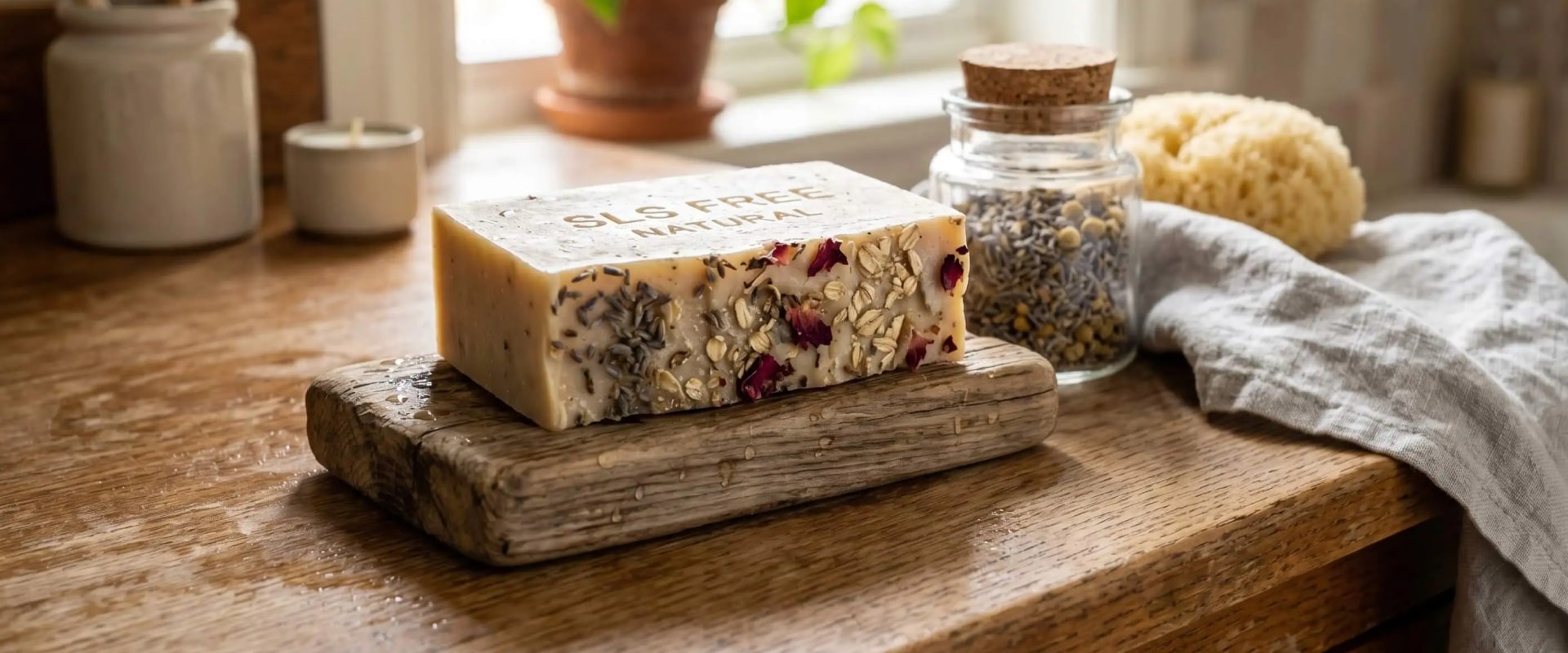
An SLS free soap won’t cure dyshidrotic eczema. Nothing on a shelf will. But swapping out the soap has produced more visible improvement than almost any other single change I’ve recommended to caregiving families, and it costs less than a copay. This page walks through why sodium lauryl sulfate is the ingredient worth pulling from your routine first, how to read a label so you actually get what you’re paying for, and which formula I hand to families when they ask.
TL;DR Quick Answers
sls free soap
SLS free soap is any cleanser formulated without sodium lauryl sulfate, the anionic surfactant that strips the skin's lipid barrier. In home-care settings, it's the cheapest fix I've seen that delivers visible relief for dyshidrotic eczema on hands and feet, usually within 7 to 10 days of consistent use.
A real SLS free soap should also be:
Fragrance-free (not just "unscented") and free of added dyes
pH balanced near 5.5, close to the skin's own pH
Free of SLES, cocamidopropyl betaine, and formaldehyde-releasing preservatives
The strongest first pick for hands and feet is a syndet bar or pH-balanced liquid carrying the National Eczema Association Seal of Acceptance.
Top Takeaways
• SLS strips the skin’s lipid barrier. Dyshidrotic skin can’t afford to lose it.
• A real SLS free soap is also fragrance-free, dye-free, pH-balanced, and free of SLES and cocamidopropyl betaine.
• The same formula works for both hands and feet. The skin chemistry doesn’t change between palms and soles.
• The biggest user error: buying a “natural” soap that still contains sulfate. Always read the full INCI list.
• Pair the soap with lukewarm water, and apply moisturizer inside sixty seconds of patting dry.
• Expect visible improvement in 7–10 days. If blisters worsen, weep, or get infected, book a dermatologist.
Why SLS triggers dyshidrotic flares
Sodium lauryl sulfate (SLS) is a synthetic anionic surfactant built to foam up and cut grease (Wikipedia: Sodium dodecyl sulfate). That property is useful on a roasting pan and destructive on skin whose barrier is already in trouble. Dyshidrotic eczema sits on the palms and soles, where the outer layer of skin looks thick but reacts hard to chemical stress, and SLS strips out exactly the lipids that layer needs to hold itself together. The deep blisters of pompholyx come next.
Home-care aides who wash their hands twenty-plus times a shift tend to see flare cycles shorten within a couple of weeks of changing soap, without changing anything else about how often they wash. Handwashing frequency isn’t what’s lighting their skin up. What’s in the pump bottle is.
What to look for on an SLS free soap label
A label that says “SLS free” isn’t enough on its own. The rest of the ingredient list has to pass muster too, both for what’s in the bottle and what’s deliberately left out.
Must-haves on the label
• Explicit “SLS-free” and “SLES-free” callouts on the bottle
• Fragrance-free, not “unscented” (which often masks a fragrance instead of omitting it)
• Dye-free with no added colorants
• pH balanced near skin pH, around 5.5
• Barrier-supporting ingredients like glycerin, colloidal oatmeal, or ceramides
• National Eczema Association Seal of Acceptance where it’s available
Ingredients to skip alongside SLS
• Sodium laureth sulfate (SLES), the milder cousin of SLS and still a documented irritant for compromised skin
• Cocamidopropyl betaine, a top contact allergen
• Methylisothiazolinone and methylchloroisothiazolinone preservatives
• Formaldehyde-releasing preservatives such as DMDM hydantoin and quaternium-15
• Synthetic fragrance, listed as “parfum” or “fragrance” on the back of the bottle
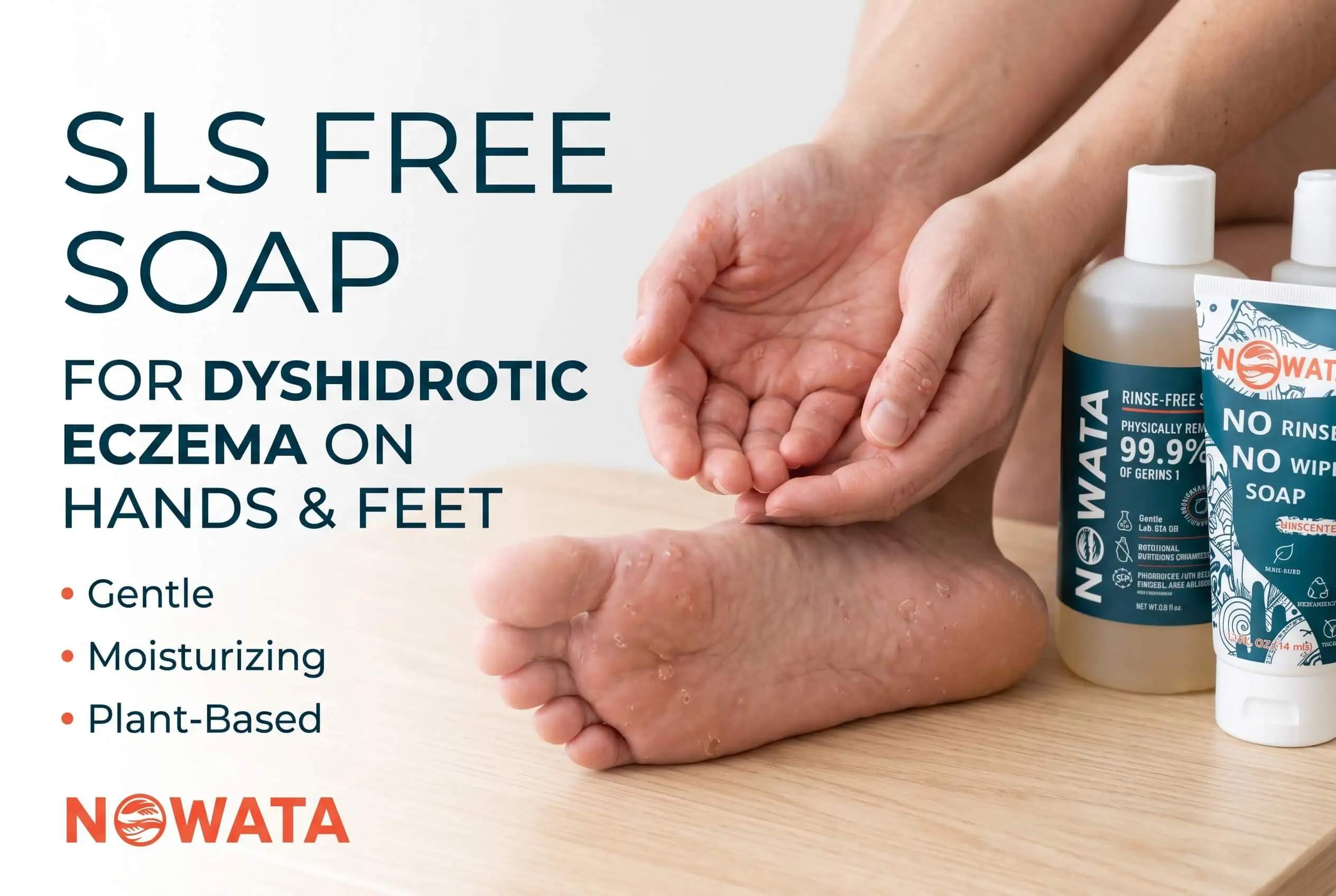
If you want a specific starting point that already clears that checklist, the Nowata SLS-free hand soap is the formula I hand to caregivers when they ask. Clean ingredient list, built around barrier-friendly humectants, priced in a range families actually buy.
Hand soap vs. foot soap, and what actually differs
Almost nothing. Dyshidrotic skin behaves the same way on palms and soles, so one SLS free soap covers both jobs. What changes is the drying and moisturizing routine around it. Wash hands, pat dry, apply an emollient inside sixty seconds (the “soak and seal” window dermatologists talk about). Wash feet, dry carefully between every toe, then switch into moisture-wicking socks. A lot of readers buy two bottles thinking they need a separate foot soap. They don’t.
Common mistakes I see, and how to step around them
A few traps families walk into repeatedly when they’re trying to get this right:
• Buying a “natural” soap that still contains SLS or sodium coco-sulfate. Read the full INCI list, not the marketing on the front. The front of the bottle is marketing. The back is chemistry.
• Leaning on alcohol sanitizer between washes. Alcohol dries the skin but it isn’t an SLS-class irritant. Pair it with a good emollient and you’re fine.
• Running the tap hot with a gentle soap. Hot water cancels out the gentle formula. Keep the temperature lukewarm.
• Applying moisturizer before the skin is patted dry. Towel off first, then apply, inside sixty seconds.
• Treating “dermatologist tested” as a synonym for SLS free. It isn’t. The National Eczema Association Seal of Acceptance is the label that actually carries weight here.
“I’ve lost count of the caregivers who walked in convinced their dyshidrotic eczema was a stress problem, only to see their hands calm down inside ten days of swapping a sulfate-based hand soap they’d been using for years. The most underrated move I’ve watched work for hand and foot eczema costs less than lunch, and the whole transaction happens on the ingredient list on the back of the bottle.”
7 Essential Resources
Every link below is a primary or authority source I lean on when families ask where to read more. None of them sell anything, and all of them are worth bookmarking.
• 1. National Eczema Association Seal of Acceptance product directory. The shortest path to vetted soaps, cleansers, and moisturizers that have been screened against the NEA Ecz-clusion list.
• 2. American Academy of Dermatology self-care guide for dyshidrotic eczema. Dermatologist-vetted guidance on handwashing, moisturizer timing, and glove use.
• 3. National Eczema Society (UK) pompholyx guide. The clearest patient-facing explanation I’ve found on why soap itself acts as an irritant for this specific subtype.
• 4. Harvard Health on dyshidrotic eczema management strategies. The page I send readers who want one consolidated overview from a major medical institution.
• 5. Cleveland Clinic overview of dyshidrotic eczema. Plain-language overview of what causes it, what counts as a normal flare, and what needs a doctor.
• 6. DermNet clinical reference for dyshidrotic eczema. The clinical reference dermatologists themselves reach for, with side-by-side imagery and treatment notes.
• 7. Wikipedia entry on Sodium dodecyl sulfate (SLS). The most-cited plain-English breakdown of what SLS is, where it shows up, and why it irritates compromised skin.
3 Statistics
Dyshidrotic eczema is more common than most people realize, and the demographics hit hardest also happen to do the most handwashing. Three numbers I keep coming back to:
• Dyshidrotic eczema accounts for 5–20% of all hand eczema cases. If you have hand eczema, there’s up to a one-in-five chance this is your specific subtype, and the treatment routine is different from atopic hand eczema. Source: Cleveland Clinic.
• Up to 25% of people with dyshidrotic eczema are affected on the feet. Most readers picture pompholyx as a hand-only condition. One in four also gets it on the soles, which is exactly why a single SLS free soap has to work for both. Source: Harvard Health.
• 61% of dyshidrotic eczema patients are female, with an average age of 37 at first diagnosis. A 2018 IBM MarketScan analysis of 34,932 patients found the condition skewed female and showed up most heavily in service-industry workers, the same people doing the most handwashing on any given day. Source: PubMed: Characterizing demographics and cost of care for dyshidrotic eczema.
Final Thoughts and Opinion
Here’s what I’ve watched happen too many times to stay quiet about: families buy the prescription cream before they buy a better soap, then spend months treating a flare that the soap is still setting off every time somebody washes up. Swap the soap first. If the cream is still needed after a few weeks, add it back. Most of the time, people find they don’t.
My honest opinion: an SLS free soap is about as cheap and low-risk as health interventions come. You don’t need an appointment, insurance, or a prescription, just a different bottle on the sink. In the cases I’ve followed closely, the improvement shows up inside the first two weeks, often sooner. That’s not a guarantee. Nothing in eczema management is. But the upside-to-effort ratio is hard to argue with.
If you want the specific formula I send first, you can buy SLS free hand soap online from Nowata, the brand caregivers in my network keep reordering. Use it with lukewarm water. Moisturize inside a minute of patting dry. Dry carefully between the toes and feet. Then give it ten days before you decide whether it’s working.
Frequently Asked Questions
Is SLS-free the same as sulfate-free?
Not quite. “SLS-free” only excludes sodium lauryl sulfate. “Sulfate-free” is broader and should also leave out SLES, ammonium lauryl sulfate, and sodium coco-sulfate. For dyshidrotic eczema, the broader sulfate-free label is the safer bet.
Will an SLS free soap stop my dyshidrotic eczema completely?
No single product stops dyshidrotic eczema completely. There’s no cure, only management. What an SLS free soap does is pull one of the most common and most controllable irritants out of your daily routine, which is why the results tend to be so consistent.
How long until I notice a difference after switching soaps?
Most readers report visible improvement in 7–10 days. Skin barrier recovery isn’t instant. The cells need time to cycle. Stay consistent for at least two full weeks before you decide whether the swap is working.
Are bar soaps or liquid soaps better for dyshidrotic eczema?
Either can work. What matters is the formula, not the format. Look for a syndet bar (a synthetic detergent bar formulated close to skin pH) or a liquid that clears the full ingredient checklist above.
Is castile soap safe for dyshidrotic eczema?
Sometimes. Pure castile soap is SLS-free but tends to run alkaline (pH around 9), which can still irritate dyshidrotic skin. If you use it, dilute heavily and follow with moisturizer right away. A pH-balanced formula is usually the safer pick.
Can children with dyshidrotic eczema use the same SLS free soap?
Generally yes, as long as the formula is fragrance-free and carries the National Eczema Association Seal of Acceptance. Pediatric skin tolerates the same gentle surfactants adults do, but patch-test on a small area first.
What’s the difference between SLS, SLES, and SCS?
SLS (sodium lauryl sulfate) is the most aggressive of the three surfactants. SLES (sodium laureth sulfate) is ethoxylated and milder but still irritates dyshidrotic skin. SCS (sodium coco-sulfate) gets marketed as “natural,” but in solution it breaks down into the same SLS molecules. Skip all three.
Ready to Make the Switch?
If you’ve read this far, you already know the move. Swap whatever’s on your sink for an SLS free soap that meets the checklist above. Run lukewarm water. Moisturize inside sixty seconds of patting dry. Then give it ten days. Skin, left alone long enough without being stripped every hour, does the healing work on its own.
The hand soap I send caregiving families to first, the one I keep on my own sink, is the Nowata SLS-free formula. See the SLS-free hand soap caregivers reach for first, and start the swap today.