Yes — but only if the right problems get addressed. And in Altamonte Springs, we find those problems on nearly every service call we make.
After years of tune-up visits throughout Seminole County, the pattern is consistent. High electric bills in Central Florida homes almost never come from one dramatic failure. They come from a system quietly working harder than it should — running longer cycles, struggling with airflow it isn't getting, compressing refrigerant at the wrong charge — while the thermostat reads normal and nothing seems obviously wrong.
That's the part most HVAC content misses.
What we find on Altamonte Springs service calls that drives bills up:
Refrigerant charge outside specified parameters — forces longer compressor run times to reach the same temperature
Airflow below design threshold — makes the system work harder to move the same amount of conditioned air
Evaporator coil fouled with biological growth — reduces heat transfer efficiency with every operating hour
Drain lines partially blocked — causes short-cycling that adds wear and unnecessary runtime
Filters at the wrong MERV rating — restricts airflow or allows bypass, neither of which shows up on the thermostat
The U.S. Department of Energy confirms that 70% to 90% of residential AC systems carry at least one of these faults right now. In a market where systems run 10 to 11 months per year, those faults don't stay small. They compound — and your FPL bill is usually the first place the evidence appears.
This page shows why making a top HVAC system tune up near Altamonte Springs FL a priority delivers real, measurable value — clarifying what a thorough tune-up includes, what it doesn’t, how much bill reduction is realistic in this climate, and what separates a service that genuinely improves performance from one that simply generates a receipt while leaving inefficiencies in place.
TL;DR Quick Answer
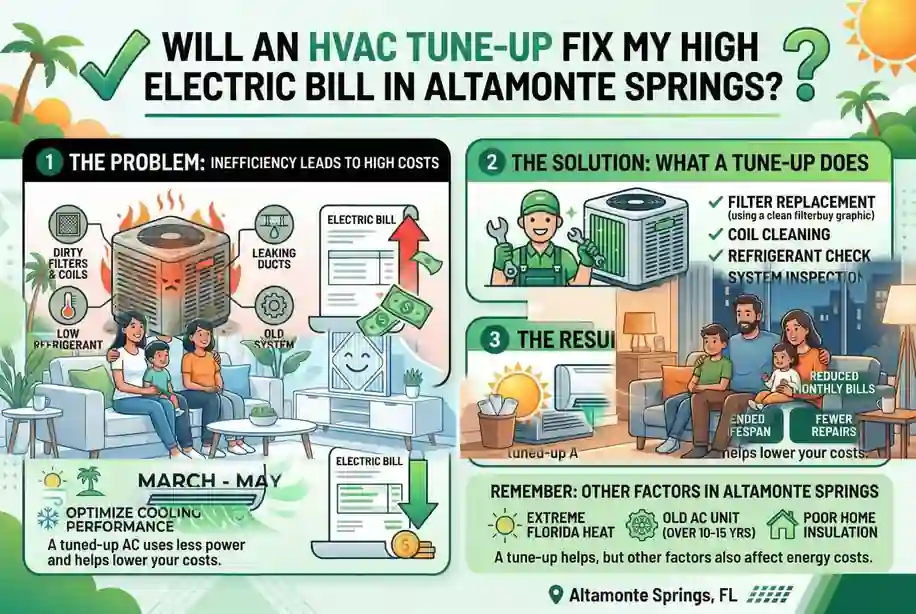
Will an HVAC Tune-Up Fix My High Electric Bill in Altamonte Springs?
Yes — in most cases, a properly scoped tune-up from a credentialed provider will reduce your FPL bill. But only if the technician is qualified and the checklist is complete.
Why electric bills run high in Altamonte Springs specifically:
AC accounts for 28% of total Florida home energy use — more than three times the national average
Systems run 10 to 11 months per year — correctable faults compound faster and longer than any other U.S. market
Year-round humidity accelerates coil fouling, drain line stress, and efficiency loss between visits
The correctable faults most commonly driving elevated FPL bills:
Refrigerant charge outside manufacturer specifications
Airflow below the system's design threshold
Evaporator coil fouled with accumulated biological growth
Drain line partially blocked and causing short-cycling
Filter at wrong MERV rating or installed with bypass gaps
What a properly scoped tune-up realistically delivers:
5% to 20% annual energy savings — documented by the U.S. Department of Energy
$40 to $80 monthly bill reductions — documented on Altamonte Springs service calls
Noticeable FPL bill improvement within one to two billing cycles after a complete visit
Before any provider arrives, verify:
Florida DBPR license — MyFloridaLicense.com
Technician NATE certification — natex.org
Written checklist confirming coil cleaning, drain line service, refrigerant verification, and airflow measurement as standard scope
Guaranteed pricing confirmed before arrival
A tune-up that skips refrigerant verification and airflow measurement leaves the faults driving the bill in place — regardless of what the invoice says. The best time to schedule in Altamonte Springs is February or March — before peak season fills every credible provider's schedule and before the operating months where that 28% AC energy share does the most damage to your monthly statement.
Top Takeaways
A high FPL bill in Altamonte Springs is almost never a mystery — it's almost always a correctable fault running unaddressed inside the air handler.
Fouled evaporator coil, off-spec refrigerant charge, restricted airflow, compromised drain line
None announce themselves from the thermostat
All consume extra electricity every cycle
In a climate where AC accounts for 28% of household energy use, those faults compound across 10 to 11 months before most homeowners connect the bill to the system
Florida homes spend more than three times the national average on air conditioning — which means efficiency loss hits harder here than virtually anywhere else.
EIA documents 28% of total Florida home energy use goes to AC versus 9% nationally
A tune-up restoring 10% to 15% of lost efficiency moves a meaningful share of the line item that dominates the monthly FPL statement
Not a minor rounding adjustment — a number families notice the following billing cycle
Proper HVAC maintenance can reduce energy bills by 5% to 20% annually — without replacing any equipment.
DOE documents this range — we see it reflected on Altamonte Springs service calls every season
What determines where a home lands in that range:
Which faults were present
How long they had been compounding
Whether the technician's checklist was complete enough to find and correct all of them
A neglected filter alone can increase energy consumption by 5% to 15% — before a technician has even looked at the coil, refrigerant charge, or drain line.
The most common correctable fault we find on Altamonte Springs service calls
Not the most dramatic — the most common
A filter at the wrong MERV rating, installed with bypass gaps, or never assessed for fit is often the first explanation for a bill quietly climbing all season
Timing determines how much of that efficiency recovery your FPL bill actually captures.
February service — captures full efficiency benefit across the highest-cost billing cycles
June, July, August service — those peak billing cycles are already lost
The tune-up stops the compounding from continuing — it doesn't undo what the faults already cost
Why Your Electric Bill Is High in the First Place
High electric bills in Altamonte Springs almost never come from a single obvious cause. They come from a system that has gradually lost efficiency — running longer cycles, working harder, and consuming more electricity to deliver the same indoor temperature it used to reach with less effort.
The compressor is the most electricity-intensive component in your system. Anything that forces it to run longer than necessary drives your bill up. In Central Florida's climate, the conditions that create that extra runtime accumulate faster than most homeowners expect — and faster than national maintenance guidelines account for.
The most common efficiency killers we find on Altamonte Springs service calls:
Refrigerant charge outside specified parameters
Airflow below the system's design threshold
Evaporator coil fouled with accumulated growth
Drain lines partially blocked and causing short-cycling
Filters restricting airflow or allowing bypass
None of these announce themselves. All of them show up on your utility bill before they show up anywhere else.
What a Tune-Up Actually Fixes — And Why It Affects Your Bill
A legitimate tune-up from a credentialed provider directly addresses the efficiency faults the DOE identifies as most consequential. Here is what gets corrected and why each item matters to your bill:
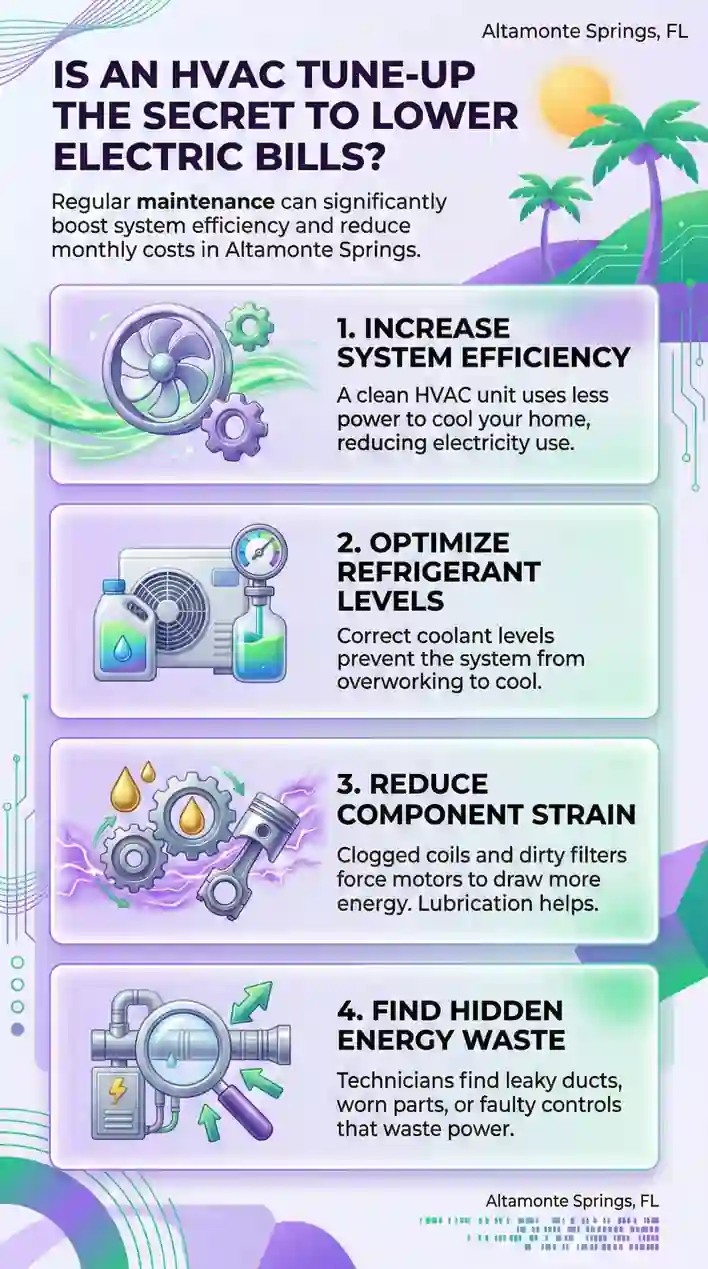
Refrigerant charge verification and correction Refrigerant outside specified parameters forces your compressor to run longer to reach the same indoor temperature. Correcting charge puts the compressor back inside its designed operating window — which is where efficient electricity consumption lives.
Airflow measurement and correction Restricted airflow means your system moves less conditioned air per cycle than it was designed to. The compressor compensates by running longer. Measuring and correcting airflow directly reduces those extended runtimes.
Evaporator coil cleaning A fouled coil can't absorb heat efficiently. Every degree of reduced heat transfer capacity is a degree your compressor has to compensate for — through additional runtime and additional electricity consumption. Coil cleaning restores the heat transfer efficiency the system was designed to deliver.
Drain line clearing A partially blocked drain line causes short-cycling. Short-cycling adds operating hours and compressor wear without delivering proportional cooling. Clearing the drain line eliminates the short-cycling pattern that quietly inflates runtime.
Filter assessment and correction A filter at the wrong MERV rating — or installed with bypass gaps — either restricts airflow or allows unfiltered air to reach the coil. Both outcomes reduce system efficiency. Both show up on your utility bill before they show up anywhere visible.
How Much Can a Tune-Up Actually Reduce Your Bill?
The U.S. Department of Energy documents that correcting HVAC faults through proper maintenance produces energy savings of 10% to 30%.
In Altamonte Springs, here is what that range reflects in practice:
A system with a single correctable fault — refrigerant charge slightly off, airflow marginally restricted — is likely at the lower end of that range
A system carrying multiple compounding faults — coil fouled, drain partially blocked, airflow restricted, refrigerant charge off — is where the larger reductions come from
The homes where we see the most significant post-tune-up bill reductions are almost always the ones where the system appeared to be functioning normally before we arrived
That last point matters. The most expensive faults are the ones that don't announce themselves. They run quietly, consume extra electricity every cycle, and compound through an entire Central Florida cooling season before a technician identifies what's actually happening inside the air handler.
What a Tune-Up Won't Fix
A tune-up addresses maintenance faults. It doesn't address everything that can drive an Altamonte Springs electric bill upward. Being clear about this distinction is part of what separates an honest provider from one selling a tune-up as a universal solution.
What a tune-up does not address:
An aging system that has lost efficiency through normal end-of-life degradation
Duct leakage delivering conditioned air outside the living space
A system that was undersized or incorrectly matched to the home at installation
Building envelope issues — inadequate insulation, air sealing, or window efficiency
A system that requires refrigerant addition due to an active leak rather than charge correction
If a tune-up has been completed thoroughly and your bill hasn't moved, one of these factors is likely the actual driver. A credentialed provider identifies the distinction and communicates it honestly — rather than recommending a follow-up service that doesn't address the real cause.
Why Altamonte Springs Bills Respond More Dramatically to Tune-Ups Than Most Markets
Central Florida's operating reality amplifies both the problem and the solution.
What makes this market different:
Systems run 10 to 11 months annually — accumulating faults faster than seasonal climates
Year-round humidity accelerates coil fouling and sustains drain line condensation stress
April through September demand pushes systems to peak output for months at a time
FPL rates mean every percentage point of efficiency loss translates directly into bill impact
A system in a seasonal climate might carry a refrigerant charge fault for six months before the next cooling season begins. A system in Altamonte Springs carries that same fault through 10 to 11 consecutive months of operation — compounding the efficiency loss and the bill impact with every additional cycle.
That is why the tune-up timing conversation matters as much as the tune-up itself. A system properly serviced in February — before peak demand season begins — captures the full efficiency benefit across the operating months that cost the most. A system serviced in July has already been running with those faults through the billing period where they do the most damage.
What to Look for in a Provider Whose Tune-Up Will Actually Move Your Bill
Not every tune-up is complete enough to deliver the efficiency improvements the DOE documents. The scope of the visit determines the outcome — and scope varies significantly between providers in this market.
What a bill-reducing tune-up requires from the provider:
Refrigerant charge measured and corrected to manufacturer specifications — not estimated
Airflow measured across the evaporator coil — not assumed adequate because the system is running
Coil cleaning completed as standard scope — not offered as a billable add-on
Drain line inspected and cleared every visit — not skipped because it isn't visibly blocked
Filter condition, fit, and MERV rating assessed for the specific system — not replaced automatically with whatever is on the truck
Findings communicated in terms of home efficiency and bill impact — not just equipment condition
Before any provider arrives, verify:
Florida DBPR license — MyFloridaLicense.com
Technician NATE certification — natex.org
Written checklist confirming complete scope
Guaranteed pricing confirmed before arrival
A provider who delivers on all of those items with the diligence and detail you would expect from true private home care is the provider whose tune-up has a genuine chance of moving your FPL bill. That is the standard worth holding out for and the standard every Altamonte Springs homeowner deserves to expect.
"After years of service calls throughout Altamonte Springs, the homes with the highest electric bills almost never have an obvious explanation sitting at the thermostat. The explanation is almost always inside the air handler — a coil that needed cleaning six months ago, a refrigerant charge that's been off since last season, an airflow reading nobody has measured in years. We've walked into homes where families had been paying an extra $40 to $80 a month on their FPL bill for an entire cooling season without knowing it — not because their system had failed, but because it had quietly lost the efficiency a thorough tune-up would have restored. The difference between a system that's running and a system that's running right isn't always visible from the outside. But it shows up on your utility bill every single month until someone gets inside and finds it."
Essential Resources
1. The First Check We Walk Every Altamonte Springs Homeowner Through — Before Anyone Arrives
Florida DBPR Contractor License Verification | MyFloridaLicense.com We've seen what happens when homeowners skip this step — and it's never a story that ends well. Florida law requires every HVAC contractor to hold an active state license before performing any residential work, and this official DBPR portal confirms that status in under a minute. It's the single most important verification any Altamonte Springs homeowner can make, and it costs nothing but the time it takes to run the search. https://www.myfloridalicense.com/wl11.asp
2. The Credential We Hold Our Own Technicians To — And the One You Should Require From Every Provider
NATE Technician ID Verification | North American Technician Excellence NATE certification is the credential that reflects real-world field competency — not just hours logged in a training program. We hold every technician we dispatch throughout Seminole County to this standard because it's what genuine working knowledge looks like in practice. Use this official verification tool to confirm the specific technician arriving at your door before they leave the shop — not after they've assessed your system. https://natex.org/contractor/verify-a-nate-id
3. The Federal Checklist We Recommend Every Altamonte Springs Homeowner Keep on Hand
ENERGY STAR Maintenance Checklist | U.S. Environmental Protection Agency This is the benchmark we measure every tune-up scope against — and the one we recommend every homeowner in Altamonte Springs review before any provider arrives. The EPA's ENERGY STAR program defines exactly what a complete residential tune-up looks like. If a provider's checklist falls significantly short of this federal standard, that gap is worth identifying before the visit begins — not after the invoice has been signed. https://www.energystar.gov/saveathome/heating-cooling/maintenance-checklist
4. The Tasks That Tell Us Whether a Tune-Up Will Actually Move Your FPL Bill
Air Conditioner Maintenance Guide | U.S. Department of Energy After years of service calls throughout Altamonte Springs, we can confirm that the tasks the DOE identifies here — refrigerant charge verification, airflow measurement, coil cleaning, electrical inspection — are precisely what determines whether a tune-up genuinely restores your system's efficiency or simply generates a receipt. Read this before booking any provider, and ask specifically whether each item appears on their standard scope. https://www.energy.gov/energysaver/air-conditioner-maintenance
5. The Local Research That Explains What We Find on Altamonte Springs Service Calls Every Week
Humidity and HVAC Performance in Central Florida | Florida Solar Energy Center / University of Central Florida This is the research that validates what our technicians document throughout Seminole County every season. UCF's Florida Solar Energy Center confirms what we observe firsthand — that Central Florida's year-round humidity accelerates coil fouling, drain line stress, and efficiency loss in ways no national maintenance guideline captures. It's the scientific context behind why an Altamonte Springs system working harder than it should almost always has a humidity-related cause at the root of it. http://www.fsec.ucf.edu/en/consumer/buildings/basics/humidity.htm
6. The Resource That Connects Your System's Efficiency Directly to Your Monthly FPL Statement
Residential Energy Efficiency Resources | Florida Power & Light We share this with every Altamonte Springs homeowner asking whether a tune-up will actually reduce their bill — because the answer lives in understanding how cooling system efficiency translates to electricity consumption in this specific market. FPL's official energy efficiency resource provides the utility-side context that turns a tune-up from an abstract maintenance task into a measurable outcome on your next statement. https://www.fpl.com/energy-resources/energy-efficiency.html
7. What Every Altamonte Springs Homeowner Should Know About Their Rights Before Any Provider Arrives
Contractor Hiring Guidelines and Complaint Process | City of Altamonte Springs Building and Fire Safety Department This is the resource we wish every homeowner had read before a difficult service experience — not after. The City of Altamonte Springs outlines local HVAC work requirements, homeowner rights, and the official complaint process for substandard or unlicensed contractor work. Knowing this before any provider arrives puts you in the strongest possible position — and makes the credential verification steps above feel less like extra effort and more like the standard they should always be. https://www.altamonte.org/faq.aspx?TID=16
These trusted local, state, and federal resources help homeowners confidently pursue top HVAC system installation by verifying contractor licensing, confirming certified field expertise, aligning work with federal performance standards, accounting for Central Florida’s humidity demands, and ensuring full compliance with local regulations—laying the foundation for maximum efficiency, lower energy costs, and long-term system reliability.
Supporting Statistics
We share these statistics because they explain conversations we have on service calls throughout Seminole County every week. Not abstract data points — the specific numbers behind why an Altamonte Springs electric bill responds to HVAC efficiency the way no other market in the country quite does.
Statistic #1: Air Conditioning Accounts for 28% of Total Home Energy Use in Florida — More Than Three Times the National Average of 9%
Source: U.S. Energy Information Administration — Residential Energy Consumption Survey, Florida State Data https://www.eia.gov/pressroom/releases/press535.php
When homeowners ask why their FPL bill is so sensitive to their AC system's condition, this is the number we point to.
What 28% means in practical terms on Altamonte Springs service calls:
Nearly a third of every household electricity dollar is tied directly to how efficiently the AC system operates
Every correctable fault — fouled coil, off-spec refrigerant charge, restricted airflow — isn't eroding a minor line item. It's eroding the line item that dominates the bill.
A HVAC tune-up restoring 10% to 15% of lost efficiency in Florida moves real money. In Maine, where AC accounts for 2% of home energy use, the same tune-up moves almost none.
We've sat with Altamonte Springs homeowners attributing bill increases to FPL rate changes for an entire season. In almost every case, the rate hadn't changed significantly. The system had quietly lost efficiency through correctable faults compounding through months of continuous operation. The bill was telling the story the thermostat wasn't.
What this means for scheduling timing:
A system serviced in February captures full efficiency benefit across the highest-cost operating months
A system carrying correctable faults through June, July, and August loses efficiency during the exact period that 28% does the most damage
The difference between a February and July tune-up isn't just scheduling convenience — it's how many peak-season billing cycles a correctable fault runs unaddressed
Statistic #2: Proper HVAC Maintenance Can Save 5% to 20% Annually on Energy Bills — Without Any Capital Investment
Source: U.S. Department of Energy — Preventative Maintenance for HVAC Equipment, Better Buildings Solution Center https://betterbuildingssolutioncenter.energy.gov/solutions-at-a-glance/preventative-maintenance-commercial-hvac-equipment
After years of tune-up visits throughout Altamonte Springs, that 5% to 20% range maps directly to what we observe. What determines where a home lands in that range isn't random.
What moves a home toward the higher end of that savings range:
Multiple compounding faults present — coil fouled, drain partially blocked, airflow restricted, filter bypassing
Faults that have been accumulating across an entire 10 to 11 month operating season
A system that appeared to be functioning normally — until a technician measured what was actually happening inside the air handler
The pattern we document throughout Seminole County season after season:
System runs — cycles, cools, thermostat reads normal
Correctable faults accumulate across 10 to 11 months of continuous operation
Bill climbs gradually — homeowner attributes it to weather or rate increases
Technician identifies fouled coil, off-spec refrigerant charge, restricted airflow, compromised drain line
Faults corrected — next billing cycle reflects the efficiency the system was designed to deliver
In a climate where AC accounts for 28% of household energy use, a 5% to 20% efficiency recovery isn't a small adjustment. On an Altamonte Springs FPL bill, it's a number families notice the month after a properly scoped tune-up. That outcome doesn't come from a rushed visit that skips refrigerant verification and airflow measurement. It comes from a credentialed technician working from a complete checklist — same-day in February or scheduled weeks in advance.
Statistic #3: A Neglected Filter Alone Can Increase Energy Consumption by 5% to 15% — and Improper Installation Can Reduce System Efficiency by Up to 30%
Source: U.S. Department of Energy — Energy Saver 101: Home Cooling | ENERGY STAR — Heat and Cool Efficiently https://www.energy.gov/energysaver/articles/energy-saver-101-home-cooling-infographic https://www.energystar.gov/saveathome/heating-cooling
These two figures represent opposite ends of the same problem — and we find both on Altamonte Springs service calls more often than most homeowners expect.
What the filter statistic reflects on service calls:
The most common single correctable fault we encounter — not the most dramatic, the most common
A filter at the wrong MERV rating, installed with bypass gaps, or never assessed for fit can account for 5% to 15% of elevated FPL bill costs
On its own — before we've even looked at the coil, refrigerant charge, or drain line
What the installation efficiency figure reflects:
Up to 30% efficiency loss present since the day the system was installed
Compounding through every operating hour since
Never identified because no prior tune-up included the measurements required to find it
What both statistics look like on Altamonte Springs service calls:
Filters at the wrong MERV rating — restricting airflow or sending unfiltered air directly to the evaporator coil
Frame gaps bypassing filtration entirely while the system appears to run normally
Systems with installation-related efficiency losses persisting for years — invisible from the thermostat, visible the moment a technician measures airflow and refrigerant charge
Why both numbers matter specifically for Altamonte Springs homeowners:
A filter issue alone can account for a meaningful share of an elevated FPL bill — and it's the first thing a complete checklist identifies
Installation-related efficiency losses can persist for the life of a system if airflow is never measured against manufacturer specifications
Both are correctable on a standard tune-up visit — from a NATE-certified technician working from a complete scope
We've walked into Altamonte Springs homes where a filter installed with bypass gaps had been sending unfiltered air to the evaporator coil for an entire season. The coil accumulated what the filter should have captured. The efficiency dropped. The bill climbed. From the thermostat — nothing appeared wrong. That's the story these statistics tell. And it's the story a complete tune-up exists to interrupt.
Final Thought & Opinion
Here is the opinion we share with every Altamonte Springs homeowner who asks whether a tune-up will actually move their FPL bill:
It depends on what's driving it. And in our experience throughout Seminole County, the answer almost always lives inside the air handler — not on the utility company's rate schedule.
What we've observed after years of service calls in this market:
High electric bills in Altamonte Springs are rarely caused by one dramatic, obvious failure
They're almost always caused by a system quietly losing efficiency through correctable faults no one has measured or identified
The homeowners most surprised by their post-tune-up bill reduction are almost never the ones whose systems were visibly struggling — they're the ones whose systems appeared completely normal
That last point is the one the HVAC industry consistently undersells.
The efficiency gap no one talks about:
A system can cool your home, cycle normally, and hold your thermostat setpoint — while simultaneously carrying a fouled evaporator coil, off-spec refrigerant charge, restricted airflow, and a filter bypassing since the last time someone opened the air handler.
None of those faults announce themselves
All of them consume extra electricity every single cycle
In a climate where AC accounts for 28% of household energy use, that extra consumption compounds across 10 to 11 months of continuous operation
Most homeowners connect a rising bill to weather or rate increases long before they connect it to what's happening inside the air handler.
Our opinion on what actually resolves high electric bills in Altamonte Springs:
The answer is almost never a new system. Almost never a rate negotiation with FPL. And almost never a mystery once a NATE-certified technician:
Measures refrigerant charge against manufacturer specifications
Checks airflow across the evaporator coil
Inspects and clears the drain line
Assesses the filter for fit and MERV rating
It's a correctable fault. Usually more than one. Almost always present longer than the homeowner realizes. Almost always addressable on a standard tune-up visit — if the provider's scope is complete enough to find it.
Why Altamonte Springs is different from most markets:
28% AC energy share — more than three times the national average
10 to 11 months of annual operation — faults compound faster and longer
Year-round humidity — accelerates coil fouling, drain line stress, and efficiency loss
A fault that costs a homeowner in a seasonal climate one or two billing cycles costs an Altamonte Springs homeowner eight or nine. The math on deferring maintenance in this market is fundamentally different — and most national HVAC content doesn't capture that difference.
What we tell every homeowner before we leave a service call:
The tune-up completed today addressed what was there to find. What comes next depends on what the system was carrying and how long it had been carrying it.
We've documented $40 to $80 monthly bill reductions from a single properly scoped tune-up
We've also walked into homes where faults were beyond what maintenance could correct — aging systems past efficient service life, duct leakage delivering conditioned air outside the living space, systems never correctly sized for the home
An honest provider tells you which situation you're in. The distinction between what a tune-up resolves and what it reveals is the most valuable thing a credentialed technician brings to an Altamonte Springs service call — and the conversation every homeowner deserves before standing in front of a repair estimate that a properly timed tune-up might have made unnecessary.
FAQ on Will an HVAC Tune-Up Fix My High Electric Bill in Altamonte Springs
Q: Will an HVAC tune-up actually lower my FPL bill in Altamonte Springs?
A: In most cases, yes — and more significantly than most homeowners expect. The homes where bills drop most noticeably after a tune-up are almost never the ones where something was obviously wrong. They're the ones where everything appeared normal.
What we find on those calls:
Refrigerant charge off-spec for an entire season
Evaporator coil fouled with accumulated biological growth
Airflow reading below the system's design threshold
Filter installed with bypass gaps sending unfiltered air directly to the coil
None of those conditions announced themselves. All of them consumed extra electricity every single cycle. In a market where AC accounts for 28% of household energy use, that extra consumption compounds across 10 to 11 months before anyone connects it to the system.
What determines how much your bill drops:
Which correctable faults the system is carrying
How long those faults have been compounding
Whether the technician's checklist is complete enough to find and correct all of them
The DOE documents 5% to 20% annual savings from proper maintenance. In Altamonte Springs, we see that range reflected on FPL bills the month after a properly scoped tune-up — not from a compressed visit that skips refrigerant verification and airflow measurement.
Q: How do I know if my high electric bill is caused by my HVAC system or something else?
A: The pattern we document throughout Seminole County is consistent. Gradual bill increases almost always trace back to efficiency loss accumulating inside the air handler. Sudden spikes more often reflect rate changes or unusual weather.
Signs your HVAC system is likely driving the bill:
Bill has climbed gradually over one or more seasons
System runs longer cycles than it used to
Home takes longer to reach thermostat setpoint
Rooms feel inconsistently cooled despite normal thermostat settings
System runs constantly during peak afternoon hours without keeping up
Signs the cause may be beyond what a tune-up addresses:
Duct leakage delivering conditioned air outside the living space
System undersized or incorrectly matched at original installation
Building envelope issues — insulation, air sealing, or window efficiency gaps
System past efficient service life needing replacement rather than maintenance
We've walked into homes where the answer was a tune-up. We've also walked into homes where the answer was an honest conversation about duct leakage or system age. A credentialed provider tells you which situation you're actually in — before recommending the next step.
Q: What specific tune-up tasks actually reduce energy consumption in Altamonte Springs homes?
A: The tasks that move the bill are the same ones a rushed or incomplete visit is most likely to skip. After years of service calls in this market, these are the five items most consistently connected to elevated FPL bills:
Refrigerant charge verification and correction — Off-spec charge forces longer compressor run times. We've corrected refrigerant charges on systems homeowners described as cooling normally. The compressor was compensating. The bill was reflecting it.
Airflow measurement and correction — Restricted airflow means the system moves less conditioned air per cycle than designed. We measure this — we don't assume it's adequate because the system is running.
Evaporator coil cleaning — In Altamonte Springs humidity, coil fouling accumulates faster than national maintenance schedules account for. Cleaning restores the heat transfer efficiency the system was designed to deliver.
Drain line inspection and clearing — Partial blockage causes short-cycling that adds operating hours without delivering proportional cooling. We clear drain lines as standard scope — not when they're visibly overflowing.
Filter condition, fit, and MERV assessment — A filter at the wrong MERV rating or installed with bypass gaps reduces efficiency in ways that show up on the bill before they show up anywhere visible.
If a provider's checklist omits any of these items, the faults driving the bill stay in place — regardless of what the invoice says.
Q: How much can I realistically expect my FPL bill to drop after an HVAC tune-up in Altamonte Springs?
A: A properly scoped tune-up from a credentialed provider produces noticeable bill reductions within one to two billing cycles in most cases.
The realistic range in this market:
Single correctable fault — 5% to 10% reduction
Multiple compounding faults — 10% to 20% reduction
Installation-related efficiency losses never previously identified — potentially higher
What that looks like in actual dollar terms:
We've documented $40 to $80 monthly reductions from a single properly scoped tune-up
In a climate where AC accounts for 28% of household energy use, those percentages represent real money — not a marginal adjustment
Two things worth knowing before booking any provider:
Significantly below-market pricing almost always signals compressed scope — faults driving the bill never get found
The most important factor isn't the tune-up cost — it's whether the checklist is complete enough to find what's actually there
Q: How does Central Florida's climate make HVAC efficiency loss worse than other parts of the country?
A: In ways we observe on service calls every week — and that most national HVAC content never fully captures.
What makes Altamonte Springs fundamentally different:
Operating season — 10 to 11 months annually versus 4 to 6 months in seasonal climates. Faults compound through nearly twice the operating hours before the next service visit.
Humidity — Accelerates coil fouling, sustains continuous drain line condensation, and maintains above-50% indoor humidity supporting biological growth on coil surfaces year-round
AC energy share — 28% of Florida home energy use versus 9% nationally. Every percentage point of efficiency loss costs more here than virtually anywhere else in the U.S.
Fault compounding — A refrigerant charge fault in a seasonal climate runs 4 to 6 months. The same fault in Altamonte Springs runs 10 to 11 consecutive months — compounding bill impact with every additional cycle.
The right tune-up schedule for this climate:
Minimum — One complete annual tune-up
Optimal — Two visits: February or March before peak season, October or November after it
Why it matters — National guidelines were written for climates running systems 4 to 6 months per year. Applying that schedule here means a system runs twice the operating hours between visits — with faults compounding the entire time.
The tune-up that protects your bill most effectively is the one completed before the operating months that cost the most — not after they've already run.
In Will an HVAC Tune-Up Fix My High Electric Bill in Altamonte Springs?, we explain that a tune-up can absolutely lower your bill when it corrects the common efficiency drains that quietly drive costs up in Central Florida: restricted airflow, dirty coils, clogged drains, loose electrical connections, and controls that are slightly out of spec. To make those improvements last, filtration has to match both your goals and your system’s airflow capacity, whether you’re swapping in a higher-capacity media option like a 20x25x6 MERV 11 air filter 2-pack, keeping routine airflow strong with a 20x25x1 MERV 8 air filters 2-pack, or confirming fit for a thicker option like a 20x20x4 MERV 11 air filter, because the most noticeable bill improvements come when the tune-up restores proper operation and the filter choice keeps the system breathing efficiently between visits.