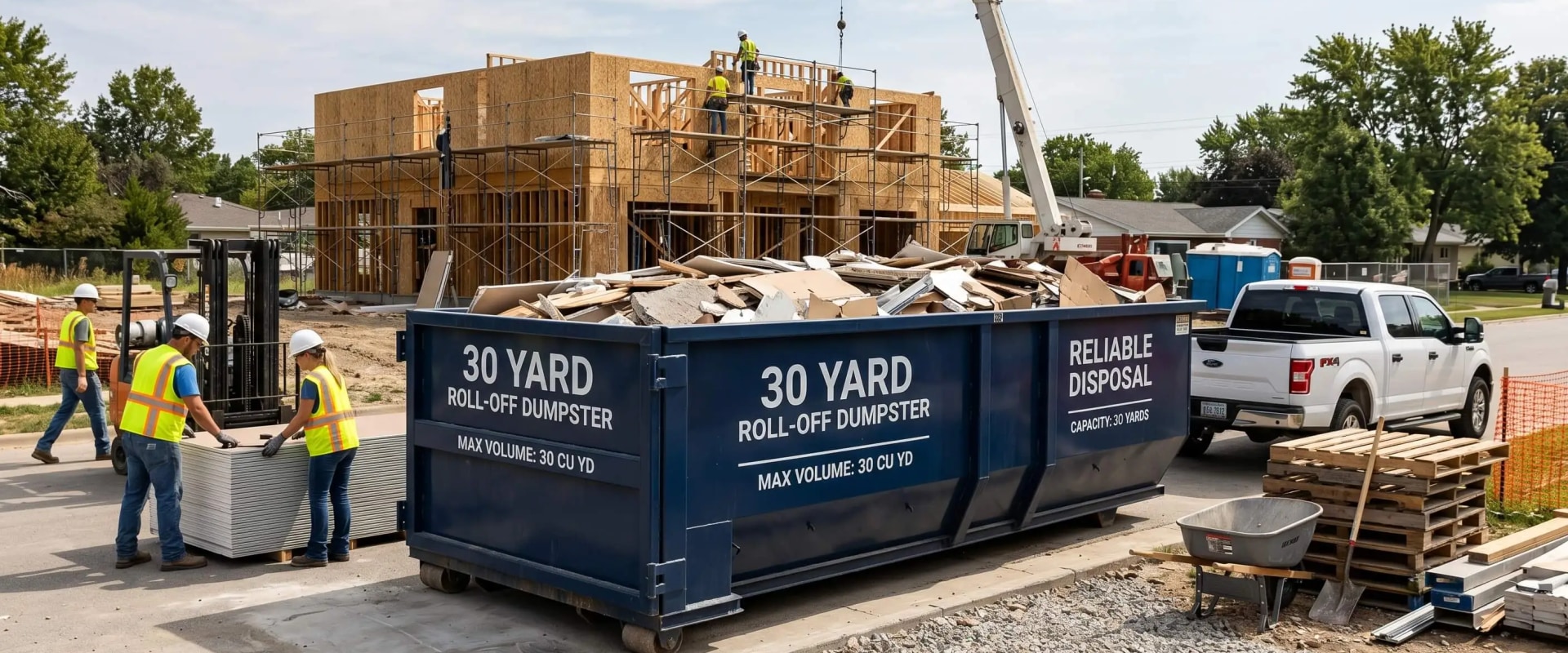
After fielding the same questions from homeowners, property managers, and weekend DIYers who've never rented one before, we've found that the right 30 yard dumpster size can make a cleanup feel much more manageable from the start. This guide walks through what actually fits in a 30 yarder, why its size works so well for larger home cleanouts, renovation debris, and bulky junk, which projects may need a different container, and the three sizing tips that help first-time renters get the most value for their money.
TL;DR Quick Answers
30 yard dumpster size
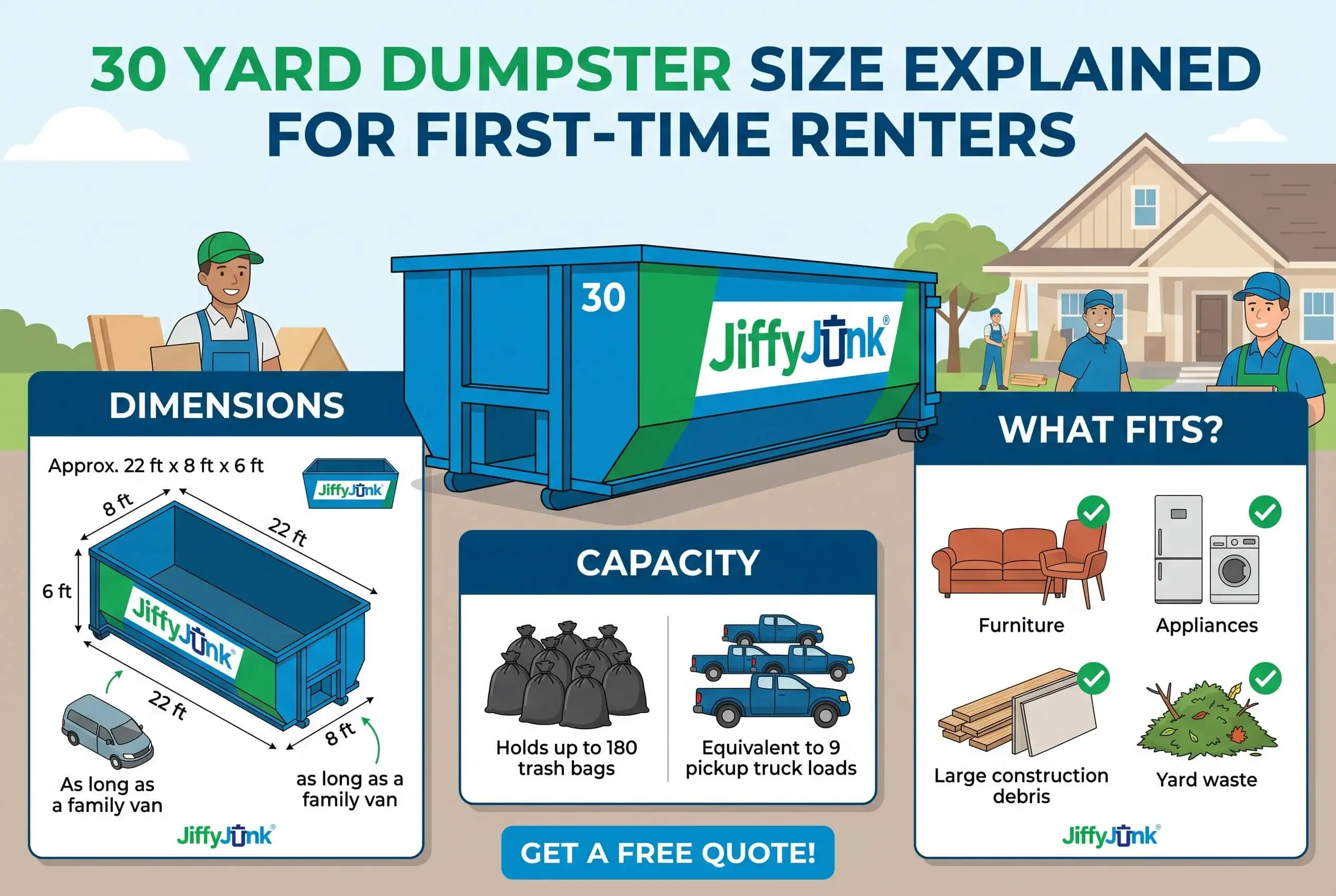
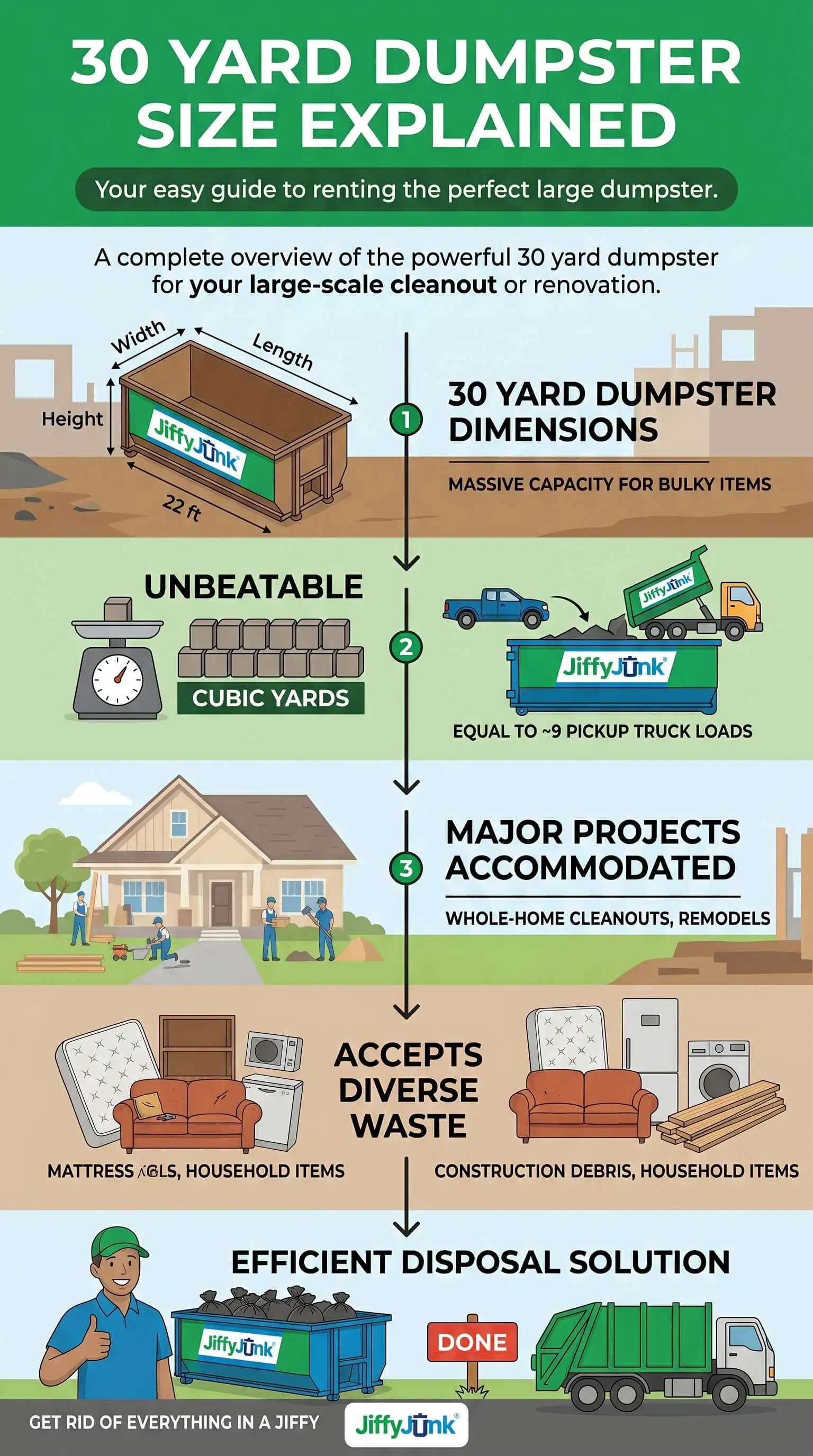
A 30 yard dumpster measures 22 feet long, 8 feet wide, and 6 feet tall, holding 30 cubic yards of debris.
Capacity equivalents: 9 to 12 pickup truck loads, or 170 to 190 standard 33-gallon trash bags
Weight limit: 3.5 to 5 tons (7,000 to 10,000 pounds)
Best for: whole-house cleanouts, multi-room renovations, re-roofing 1,500 to 2,500 sq ft homes
Wrong choice for: heavy debris like concrete, brick, or dirt (you'll hit the weight limit before filling the box)
Delivery clearance needed: 60 feet of straight clear length, 23 feet of overhead clearance
Typical cost: $450 to $830 per week, plus $65 to $100 per ton in overage fees
The first-time renter rule we give every caller: when you're between two sizes, go bigger. A second pickup costs more than the size upgrade.
Top Takeaways
A 30 yard dumpster is 22 ft long × 8 ft wide × 6 ft tall and holds 30 cubic yards of debris, or about 9 to 12 pickup truck loads.
Weight limit is the constraint that catches first-time renters off guard. Typical limit: 3.5 to 5 tons (7,000 to 10,000 lbs).
Best for: full kitchen and bath remodels, whole-house cleanouts, re-roofing 1,500 to 2,500 sq ft homes, large garage and estate cleanouts.
Wrong choice for: heavy dense debris (concrete, brick, dirt, large volumes of tile), tight driveway access, single-room cleanouts.
Expect to pay $450 to $830 per week nationally, plus $65 to $100 per ton in overage fees.
You need 60 feet of straight clear length and 23 feet of overhead clearance for delivery.
When between two sizes, go bigger. A second pickup costs more than the size upgrade.
Always confirm permit requirements for street placement. Driveway placement is usually permit-free.
What a 30 Yard Dumpster Actually Is
A 30 yard dumpster is a roll-off container that holds 30 cubic yards of debris. The standard footprint runs 22 feet long, 8 feet wide, and 6 feet tall, which gives you roughly 9 to 12 pickup truck loads or 170 to 190 contractor-grade trash bags worth of capacity.
Exterior dimensions vary by a foot or two depending on which hauler you use. Some run 22 feet long, others 23. The interior volume holds steady at 30 cubic yards across the industry, but the weight limit doesn't. Most haulers cap a 30 yarder at 3.5 to 5 tons, or 7,000 to 10,000 pounds. Watch this number more carefully than the dimensions.
What Actually Fits in a 30 Yard Dumpster
This is what most first-time renters are really asking. Concrete benchmarks:
Renovation projects
A full kitchen demo (cabinets, countertops, flooring, drywall)
One to two full bathroom gut jobs
4,000 to 6,000 square feet of carpet tear-out
Cleanouts
A full garage cleanout including furniture and appliances
A 3- to 4-bedroom whole-house decluttering
Estate cleanouts and downsizing projects
Roofing and exterior
Re-roofing a 1,500 to 2,500 square foot single-story home (90 to 120 bundles of shingles)
Deck demolition
Heavy yard waste from a landscape overhaul
Light construction
Interior debris from new-build framing
Small commercial tenant improvement projects
In our experience working with property managers and renovation contractors, a 30 yarder usually handles a full kitchen-and-bath remodel without coming back for a second haul, but only if drywall is the heaviest material going in. Once you start adding tile, concrete, or bricks, you'll hit the weight limit before the container looks half full.
30 Yard vs. 20 Yard vs. 40 Yard: Picking the Right Size
20 yard: 22 × 8 × 4.5 ft. Holds about 6 pickup loads. Best for a single-room remodel or a mid-size cleanout.
30 yard: 22 × 8 × 6 ft. Holds 9 to 12 pickup loads. Best for a whole-house cleanout or multi-room renovation.
40 yard: 22 × 8 × 8 ft. Holds about 16 pickup loads. Best for new construction or major demolition.
The footprint stays the same across all three. What changes is height. A 40 yarder is a 30 yarder with two extra feet of wall, giving you about 33% more capacity for tall, bulky debris.
Here's the rule we give every first-time renter: when you're between two sizes, go bigger. The cost gap between 20 and 30 yards usually runs $100 to $200, which is much less than what you'll pay for a second pickup if you underestimate. For a deeper breakdown on 30 cubic yard dimensions and rental costs by region, this detailed 30-yard dumpster size guide from Jiffy Junk walks through pricing variance and weight overage scenarios.
When a 30 Yard Is the Wrong Call
Just as important: when not to order one.
Heavy, dense debris. Concrete, dirt, gravel, brick, or large volumes of roofing tile will hit the weight limit fast. A smaller dumpster with a higher weight allowance is the safer pick.
Tight driveway or street access. A roll-off truck needs roughly 60 feet of clear straight length and around 23 feet of overhead clearance. Low tree branches, narrow gates, and overhead wires can kill the delivery.
HOA or municipal restrictions. Some neighborhoods cap container size on residential streets. Always check before booking.
Short or simple project. If you're cleaning out a single room or doing a half-day garage purge, a 10- or 15-yard container is the right tool.
What a 30 Yard Dumpster Costs
Nationally, expect to pay $450 to $830 per week for a 30 yard rental. The range varies by region, weight overages, and rental duration.
What's typically included: delivery, base disposal fee, pickup, and a 7-day rental window.
What's extra: per-ton weight overages (usually $65 to $100 per ton above the included limit), rental extensions beyond the base window, and surcharges for prohibited materials like tires, mattresses in some jurisdictions, and anything containing refrigerants.
Three Sizing Mistakes First-Time Renters Make
1. Thinking about volume instead of weight. A 30 yarder fills with bulk fast but can hit its weight limit while still half empty if the debris is dense. Two pallets of shingles plus a tile-floor tear-out can max it out before the container even looks full. The upside is that roll off dumpster cost becomes much easier to manage when you ask the hauler what tonnage is included in the flat rate, what overage costs per ton, and whether your debris type is likely to stay within the included weight.
2. Forgetting about delivery clearance. Walk the delivery path before booking. The truck dropping the container is bigger than the container itself. We've seen drivers turn around on driveways that looked plenty big from the homeowner's perspective.
3. Skipping the permit conversation. Driveway placement is permit-free in most jurisdictions. Street placement almost never is. Call your municipality before booking, or ask the hauler whether they pull permits as part of standard service.
"Most first-time renters worry about ordering the wrong size when they should be worrying about the weight limit. People look at a 30 yard container, decide it's enormous, and assume they can pile anything in it until it's level with the rim. Then they get a bill with a $400 overage charge they didn't budget for. A 30 yarder is built around volume, not tonnage. If your project produces heavy debris like concrete, roofing tile, dirt, or brick, the right container is often a smaller one with a higher weight allowance instead of a bigger one. Walk through your debris list with the hauler before booking, not after the truck shows up. That five-minute conversation is the difference between a clean project and a surprise invoice."
7 Essential Resources
These are the references we keep coming back to. Government data, industry association guidance, and the technical references that hold up under scrutiny.
EPA — Construction and Demolition Debris: Material-Specific Data — The federal government's authoritative dataset on what's in the C&D waste stream and where it goes. Useful for understanding what your hauler can and can't accept.
EPA — Sustainable Management of Construction and Demolition Materials — EPA's guidance on best practices for reducing, reusing, and recycling C&D materials during a project.
EPA — Industrial and Construction and Demolition (C&D) Landfills — Explains where roll-off contents actually end up and the regulatory framework that governs disposal facilities.
Construction & Demolition Recycling Association (CDRA) — The only national trade association focused exclusively on C&D recycling. A good source for finding recyclers and understanding what materials have viable next-use markets.
EPA — RCRA in Focus: Construction, Demolition, and Renovation (PDF) — The federal guidance document on hazardous waste rules that apply to C&D projects. Critical reading if your project might generate lead paint, asbestos, or solvents.
Wikipedia — Dumpster — The plain-language reference for the term itself, including the history of roll-off and the standard dimensions across container types.
Jiffy Junk — How Big Is a 30 Cubic Yard Dumpster? Size, Dimensions, and Rental Cost — A practitioner-side guide that breaks down regional cost variance, weight overage scenarios, and typical rental terms in detail.
These essential resources help readers make confident rental decisions by explaining C&D waste rules, recycling options, landfill requirements, dumpster dimensions, and how the cost to rent a small dumpster can stay manageable when you understand container size, rental terms, and project debris before booking.
3 Statistics
The U.S. generated 600 million tons of construction and demolition debris in 2018, more than twice the volume of all municipal solid waste combined. This is the waste stream that 30 yard roll-offs are built to handle. (U.S. Environmental Protection Agency)
The U.S. recovered or recycled 76% of all C&D waste in 2018. Concrete and asphalt, the two heaviest debris types, hit recovery rates above 95%. The recyclability of your debris affects what your hauler can accept and what you'll pay in disposal fees. (U.S. EPA — Sustainable Management of C&D Materials)
Demolition activity accounts for more than 90% of all C&D debris generated in the U.S., while new construction accounts for less than 10%. This is why 30 and 40 yard containers are sized the way they are. Engineers built them around the volume profile of demolition projects, not new builds. (U.S. EPA — Sustainable Management of C&D Materials)
Final Thoughts and Opinion
If you take one thing from this guide, take this: a 30 yard dumpster is built for volume, not weight. It works for projects that produce a lot of bulky, lightweight debris like drywall, cabinets, carpet, furniture, framing scraps, and roofing shingles in moderate volume. When the project matches the size, a 30 yarder gives you the lowest per-cubic-yard cost in the residential lineup, since the cost drops as you go from 20 to 30 to 40 yards.
Used for the wrong project, it's a money pit. We've watched homeowners load a 30 yarder with concrete from a patio teardown, hit the weight limit at maybe 40% of capacity, and end up paying overage fees that doubled their original quote.
Our honest opinion after years of guiding first-time renters through this decision: when in doubt, call the hauler and describe your project before you pick a size. Every reputable hauler will help you size correctly because it saves them headaches too. The five-minute phone call is worth more than any sizing chart, including this one.
If you're choosing between a 20 and a 30, go with the 30. If you're choosing between a 30 and something heavier-duty for dense debris, the right answer is sometimes two smaller containers instead of one bigger one, especially when you're trying to keep household project expenses predictable in the same way you would compare соst оf prіvаtе home саrе before making a bigger service decision.
Frequently Asked Questions
How big is a 30 yard dumpster in feet? A 30 yard dumpster is typically 22 feet long, 8 feet wide, and 6 feet tall. Some haulers run slightly different exterior dimensions, but the interior volume holds at 30 cubic yards.
How many pickup truck loads fit in a 30 yard dumpster? A 30 yard dumpster holds about 9 to 12 standard pickup truck loads.
How much does a 30 yard dumpster weigh empty? An empty 30 yard roll-off dumpster weighs about 5,500 pounds. Loaded weight maxes out around 15,000 pounds in most service areas.
Can I put a 30 yard dumpster in my driveway? In most cases, yes. You'll need at least 60 feet of clear straight length for delivery and a driveway surface that can support up to 15,000 pounds of combined weight. A standard concrete or asphalt driveway handles this without issue. Gravel and pavers are riskier.
How many trash bags fit in a 30 yard dumpster? A 30 yard dumpster holds about 170 to 190 standard 33-gallon trash bags.
What's the difference between a 30 yard and a 40 yard dumpster? The 30 yard and 40 yard dumpsters share the same length and width (22 × 8 ft). The 40 yard is 8 feet tall instead of 6, giving you about 33% more capacity for tall, bulky debris. Both have similar weight limits, so a 40 yarder is the right call only when your project is volume-heavy and not weight-heavy.
Do I need a permit for a 30 yard dumpster? For driveway placement, usually no. For street or sidewalk placement, almost always yes. Call your local municipality, or ask the hauler whether they pull permits as part of standard service.
How long can I keep a 30 yard dumpster? Standard rental windows are 7 days. Most haulers offer extensions for an additional daily fee. Some offer 10- or 14-day windows at the base price for larger projects.
Call to Action
Still unsure whether 30 yards is the right size for your project? The fastest way to get an answer is to walk a hauler through your debris list before booking. Most will recommend the right size honestly because it's easier for them too.
If you found this guide useful, browse our other home-services resources for related reading on garage cleanouts, how junk removal works step by step, and property cleanout pricing for first-time investors. Bookmark this page for your next project, and share it with anyone tackling their first big cleanout.
Have a sizing question we didn't answer here? Drop it in the comments below. We read every one and update this guide based on what first-time renters keep asking.