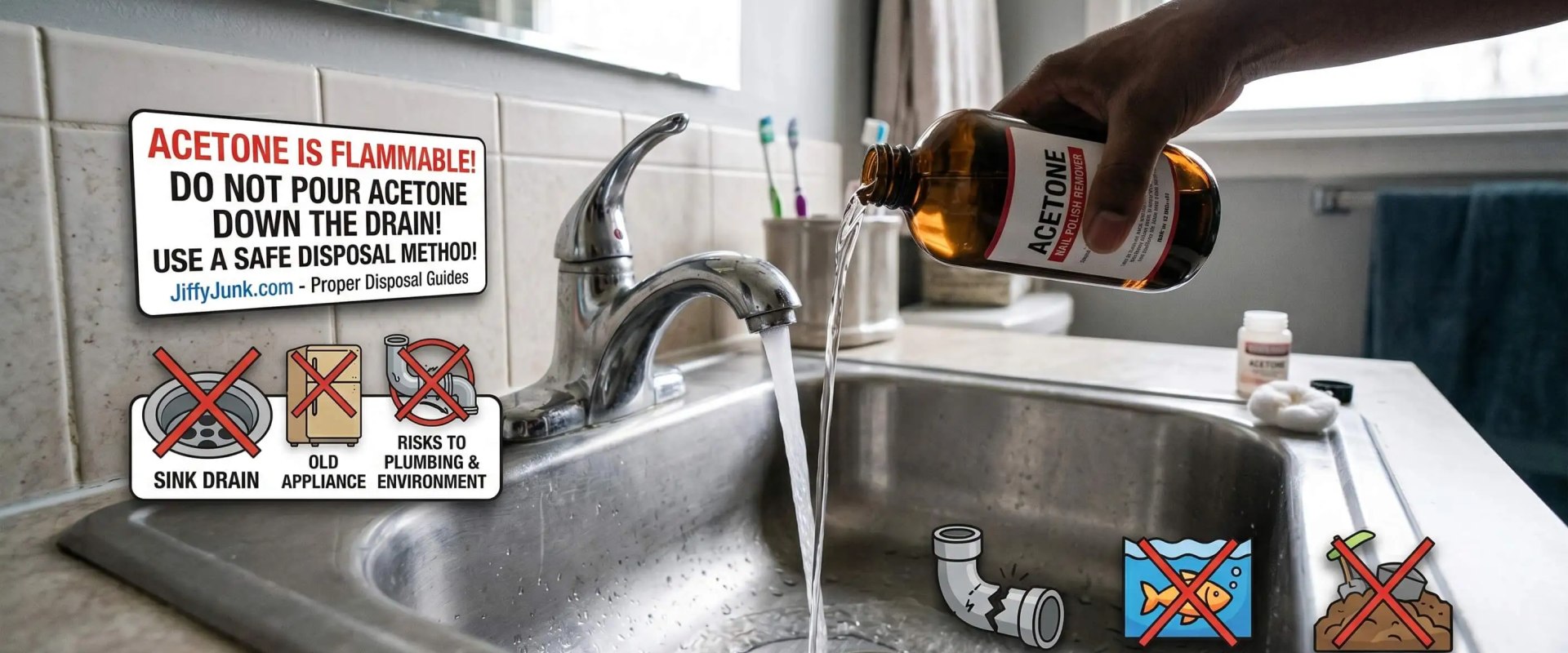
Can you pour acetone down the sink? You shouldn't. Acetone is a flammable solvent with a flash point below indoor room temperature, and a kitchen or bathroom drain is one of the worst places for it to land. The good news: most household spills are recoverable if you move in the next ten minutes.
We field this call often at Jiffy Junk, usually after manicures, DIY adhesive jobs, or the kind of late-night appliance cleanup that ends with a panicked search at 11 p.m. Almost every one of them resolves at home.
TL;DR Quick Answers
Can you pour acetone down the sink?
No. Acetone is a flammable solvent with a flash point of 0°F, which means it produces ignitable vapor at indoor room temperature. Down a drain it can soften plastic pipes, send fumes back up through the trap, kill the bacteria in a septic tank, and create a fire hazard near any open flame in the room. At Jiffy Junk we go by one rule. If something strips grease, adhesive, or finishes off a surface, it's not drain-safe. Treat it like fuel. Seal leftover acetone, label it, and take it to a household hazardous waste drop-off site instead.
Top Takeaways
• Don't pour acetone down the sink. If you already have, a small mistake is almost always recoverable.
• Ventilate first, cut every ignition source within ten feet of the drain, and never run hot water after a spill.
• Cold water flush for small splashes. Sealed bottle and HHW drop-off for anything you have left in a container.
• On a septic system, treat any solvent spill as a tank risk and call for a septic check at the few-ounce mark.
• Acetone's flash point sits at 0°F, which means it produces ignitable vapor at indoor temperature.
• If fumes haven't cleared after 30 minutes of active ventilation, leave the room and call your local poison control line.
First, what NOT to do (the 60-second list)
Before anything else, stop these reflexes:
• Don't run hot water down the drain. Heat flashes acetone vapor up and out of the trap, into the room you're standing in.
• Don't add bleach, ammonia, drain cleaner, or any other chemical. Mixing solvents with household cleaners produces gas combinations you can't ventilate fast enough.
• Don't light a match, candle, gas burner, or pilot near the sink. Acetone's flash point sits at 0°F, well below indoor room temperature in nearly every U.S. home.
• Don't pour more solvent down the drain to "flush" the first. You're doubling the problem, not solving it.
• Don't seal the room. Acetone vapor needs somewhere to go, and that somewhere is outside.
Step-by-step recovery
Work through these in order. Most household spills resolve at Step 4.
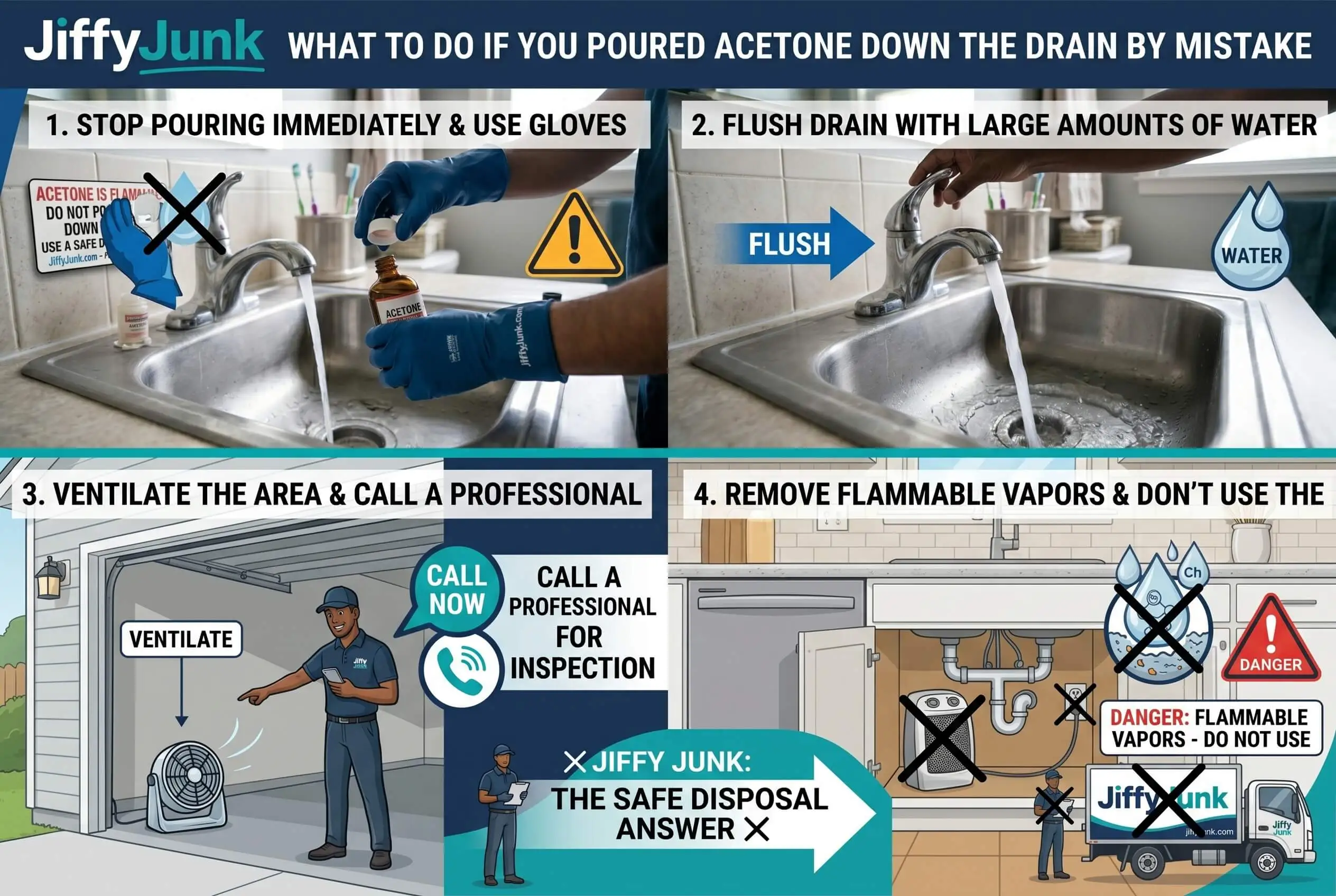
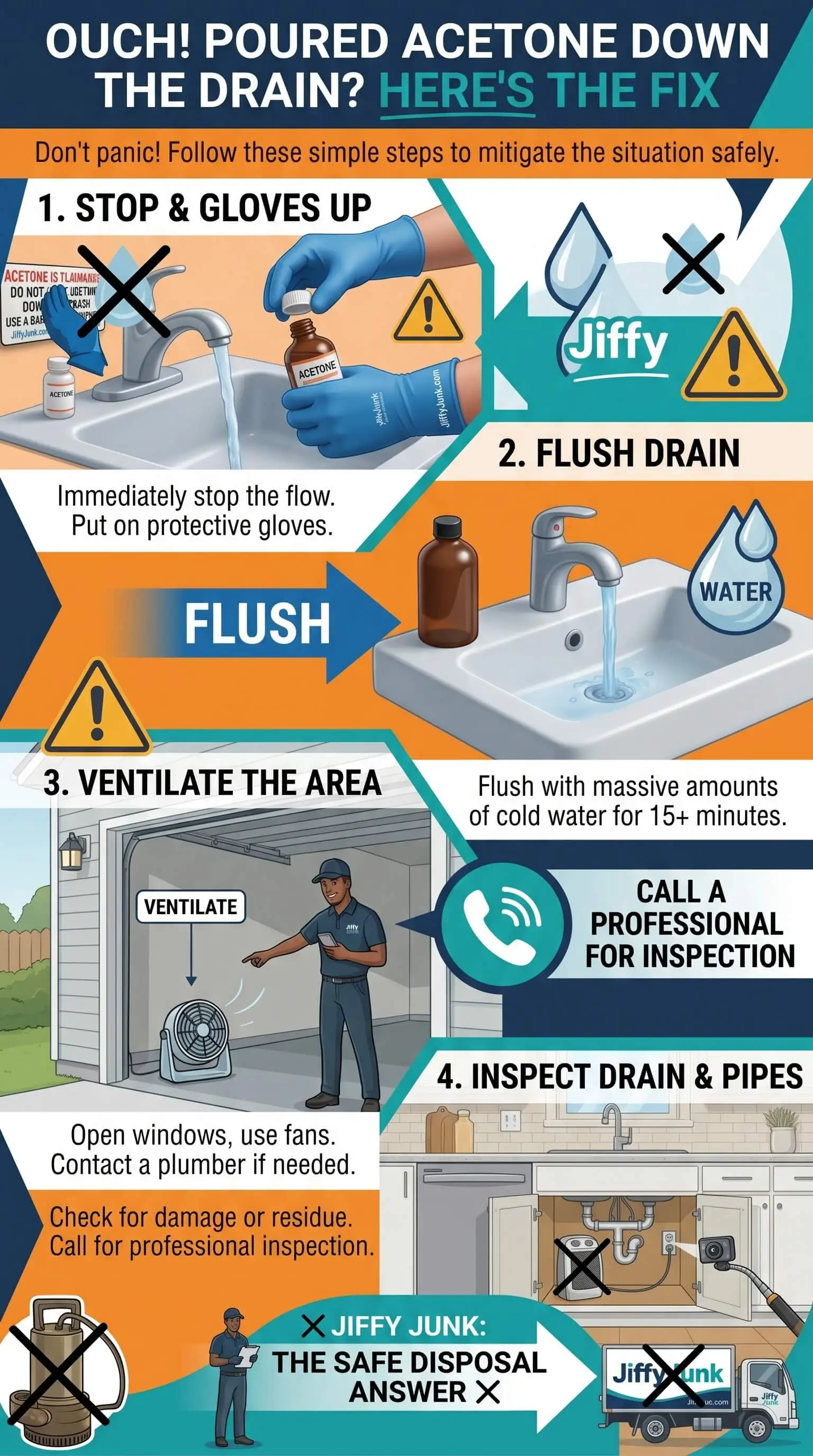
1. Ventilate immediately. Open windows and turn on the range hood, bathroom exhaust fan, and any nearby ceiling fan. Then kill open flames within ten feet of the drain.
2. Cut every ignition source. Stove off, oven off, candles out, electric heaters off, gas pilots checked. Acetone vapor is heavier than air and pools low to the floor.
3. Run cold water gently for 60 to 90 seconds. Cold dilutes the acetone and pushes residual liquid past the P-trap. Hot water flashes vapor. Cold water doesn't.
4. Wait five minutes with the room ventilating, then check for fumes. If the smell has faded, you're through the danger window.
5. If the smell persists, leave the room and let it air out for at least 30 minutes before going back in. Don't mask the smell with sprays or candles.
6. Seal any leftover acetone in its original container. Label it. Set it aside for proper disposal at a household hazardous waste drop-off, not the drain.
7. Wipe down the area around the sink for splashes and drips. Bag the towels separately, seal the bag, and put them in outdoor trash.
If the spill was more than a cup, or fumes don't clear after 30 minutes of active ventilation, the situation has moved past DIY. For homeowners asking can you pour acetone down the sink, the Jiffy Junk full guide covers the disposal options most people don't know exist.
How acetone interacts with your plumbing
Acetone is a powerful solvent, which is the property that makes it useful for stripping nail polish, dissolving adhesives, and cleaning appliance grease. That same property is what makes it bad news for pipes.
• PVC and ABS plastic pipes are vulnerable to repeated acetone exposure. The solvent softens plastic and weakens solvent-welded joints over time. A one-time small dose rarely causes immediate failure, but the risk scales with volume and frequency.
• The P-trap holds standing water that's supposed to block sewer gas. Acetone is volatile and sits on top of water, so vapor can travel back up through the trap and into the room. That accounts for most "fumes from the drain" complaints we hear.
• Wastewater treatment plants flag flammable solvents as a problem input. A single bottle of nail polish remover won't crash the system, but the city isn't designed to receive solvents through a drain.
• Septic systems are the most exposed of all. Acetone kills the bacteria that break down household waste in the tank, and even modest volumes can disrupt the cycle. Septic households should treat any solvent spill more seriously than municipal-sewer households do.
How much acetone changes the response
Volume drives the response.
• A few drops from a cotton ball or rinse rag are usually fine after ventilation, cold water, and 15 minutes of monitoring. No further action needed in most cases.
• An ounce or two, like the dregs of a nail polish remover bottle, calls for aggressive ventilation, cold water dilution, and an hour of watching the room. If fumes return, leave and re-ventilate.
• More than a cup, such as a workshop solvent rinse or a full bottle, means leaving the room, ventilating from outside if you can, and calling both a plumber and your local poison control line for fume guidance.
• On a septic system, drop the trigger volume by half. A few ounces is where we'd schedule a septic check rather than wait.
“After thousands of household cleanups across kitchens, bathrooms, and home workshops, the down-the-drain acetone call we get most often comes from someone who finished a manicure or a craft project. Workshop owners working with bulk solvents call us less than first-time-mistake homeowners do. Most people miss the fume window on a small spill, which runs about 15 to 30 minutes. In that span, a cracked window does more than any cleaning product on the market. We give every homeowner the same rule. If something strips grease, adhesive, or finishes off a surface, it's not drain-safe. Treat it like fuel. That single home care mental shift prevents most of the situations we get called to clean up.”
7 Essential Resources
Each of these is a source we point homeowners to when the question goes deeper than a single article. Verified at the time of publishing. Bookmark whichever one fits your situation.
1. EPA Household Hazardous Waste (HHW) Guide — Why Acetone Belongs Here, Not in a Drain
This is the federal explanation of why solvents like acetone get categorized as household hazardous waste in the first place. It frames the disposal logic we apply to every leftover bottle we encounter on a cleanup.
https://www.epa.gov/hw/household-hazardous-waste-hhw
2. EPA Septic Systems Overview — What Solvents Do to a Septic Tank
If your home is on septic, this resource lays out how the bacterial colony in your tank actually works and what disrupts it. We point septic-system clients here before any cleanup that involves chemicals because the rules change when the wastewater stays on your property.
3. CDC/NIOSH Pocket Guide to Chemical Hazards — Acetone
The official inhalation exposure limits, health effects, and recommended controls for acetone, all from the federal occupational health agency. We treat the NIOSH numbers as our ceiling on what's acceptable in a closed room during a spill response.
https://www.cdc.gov/niosh/npg/npgd0004.html
4. OSHA Chemical Data — Acetone (#476)
The technical data sheet covers flash point, vapor pressure, fire class, and physical properties. If you want to understand why a kitchen sink and an open flame are a bad combination, this is the source. We reference OSHA's data on every solvent we handle in the field.
https://www.osha.gov/chemicaldata/476
5. EPA Hazardous Waste Regulations Overview — The Rules Behind Drain and Trash Bans
This federal overview explains the regulatory frame that makes pouring solvents down a drain a violation in most jurisdictions. It's the reason behind the rules we follow on every job.
https://www.epa.gov/regulatory-information-topic/regulatory-and-guidance-information-topic-waste
6. Earth911 Local HHW Drop-Off Search
A practical, zip-code-based locator for hazardous waste drop-off sites near you. We use it to verify drop-off options for clients before scheduling a pickup, and homeowners can use it the same way. It's also the natural starting place when you're working through a garage cleanout and uncovering old solvent bottles you forgot were back there.
7. American Poison Centers — Find Your Local Poison Control Center
For exposure questions, fume responses, or any uncertainty after a spill, the local poison control line is the right call. The line is free, confidential, and staffed by toxicologists who can triage by phone. We recommend it before a 911 call when nobody is in immediate distress.
3 Statistics
1. Acetone has a 0°F flash point
The flash point of acetone, the temperature at which it produces enough vapor to ignite from a spark or open flame, sits at 0°F (-18°C). That means acetone produces ignitable vapor at refrigerator temperature.
Source: OSHA Chemical Data — Acetone
2. Inhalation exposure caps come faster than people expect
The NIOSH Recommended Exposure Limit for acetone is 250 parts per million (TWA), and the OSHA Permissible Exposure Limit is 1,000 ppm (TWA).
Source: CDC/NIOSH Pocket Guide to Chemical Hazards — Acetone
3. The average household stockpiles hazardous waste for years
The average U.S. household generates more than 20 pounds of household hazardous waste per year, and up to 100 pounds can accumulate in a single home before disposal.
Source: EPA Household Hazardous Waste reference
Final Thoughts and Opinion
The drain is the worst place to put acetone. Plumbing damage builds slowly with repeated exposure, fumes arrive in minutes, and fire risk is binary, meaning it ignites at room temperature or it doesn't. On a septic system, what looks like a small mistake in the moment turns into a maintenance bill weeks later.
We're not interested in shame. Almost every homeowner who pours acetone down the drain knows they shouldn't, and does it anyway because the alternative feels like more friction than the moment deserves. Sealing the bottle, labeling it, and driving to the drop-off is small friction. The consequences of skipping that path aren't small.
At Jiffy Junk we treat acetone the same way we treat a propane tank or a gallon of gasoline. You don't pour those down a drain, and you don't pour acetone down one either. Once that mental shift lands, the disposal habit follows on its own. For homeowners ready for the next step, our guide on the most eco-friendly ways to handle acetone covers the recycling and reuse options that exist before HHW disposal becomes the only option left.
Frequently Asked Questions
Can you pour acetone down the sink?
No. Acetone is a flammable solvent with a flash point below room temperature, and it can damage plastic plumbing, send vapor back up through your trap, disrupt septic systems, and create a fire risk near any open flame in the room. A sealed container plus household hazardous waste drop-off is the only correct disposal path.
What happens if you pour acetone down the drain?
Several risks start the moment the acetone hits the drain. Vapor travels back up through the P-trap and into the room you're standing in. The acetone itself keeps moving through your plumbing toward either the municipal sewer or your septic tank, where it shouldn't be. And anywhere along the path between drain and treatment, an ignition source can flash the vapor before it disperses.
Will acetone damage PVC pipes?
With repeated exposure, yes. Acetone softens PVC and ABS plastics and weakens solvent-welded joints over time. A one-time small splash usually doesn't cause immediate failure, but volume and frequency both raise the risk. If acetone goes down a drain regularly, expect joint trouble within a few years.
Is acetone safe for septic systems?
No. Acetone kills the anaerobic bacteria that break down household waste in a septic tank. Even a few ounces can disrupt the colony, and disrupted colonies translate to slow drains, backups, and maintenance calls weeks after the spill. Septic households should call a tank service for any solvent spill above an ounce.
Should I run hot water after pouring acetone down the sink?
No. Heat flashes acetone vapor up through the trap and into the room you're standing in, which is the opposite of what you want. Run cold water gently for 60 to 90 seconds instead. Cold water dilutes the solvent and pushes it past the trap without flashing vapor.
How do I dispose of acetone properly instead?
Seal it in its original container, label it clearly as acetone, and bring it to a household hazardous waste drop-off site or a local HHW collection event. The Earth911 search tool finds drop-off points by zip code. For more, see our safety-first guide to acetone disposal.
How long until acetone fumes clear from a kitchen or bathroom?
With cross-ventilation, a few drops typically clear within 15 minutes. An ounce or two clears in 30 to 45 minutes if windows and exhaust fans are running. Anything beyond a cup may need an hour or longer of active ventilation, and you shouldn't be in the room while that's happening.
Call to Action
Don't make the same mistake twice. The next time you have leftover acetone, follow our safety-first acetone disposal guide for the full storage and drop-off process. To find a hazardous waste drop-off site near you right now, use the Earth911 HHW locator. And if the spill was bigger than DIY, meaning multiple bottles, mixed solvents, or a contaminated cleanup, Jiffy Junk handles solvent removal as part of our junk removal services, so you don't have to figure out the disposal step alone.