TL;DR Quick Answers
How to dispose of mattress
The best way depends on conditions and local rules. Here’s the fastest decision path we use at Jiffy Junk:
Donate it (only if clean, dry, no stains/odors/tears)
Recycle it (best for most used mattresses; 75%+ can often be recycled)
Schedule bulk pickup (many cities require an appointment + wrapping)
Hire mattress removal (safest option for stairs, tight spaces, heavy mattresses)
Pro tip from our crews: If it’s stained or hard to carry, skip the curb gamble—go straight to recycling or professional haul-away to avoid rejected pickups and injuries.
Top Takeaways
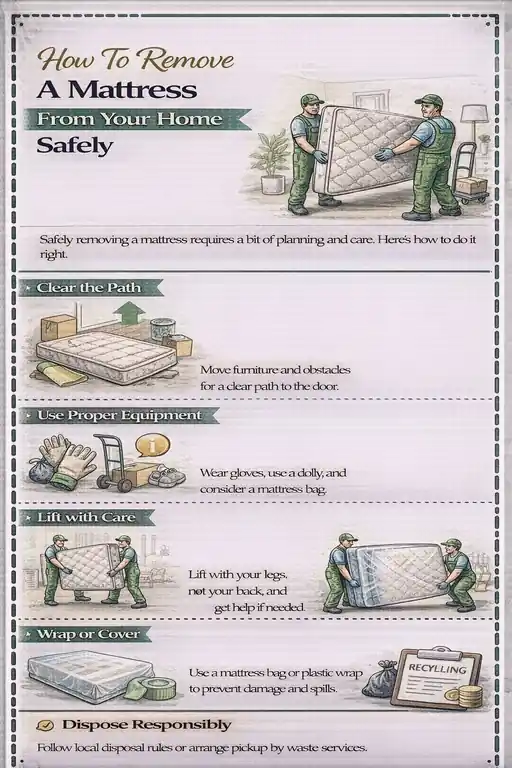
Prep first. Clear the path. Measure tight spots. Remove trip hazards.
Bag or wrap it. Prevent mess, snags, and wall damage.
Lift safely. Bend knees. Don’t twist. Pivot your feet.
Stairs = highest risk. Use two people. Move slowly. Keep it upright.
Dispose the right way. Donate, recycle, curb pickup—or call a removal team.
Before You Move the Mattress: Prep for Safety
A mattress is bulky, flexible, and heavier than most people expect—which makes it easy to twist your back or scrape walls while trying to maneuver it out. Before lifting anything, take 2–3 minutes to prep:
Clear a path from the bedroom to the exit (remove rugs, shoes, décor, and small furniture)
Measure tight spots like stairwells, door frames, and hallway turns
Open doors fully and secure pets/kids in another room
Wear proper gear: closed-toe shoes and work gloves to prevent slips and pinches
At Jiffy Junk, we’ve found that most mattress-removal injuries happen before the mattress even moves—when people rush and don’t clear the route, especially when planning around dumpster rental prices and disposal logistics.
Step 1: Bag or Wrap the Mattress to Prevent Mess & Damage
Mattresses collect dust, hair, and debris, and the fabric can snag on corners and railings. To avoid dragging allergens through your home (and to protect your walls), wrap it first.
Best options:
Mattress bag (recommended): inexpensive and keeps everything contained
Plastic wrap + packing tape: works in a pinch
Old moving blankets: adds extra protection in narrow spaces
Pro tip: If the mattress is stained or has any pest risk, always bag it—this is also required for many donation centers.
Step 2: Use the Right Lifting Method (Don’t Bend & Twist)
A mattress doesn’t lift like a box—it folds and shifts, which can pull your body out of alignment. The safest way to lift is:
Stand close to the mattress
Bend at the knees, not your waist
Keep your back straight
Lift with your legs
Avoid twisting—pivot your feet instead
If it feels unstable, stop and reposition. When mattresses “flop,” people instinctively try to catch them, which is how shoulder and back injuries happen.
Step 3: Move It Out Safely (Stairs, Turns, and Doorways)
Once lifted, focus on control—not speed.
Through doorways
Turn the mattress sideways
Use a vertical “taco fold” if needed
Protect frames with a towel or blanket
Down stairs
Always have two people
Keep the mattress upright, not flat
One person leads, one stabilizes
Move one step at a time and communicate clearly (“step,” “pause,” “turn”)
If you’re removing a mattress from an upper floor, don’t attempt it alone. In our experience, staircases are the #1 place accidents happen.
Step 4: Choose the Safest Removal Option
Once the mattress is out, the next step is proper disposal. Your best option depends on the mattress condition and local rules.
Option A: Donate (only if it’s clean and in good condition)
Many donation centers won’t accept mattresses that are:
stained
torn
sagging
exposed to smoke/pets/pests
Call ahead before hauling it anywhere.
Option B: Recycle (eco-friendly and often required)
Mattresses can be broken down into reusable materials like:
metal springs
foam
wood
fabric
Some cities require recycling instead of curb disposal.
Option C: Curb pickup (check local rules first)
If your city allows it:
schedule pickup
bag the mattress
follow placement rules (often the night before pickup)
Option D: Professional mattress removal (fastest + lowest risk)
If you’re dealing with stairs, a king-size mattress, or just want it gone without hassle, a removal crew can handle everything safely—including lifting, loading, and disposal.
At Jiffy Junk, our teams remove bulky items like mattresses every day, and we handle the heavy lifting, protect your home during removal, and ensure responsible disposal whenever possible.
Quick Safety Checklist (Before You Lift)
Use this simple checklist to avoid injuries and damage:
Path cleared and measured
Mattress wrapped/bagged
Gloves + closed-toe shoes on
Two people available for stairs
No twisting while lifting
Disposal plan confirmed
Need Help Removing a Mattress?
If your mattress is too heavy, you’re dealing with tight staircases, or you just want the safest option, Jiffy Junk can remove it quickly and responsibly—without the stress, strain, or mess.
Ready to get it out today? Contact Jiffy Junk for fast mattress removal with our junk removal service.
“Most mattress-removal injuries don’t happen because the mattress is ‘too heavy’—they happen because people rush the first five minutes. At Jiffy Junk, we’ve removed thousands of mattresses, and the safest jobs always start the same way: clear the path, wrap the mattress, and move it with control—not speed.”
Essential Resources
Here are 7 expert-recommended resources, presented in a scannable, benefit-driven format using Jiffy Junk’s clear, straight-talk voice so you can quickly find the information you need to dispose of your mattress responsibly — whether you’re donating, recycling, scheduling a pickup, or weighing DIY vs. professional removal.
1. Lowe’s Mattress Disposal Guide — Easy, No-Nonsense Starting Point
Get a simple, homeowner-friendly breakdown of disposal options, including donation, recycling, curbside rules, and what to check with your local waste services before you act.
https://www.lowes.com/n/how-to/dispose-mattress
2. WasteDoor Mattress Disposal & Recycling Guide — Compare Your Best Options
A comprehensive side-by-side look at disposal methods, recycling fees, bulk pickup logistics, and when it makes sense to hire help — great if you want to know the real trade-offs before deciding.
https://wastedoor.com/article/mattress-disposal-recycling-guide
3. Forbes “How to Dispose of a Mattress” — Expert-Curated Tips & Practical Advice
Written with consumers in mind, this trusted business resource helps you understand pros/cons of donation vs. recycling vs. professional removal with straight talk you can trust.
https://www.forbes.com/sites/forbes-personal-shopper/article/how-to-dispose-of-a-mattress/
4. Rest Right Mattress Disposal Resources — Best for Local Pickup & Donation Info
Find state-specific disposal resources, donation locations, and regional guidance so you can quickly locate services near you without guesswork.
https://restrightmattress.com/mattress-disposal/
5. Ex-Mattress Drop-Off & Donation Locator — Find Real Places That Accept Mattresses
This resource helps you locate nearby recycling centers and donation drop-offs, with practical tips on what they accept and how to prepare your mattress for drop-off.
https://exmattress.com/where-to-take-used-mattresses/
6. Sleep Foundation Mattress Info — Decide Between Donate, Recycle, or Replace
Use this educational guide to understand mattress lifespan, signs it’s time to replace, and whether your mattress is still in a condition that qualifies for donation.
https://sleepfoundation.org/mattress-information/mattress-disposal-guide
7. Bye Bye Mattress (Mattress Recycling Council) — Official Recycling Program Info
If you’re in a participating state, this official mattress recycling program shows you where you can recycle for free or low cost — a smart choice for eco-minded disposal.
https://byebyemattress.com/
Supporting Statistics
When our crews remove old mattresses, we hear the same thing all the time: “I didn’t know there were better options than the landfill.” The data backs that up.
1) Landfills are still the default
The U.S. generated 292.4 million tons of municipal solid waste (MSW) in 2018.
50% (over 146 million tons) of that waste was landfilled.
That’s why checking donation and recycling options first can make a real impact.
Source (EPA.gov): https://www.epa.gov/facts-and-figures-about-materials-waste-and-recycling/national-overview-facts-and-figures-materials
2) Mattresses are a massive daily waste stream
The Mattress Recycling Council reports 50,000+ mattresses are discarded every day in the U.S.
75%+ of a mattress can be recycled (metal, foam, wood, fibers).
In our experience, mattresses are one of the most common bulky items that people delay removing because they’re hard to dispose of correctly.
Source (.org): https://mattressrecyclingcouncil.org/our-impact/
3) Recycling programs work at scale (real-world proof)
CalRecycle’s review of MRC’s 2024 annual report shows:
1,560,655 program units recycled in California in 2024
1,584,852 total units recycled (including non-program units)
85.9% statewide recycling rate
Source (CalRecycle CA.gov PDF): https://www2.calrecycle.ca.gov/PublicNotices/Documents/17836
4) Recycling access is closer than most people think
In 2024, 97.7% of California residents lived within 15 miles of a permanent collection site or curbside collection program.
That means responsible disposal is often available—it’s just not always obvious.
Source (CalRecycle CA.gov PDF): https://www2.calrecycle.ca.gov/PublicNotices/Documents/17836
Final Thought & Opinion
Removing a mattress safely isn’t just about getting it out of the house.
It’s about doing it without injuries, without damage, and without wasting your entire day.
The biggest takeaway
Most mattress-removal problems are preventable. The safest removals always start with the basics:
Clear the path first (hallways, stairs, doorways)
Bag or wrap the mattress to avoid mess and snagging
Lift with control (no twisting, no rushing)
Don’t attempt stairs alone
Our opinion (based on real removals)
At Jiffy Junk, we’ve seen the same issue again and again: people treat a mattress like normal trash. It isn’t.
Mattresses are bulky, unstable, and easy to drop
They’re one of the most common items left at the curb or stored in garages
A large portion can be recycled, but many people don’t know the rules or options
Bottom line
If you can donate or recycle, that’s the best choice.
But if you’re dealing with stairs, tight spaces, or a heavy mattress, don’t force it.
The safest move is getting help.
FAQ on How to Dispose of Mattress
Q: What’s the best way to dispose of a mattress?
A: It depends on conditions and local rules. In our experience at Jiffy Junk, the best options usually follow this order:
Donate (only if clean and usable)
Recycle (best for worn mattresses)
Bulk pickup / haul-away (fastest when donation isn’t possible)
Q: Can I leave my mattress on the curb for pickup?
A: Sometimes, but many cities have rules. Common requirements include:
Scheduling bulk pickup
Plastic wrapping/bagging
Specific placement locations
We often see curb pickups rejected because the mattress wasn’t prepared correctly.
Q: Where can I recycle a mattress in the U.S.?
A: Start with:
Local recycling centers
Municipal drop-off sites
Official state programs (when available)
Tip from our crews: use an official locator like Bye Bye Mattress to avoid wasted trips.
Q: Can I donate an old mattress?
A: Only if it’s in excellent condition. Most donation centers refuse mattresses with:
stains
odors
tears
sagging
pest risk
Always call ahead before loading it up.
Q: What if my mattress is too heavy to move safely?
A: Don’t force it. Mattresses are bulky and unstable, especially on stairs. If needed:
use two people
move slowly and upright
consider professional removal to avoid injury or home damage