The issue usually isn’t the amount of clutter—it’s the uncertainty around what to do with each item. Garages contain a wide range of belongings, from usable tools and seasonal decorations to broken equipment, chemicals, and long-forgotten storage boxes. When everything is mixed together, making decisions becomes time-consuming and overwhelming, causing many cleanouts to stall before real progress is made.
Unlike other rooms in the house, a garage serves multiple purposes. It’s often part storage space, part workshop, and part overflow area for items that don’t fit anywhere else. This creates a unique challenge: some items are still functional, others may be unsafe to keep, and many require special handling for donation, recycling, or disposal. General decluttering advice doesn’t address these garage-specific issues, which is why it often falls short.
This guide breaks down a simple, garage-focused sorting approach designed to reduce confusion and keep the cleanout moving. Instead of complicated rules or emotional decision-making, it focuses on clear categories, safety awareness, and practical steps that work for real garages—not idealized spaces.
By the end, you’ll know how to sort garage items efficiently, make faster decisions, and complete a garage cleanout that actually lasts.
Quick Answers
Garage Cleanout Sorting
Sorting items during a garage cleanout means quickly deciding what stays, what goes, and what needs proper disposal. From our experience, the most effective approach uses simple categories, fast decisions, and immediate removal to prevent clutter from cycling back in.
Top Takeaways
Sorting is where most garage cleanouts slow down or fail.
Simple categories work better than detailed ones.
Fast decisions matter more than perfect ones.
Immediate removal prevents sorted items from piling up again.
A clear sorting system saves time and mental energy.
Sort for Speed, Not Perfection
The biggest mistake we see is trying to evaluate every item in detail. Garages hold utility items, old projects, and “just in case” storage—not museum pieces. Sorting works best when the goal is speed and function, not emotional certainty.
Use Clear, Limited Sorting Categories
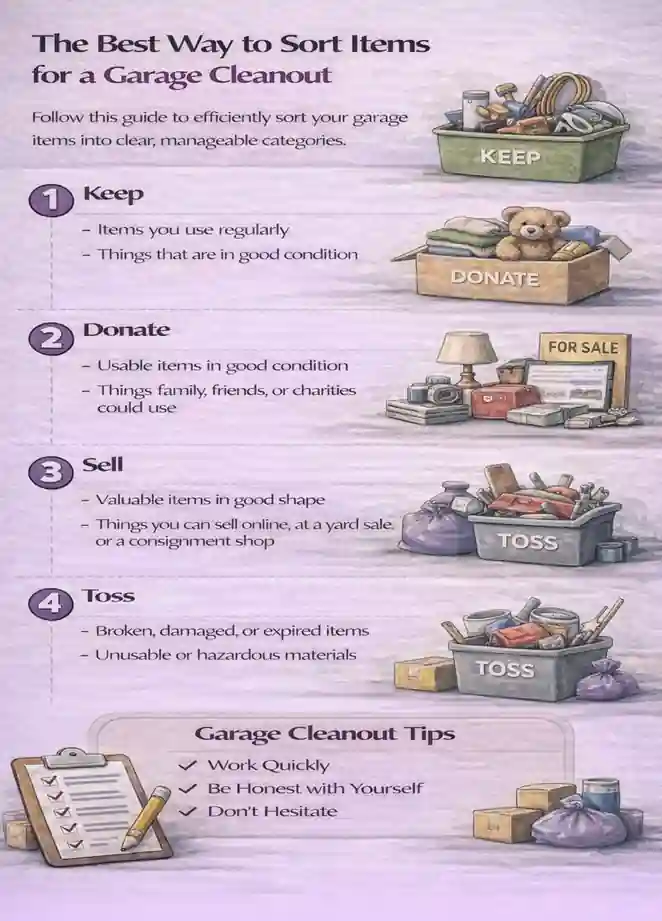
Too many categories create decision fatigue. From real cleanouts, the most effective system uses just four groups:
Keep (used or needed)
Donate (usable but unnecessary)
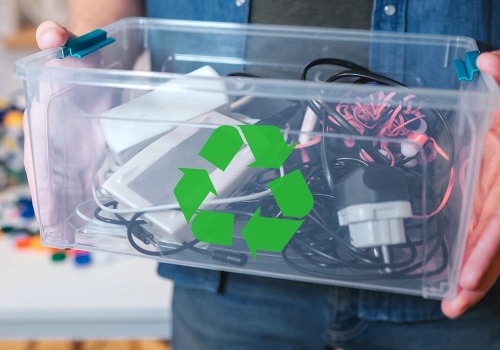
Recycle / Dispose (broken, expired, unsafe)
Unsure (limited, temporary holding zone)
This keeps sorting moving without stopping momentum.
Start With Obvious Wins First
Always begin with items that require no debate: broken tools, empty boxes, outdated materials, and duplicates. Removing these first builds confidence and clears physical space, making harder decisions easier later.
Handle “Unsure” Items Last
Unsure piles should be small and temporary. If an item hasn’t been used in years and has no clear future purpose, it’s usually safe to let it go. In our experience, revisiting these items after visible progress makes decisions far easier.
Remove Sorted Items Immediately
Sorting alone doesn’t finish a garage cleanout. Bags and boxes labeled donate or junk often sit for months and drift back into storage. Scheduling removal or drop-off right away locks in progress and prevents reversal.
Final Takeaway
The best way to sort items for a garage cleanout, particularly during an estate cleanout, is to keep decisions simple, categories limited, and removal immediate. When sorting is fast and focused, estate cleanouts and garage cleanouts move forward instead of stalling.
“After sorting thousands of garages, we’ve learned that clutter isn’t caused by having too much stuff—it’s caused by delayed decisions. The garages that get cleared are the ones where sorting stays simple and items leave immediately.”
Essential Resources for Garage Cleanout
1. Learn a Proven Sorting Framework
Step-by-Step Garage Cleanout Planning Guide — NewSouth Waste
Breaks down how to sort items efficiently while planning disposal and recycling responsibly.
https://newsouthwaste.com/garage-cleanout-success-waste-management-plan/
2. Understand the Full Cleanout Flow
Complete Garage Cleanout Guide — JunkSmiths
Shows how sorting fits into the overall garage cleanout process.
https://junksmiths.com/garage-clean-outs-guide/
3. Decluttering Without Overthinking
Garage Cleanout & Decluttering Tips — Home Sidekick
Helpful strategies for deciding what stays and what goes.
https://homesidekick.com/blog/garage-cleanout-guide.html
4. Stay Organized While Sorting
Garage Cleanout Checklist Printable — Zopago
Keeps sorting steps clear and prevents category creep.
https://zopago.com/your-printable-garage-cleanup-plan/
5. Prep Before You Sort
Garage Cleaning & Prep List — Angi
Explains how to prep the garage so sorting goes faster.
https://www.angi.com/articles/garage-cleaning-checklist.htm
6. Responsible Disposal Guidance
Garage Cleanout Strategies — Waste Removal USA
Covers recycling, disposal, and donation best practices.
https://wasteremovalusa.com/blog/garage-cleanout/
7. What Comes After Sorting
Step-by-Step Organization Guide — Hello Garage
Helps prevent clutter from returning once sorting is complete.
https://www.hellogarage.com/blog/step-by-step-guide-to-your-garage-cleanout/
These resources guide homeowners through efficient garage cleanout sorting, preparation, disposal, and organization, showing how a structured, hands-on approach similar to a personal care assistant helps keep decisions focused, reduces overwhelm, and supports consistent progress throughout the cleanout process.
Supporting Statistics
The U.S. generates 292.4 million tons of waste annually, much of which ends up stored in garages.
Source: https://www.epa.gov/facts-and-figures-about-materials-waste-and-recycling/national-overview-facts-and-figures-materialsOnly 32.1% of waste is recycled or composted, highlighting the importance of proper sorting.
Source: https://www.epa.gov/facts-and-figures-about-materials-waste-and-recycling/frequent-questions-regarding-epas-facts-and99% of lead-acid batteries are recyclable, yet many sit forgotten in garages.
Source: https://www.epa.gov/electronics-batteries-management/battery-collection-action-case-study-lead-acid-battery-collection
These statistics highlight how much waste accumulates in garages and why proper sorting matters, reinforcing the need for structured garage cleanouts supported by responsible follow-up steps and oversight often associated with private home care to maintain safer, more functional living spaces.
Final Thought & Opinion
In our experience, sorting not space is the real challenge of a garage cleanout. The homeowners who succeed aren’t the ones who analyze every item; they’re the ones who commit to simple categories and fast removal, prioritizing clear access for essential tasks like dryer vent cleaning that are often blocked by clutter. Sorting should move you forward, not slow you down.
What works best:
Fewer categories
Faster decisions
Immediate removal
Bottom line:
When sorting stays simple, garage cleanouts stay manageable—and actually get finished.
FAQ on Garage Cleanout
Q: What’s the best way to sort garage items?
A: Use four categories: keep, donate, recycle/dispose, and unsure. Keep it simple.
Q: How do I avoid getting stuck while sorting?
A: Start with obvious items first and limit how long you spend deciding.
Q: What should I do with unsure items?
A: Set them aside temporarily and revisit them after progress is visible.
Q: Should I sort everything before removing items?
A: No. Removing items as you sort prevents clutter from piling up again.
Q: How do I keep the garage organized after sorting?
A: Only return items with a clear purpose and storage plan.