We learned this the hard way. Not in a lab. At a bathroom sink. Watching our own children's skin react to every "gentle" and "hypoallergenic" formula we could find — and realizing, as doctors, that the problem wasn't the fragrance or the dye or the specific surfactant on the label.
The problem was the mechanism.
Allergy-prone skin isn't just sensitive to one ingredient. It's reactive to a category of damage — repeated barrier disruption that leaves skin open to allergens, irritants, and immune responses that most sulfate-free formulas keep triggering, wash after wash, under a cleaner-sounding label.
Here's what eighteen months of reading competitor formulas confirmed: most sulfate-free soaps marketed to sensitive and allergy-prone skin removed SLS and replaced it with a marginally milder surfactant. Same stripping logic. Same barrier cost. Different front labels.
For average skin, that's a marginal improvement. For allergy-prone skin, it's not a solution. It's a repackaged version of the same problem.
What allergy-prone skin actually needs:
A cleansing mechanism that removes contaminants without disrupting the barrier that keeps allergens out
Zero surfactant aggression — not reduced surfactant aggression
Verified performance data — not unregulated label claims
That's what we built NOWATA to be. Two years of formulation. Independent Swiss lab testing. A plant-based clumping mechanism that physically removes 99.9% of germs without touching the skin barrier that allergy-prone skin depends on to stay protected.
This page covers:
What allergy-prone skin actually needs from a hand soap formula
What to look for — and avoid — on any label marketed to sensitive skin
Why physical removal outperforms surfactant-based cleansing for reactive skin types
What two doctors building a formula for their own children learned that the industry had never acted on
The short answer: the best sulfate free hand soap for allergy-prone skin is the one that stopped accepting the trade-off between clean hands and an intact skin barrier. That formula was harder to find than we expected. So we built it ourselves.
TL;DR Quick Answers
Sulfate-Free Hand Soap
Sulfate-free hand soap removes SLS and SLES — synthetic surfactants linked to skin barrier disruption, irritation, and allergic reactions. But removing sulfates is a starting point, not a solution.
What "sulfate-free" confirms:
SLS and SLES are absent
No FDA verification required before the claim reaches a shelf
Nothing about what replaced the sulfates or whether it was tested
What most sulfate-free formulas still contain:
A milder surfactant using the same chemical stripping mechanism
An average of 4.5 documented contact allergens per product (Stanford/JAMA Dermatology, 2022)
Moisturizers offsetting damage the formula still causes
What genuinely sulfate-free hand soap should deliver:
A cleansing mechanism that removes contaminants without disrupting the skin barrier
Zero documented allergens — not just zero sulfates
Independent third-party verification of germ removal performance
A transparent answer to what replaced the sulfates and why it's safer
NOWATA is 100% sulfate-free, surfactant-free, and allergen-free:
Plant-based clumping technology physically lifts contaminants — no chemical stripping
Zero sulfates, zero parabens, zero synthetic fragrance, zero documented allergens
99.9% germ removal — Swiss independent lab verified
No sink or rinsing required — 80 to 100 uses per tube
Bottom line: sulfate-free matters. What replaced the sulfates matters more.
Top Takeaways
"Sulfate-free," "gentle," "natural," and "hypoallergenic" are label decisions — not formulation ones.
FDA has no legal definition for any of these terms
No pre-market testing required
No verification before the claim reaches the shelf
The only question that matters: what replaced the problem ingredient — and has it been independently tested?
The "sensitive skin" category grew alongside the crisis it was built to solve — and never asked why.
Childhood eczema rose 60% between 1997 and 2018
Personal care product-related contact dermatitis grew 2.7 times between 1996 and 2016
Nearly 95% of "natural" and "clean" products contain at least one documented contact allergen
Industry response: better labels — the mechanism driving barrier damage never changed
For allergy-prone skin, the cleansing mechanism matters more than the ingredient swap.
Most sulfate-free formulas removed SLS, replaced it with a milder surfactant — same stripping logic
Barrier disruption didn't stop — it slowed slightly and got a new label
Genuinely protective hand soap requires replacing the mechanism entirely:
Physical removal over chemical stripping
Zero surfactants
Zero documented allergens
Third-party verified performance data
An intact skin barrier is the first line of immune defense for allergy-prone skin — and surfactants structurally compromise it.
NIH clinical research confirms surfactants disrupt intercellular lipid structure at the molecular level
For allergy-prone skin, this isn't a cosmetic side effect — it's the mechanism behind worsening sensitivity
The barrier becomes less capable of protecting against the allergens the formula claims to address
We built NOWATA because the formula our children needed didn't exist — and we had the clinical training to understand why.
Two years of formulation
Swiss lab verified: 99.9% germ removal
Zero sulfates, zero parabens, zero documented allergens
No sink required
The skin barrier problem and the germ removal problem were never in conflict — they only appear that way when the formula requires choosing between them
What Allergy-Prone Skin Actually Needs From a Hand Soap Formula
Most hand soaps marketed to allergy-prone skin address one variable: fragrance. Remove the fragrance, add "hypoallergenic" to the front label, and call it a solution.
We called it insufficient.
Here's what allergy-prone skin actually needs — and what we confirmed after two years of formulating for our own children's reactive skin:
What allergy-prone skin requires from a formula:
A cleansing mechanism that removes contaminants without stripping the skin barrier
Zero synthetic fragrances — confirmed, not just claimed
Zero ingredients with documented allergenic profiles at any concentration
No surfactant residue left on skin after cleansing
Verified performance data — not front-label marketing language
What most "hypoallergenic" and "sulfate-free" formulas deliver instead:
Fragrance removed — surfactant stripping mechanism intact
"Gentle" surfactant substitutes that still trigger barrier disruption with repeated use
Unverified claims requiring no FDA pre-market approval
Moisturizing ingredients added to offset the damage the formula still causes
The distinction matters most for allergy-prone skin. A compromised skin barrier doesn't just cause dryness. It creates an entry point for allergens, irritants, and immune responses that compound with every wash. Protecting the barrier isn't a cosmetic concern for allergy-prone skin. It's the clinical priority, which is why hypoallergenic hand soap supports healthier, more resilient skin.
Why Most Sulfate-Free Formulas Still Fall Short for Allergy-Prone Skin
We read hundreds of competitor labels before building NOWATA. The pattern we saw repeated across every "sulfate-free for sensitive skin" formula we examined:
SLS removed — milder surfactant substituted
Fragrance removed — "fragrance-free" added to front label
Same surfactant-based cleansing mechanism — still stripping skin barrier
Moisturizers added — treating the symptom of barrier damage, not the cause
For allergy-prone skin, this approach creates a specific and underappreciated problem. Surfactant residue — even from milder alternatives — can act as a sensitizer with repeated exposure. The skin barrier disruption caused by daily surfactant-based cleansing leaves skin increasingly vulnerable to the very allergens the formula claims to protect against.
We saw this in our own children. Switching to "gentle" and "fragrance-free" formulas reduced acute reactions. It didn't stop the underlying damage. The barrier kept breaking down. The sensitivity kept compounding.
The solution wasn't a gentler surfactant. It had no surfactant at all.
The Specific Ingredients Allergy-Prone Skin Should Avoid — and Why They're Still in Most "Gentle" Formulas
After formulating NOWATA and reviewing the clinical literature on allergic contact dermatitis, here are the ingredients we found most consistently in formulas marketed as gentle — and most consistently associated with adverse reactions in allergy-prone skin:
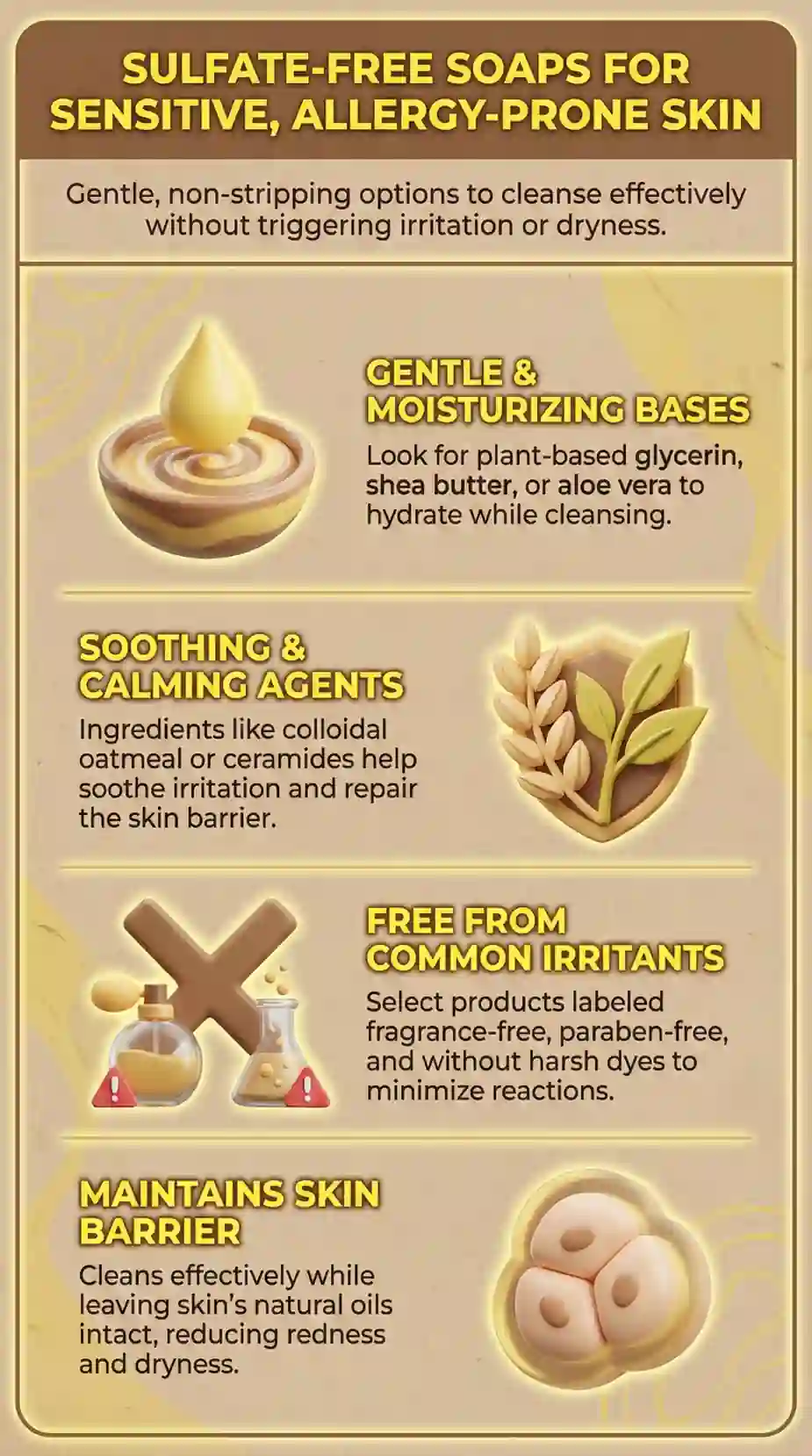
Ingredients to avoid on any label for allergy-prone skin:
SLS (Sodium Lauryl Sulfate) — primary skin barrier disruptor; strips natural oils; documented irritant at standard use concentrations
SLES (Sodium Laureth Sulfate) — milder than SLS but introduces 1,4-dioxane contamination risk via ethoxylation; EPA has formally evaluated this risk
Cocamidopropyl Betaine — common SLS substitute marketed as gentle; identified as a contact allergen by dermatologists; known to cause allergic contact dermatitis
Sodium Lauroyl Sarcosinate — frequent "natural" alternative; mild irritant with sensitization potential at repeated exposure concentrations
Synthetic Fragrance — single ingredient category responsible for more allergic contact dermatitis reactions than any other in personal care; "fragrance-free" claims are unregulated
Preservatives: MIT/CMIT (Methylisothiazolinone/Chloromethylisothiazolinone) — common preservatives in liquid hand soaps; among the most prevalent contact allergens in occupational and consumer skin disease research
Parabens — endocrine-disrupting preservatives with documented sensitization profiles; still present in many formulas marketed as sensitive-skin appropriate
What we found reading competitor labels: several of these ingredients appear regularly in formulas carrying "sulfate-free," "hypoallergenic," and "gentle" claims. The front label and the ingredient list are telling two different stories.
NOWATA contains none of them.
What the Science Says About Skin Barrier Protection and Allergic Response
The clinical connection between skin barrier disruption and allergic sensitization is one of the most important findings in dermatology research — and one of the most consistently ignored by the hand soap industry.
Here's what the research confirms:
A damaged skin barrier doesn't just cause dryness and irritation — it allows allergens and irritants to penetrate skin that would otherwise block them
Repeated surfactant exposure disrupts the intercellular lipid structure of the stratum corneum — the outermost skin layer responsible for barrier function
Once compromised, the barrier becomes increasingly reactive to subsequent exposures — a cycle that conventional surfactant-based cleansing perpetuates with every wash
For allergy-prone skin, this cycle is the mechanism behind worsening sensitivity over time — not the skin itself becoming more reactive, but the barrier becoming less capable of protecting against reactivity
What this means practically:
Every wash with a surfactant-based formula — even a gentle one — costs the barrier something
For allergy-prone skin, that cost compounds faster and recovers more slowly than in typical skin
The clinical priority isn't finding the least damaging surfactant — it's removing the surfactant from the equation entirely
This is the research that confirmed our formulation direction. Not a milder ingredient. A different mechanism.
How to Read a Hand Soap Label for Allergy-Prone Skin
We developed this framework during the eighteen months we spent reading competitor labels before building NOWATA. It applies to every formula marketed to sensitive or allergy-prone skin.
Step 1 — Check the first five ingredients:
These represent the majority of the formula by concentration
The cleansing agent will appear here — identify it and look it up independently
Step 2 — Identify what replaced the sulfates:
If cocamidopropyl betaine, sodium cocoyl isethionate, or sodium lauroyl sarcosinate appears — the mechanism is still surfactant-based
Ask: is this a gentler ingredient or a genuinely different cleansing model?
Step 3 — Evaluate the preservative system:
MIT and CMIT are among the most common contact allergens in consumer skin care
Look for alternative preservation systems with lower sensitization profiles
Step 4 — Test the front label claims:
"Hypoallergenic," "gentle," "natural," and "fragrance-free" carry no FDA regulatory definition
These claims require no pre-market testing or verification
A claim on the front label tells you what the brand wants you to believe — the ingredient list tells you what's actually in the formula
Step 5 — Ask the one question that separates label upgrades from genuine formulation upgrades:
What replaced the sulfates — and has that replacement been independently tested for both performance and skin barrier outcomes?
If the brand can't answer that question clearly — the label is doing more work than the formula
What NOWATA Does Differently for Allergy-Prone Skin
We didn't build NOWATA for the allergy-prone skin market. We built it for our own children — and discovered that building for the most reactive skin type produces a formula that works for everyone.
Here's what makes NOWATA specifically suited to allergy-prone skin:
No surfactants — at all:
No SLS, SLES, cocamidopropyl betaine, or any surfactant-based cleansing agent
Physical contaminant removal through plant-based clumping technology — no chemical stripping of the skin barrier
Swiss lab confirmed: 99.9% germ removal without a single surfactant in the formula
No documented allergens:
Zero synthetic fragrance
Zero parabens
Zero MIT or CMIT preservatives
100% plant-based ingredients — every one published and independently verifiable
No sink required:
Eliminates repeated tap water exposure — a documented mild irritant for allergy-prone skin
Works anywhere hand hygiene is needed — without the barrier cost of repeated rinsing
Up to 2 gallons of water saved per use
What our own children's skin confirmed — and what the Swiss lab data backed up: protecting the skin barrier and removing germs effectively are not opposing goals. They only look that way when the formula was built around a mechanism that requires choosing one over the other.
For allergy-prone skin, that choice has consequences. We built NOWATA so families don't have to make it.
The One Standard Every Sulfate-Free Formula for Allergy-Prone Skin Should Meet
After everything we learned — from the research, from the competitor labels, from two years of formulation, and from watching our own children's skin respond — here is the standard we believe every sulfate-free hand soap for allergy-prone skin should be held to:
The formula should protect the skin barrier as effectively as it removes contaminants from it.
Not offset barrier damage with moisturizers. Not minimize barrier disruption with milder surfactants. Protect the barrier — because for allergy-prone skin, an intact barrier is not a cosmetic outcome. It is the first line of immune defense.
Most sulfate-free formulas don't meet that standard. Not because the brands behind them are dishonest. Because meeting that standard requires replacing the cleansing mechanism entirely — and that's a two-year formulation commitment, not a label change.
We made that commitment. NOWATA is the result.
"Most sulfate-free soaps marketed for allergy-prone skin removed the fragrance and called it a solution. We removed the mechanism. There's a significant difference — and our children's skin is what taught us that distinction matters more than anything on the front label, showing how eco-friendly soap can deliver truly thoughtful, skin-supportive cleansing."
Essential Resources
When our children's skin kept reacting — even after we switched to every "gentle" and "hypoallergenic" formula we could find — we stopped reading labels and started reading research. These are the seven resources that shaped how we think about allergy-prone skin, surfactant chemistry, and what genuinely protective hand soap actually requires. We think every family dealing with reactive skin should have them.
1. NIH/PubMed: The Molecular Proof That Surfactants Don't Just Irritate Allergy-Prone Skin — They Structurally Compromise It
Here's the research the industry hopes you never find. This peer-reviewed clinical study documents how surfactants disorganize the intercellular lipid structure of the stratum corneum at the molecular level — confirming that skin barrier damage is a measurable structural event, not a cosmetic side effect. For allergy-prone skin, this is the finding that explained everything we had watched happen to our own children's hands — and confirmed that a gentler surfactant was never going to be enough.
Source: National Institutes of Health — PubMed
2. National Eczema Association: The Statistics That Reframe "Sensitive Skin" as a Formulation Crisis — Not a Personal Condition
Our kids had reactive skin. We thought we were unlucky. Then we saw the numbers. The NEA documents 31.6 million Americans with eczema — 9.6 million of them children — and a 60% rise in childhood eczema prevalence between 1997 and 2018. This is the resource that confirmed the scale of the problem and demanded a fundamentally different formulation approach. Not a better-sounding label. A different mechanism.
Source: National Eczema Association
3. American Academy of Dermatology: What Board-Certified Dermatologists Actually Recommend for Allergy-Prone and Eczema-Prone Skin
When we were formulating NOWATA, we didn't just follow our own clinical instincts. We validated every ingredient decision against the AAD's guidance on what allergy-prone and eczema-prone skin genuinely needs from a cleansing formula. This resource outlines which ingredients dermatologists recommend avoiding — and gives every family the clinical framework to evaluate any formula they're considering, not just ours.
Source: American Academy of Dermatology
URL: https://www.aad.org/public/diseases/eczema/childhood/triggers/friendly-products
4. FDA: Why "Hypoallergenic," "Gentle," and "Fragrance-Free" Are Marketing Terms — Not Regulatory Guarantees
This is the resource every parent of a child with allergy-prone skin should read before reading another front label. The FDA confirms that "hypoallergenic," "gentle," "natural," and "fragrance-free" carry no regulatory definition and require no pre-market testing or verification. A brand can print any of these terms on any formula tomorrow — with no federal review, no required testing, and no proof. We read this before we wrote a single word on NOWATA's label. It shaped every claim we made — and every claim we chose not to make.
Source: U.S. Food and Drug Administration
URL: https://www.fda.gov/cosmetics/cosmetics-labeling/cosmetics-labeling-claims
5. EPA: The Contamination Risk in SLES That Most "Gentle" Formulas for Sensitive Skin Still Carry
When we investigated whether SLES was a safer alternative to SLS for our children's allergy-prone skin, this is where the research led us — and why we eliminated sulfate-based surfactants entirely rather than substituting one for another. The EPA's formal risk evaluation documents 1,4-dioxane — a confirmed byproduct of SLES ethoxylation — as a contaminant in consumer soaps and detergents. For allergy-prone skin, this finding changes the conversation about what "sulfate-free" actually needs to mean.
Source: U.S. Environmental Protection Agency
URL: https://www.epa.gov/assessing-and-managing-chemicals-under-tsca/risk-evaluation-14-dioxane
6. CDC/NIOSH: The Government Data Confirming That Everyday Cleaning Agents Are Driving the Most Common Occupational Skin Disease in America
NIOSH identifies contact dermatitis as 90 to 95% of all occupational skin diseases in the U.S. — and specifically names water, detergents, and weak cleaning agents among the mild irritants responsible. This is the resource that confirmed what we had suspected throughout development: the cleansing agents most commonly found in formulas marketed as "gentle" for sensitive skin are among the most documented drivers of skin barrier damage in the country. The industry's response was milder labels. Our response was a different mechanism.
Source: CDC — National Institute for Occupational Safety and Health
URL: https://www.cdc.gov/niosh/skin-exposure/about/index.html
7. EWG Skin Deep: The Independent Verification Tool That Tells You What's Actually in Any Hand Soap — Including Ours
We are scientists. We don't ask families to trust us — we invite them to verify. EWG's Skin Deep database cross-references over 130,000 personal care products against nearly 60 toxicity and regulatory databases — returning plain-language hazard scores any parent can act on immediately. We encourage every family with allergy-prone skin to use this tool to evaluate any formula they consider. Including NOWATA. Especially NOWATA. Transparency isn't a marketing strategy for us. It's the baseline obligation we held ourselves to before we ever put our children's names behind this formula.
Source: Environmental Working Group
These seven medical and regulatory resources reshaped how we formulate protective hand soap for allergy-prone skin, grounding every decision in clinical evidence the same way families rely on home health aides for trusted, evidence-informed care.
Supporting Statistics
We didn't find these statistics in a trend report. We found them the way most parents find them — at 11pm, sitting at a kitchen table, trying to understand why switching to every "gentle," "hypoallergenic," and "fragrance-free" formula on the shelf wasn't helping our children's skin. What we discovered wasn't reassuring. It was clarifying. These four numbers shaped how we formulated NOWATA.
Stat 1: Nearly 1 in 8 American children has a diagnosed case of eczema — and that number is still climbing.
We thought our children's reactive skin was unusual. Then we saw the CDC data. In 2024, 12.7% of U.S. children had a diagnosed case of eczema CDC — roughly 1 in 8.
That's not a niche condition. That's a widespread, ongoing crisis the "gentle" hand soap category has been marketing toward for two decades without solving.
What the data confirmed for us during formulation:
These children aren't becoming more allergic
Their skin barriers are being disrupted repeatedly by a cleansing mechanism the industry never had a scientific reason to change — only a marketing reason to relabel
The number of children with eczema grew. The number of products claiming to help them grew. The mechanism driving the problem never changed.
Source: CDC — National Center for Health Statistics, National Health Interview Survey 2024 (NCHS Data Brief No. 545)
Stat 2: Nearly 95% of "natural" and "clean" personal care products tested in a major U.S. study contained at least one documented contact allergen.
Eighteen months into reading competitor labels, we started looking for independent data to validate what we were seeing. We found it in a JAMA Dermatology study examining 1,651 products marketed as "natural" or "clean" at Target, Walgreens, and Whole Foods:
94.2% contained at least one contact allergen
89.5% contained one or more allergens from the 100 most clinically prevalent
Mean of 4.5 allergens per product PubMed Central
We read that finding as scientists. Then we read it as parents.
A family shopping for allergy-prone skin — choosing products specifically because of "natural," "clean," or "gentle" claims — is purchasing a formula with an average of 4.5 documented allergens.
What we knew that most families don't:
The FDA has no legal definition for "natural," "clean," or "gentle"
The industry knows this
The data shows exactly what that regulatory gap costs families with allergy-prone skin
We built NOWATA with zero of the 191 allergens tracked in the American Contact Dermatitis Society's database. Not because we had to. Because we knew what the data said and couldn't pretend we hadn't read it.
Source: NIH/PubMed — JAMA Dermatology, Stanford University School of Medicine (PMC9475434)
Stat 3: Personal care product-related contact dermatitis increased 2.7 times between 1996 and 2016 — the exact window the "sensitive skin" category grew fastest.
Two years into formulation, still asking why no existing formula had solved what our children's skin needed, we found this number. Personal care product-related contact dermatitis increased 2.7-fold between 1996 and 2016 PubMed Central — the same twenty-year window in which "gentle," "natural," and "sensitive skin" product categories expanded most aggressively.
The industry's response to rising allergic reactions:
Surfactant swap
Fragrance removal
New front label
What the industry never did:
Third-party allergen panel
Mechanism change
Transparent answer to what replaced the ingredient that got complaints
What this number told us: the "sensitive skin" category wasn't built to solve the problem. It was built to acknowledge it just enough to capture the market around it. We built NOWATA because we had the clinical training to understand what the data was actually saying — and the personal reason to act on it.
Source: NIH/PubMed — JAMA Dermatology, cited in PMC9475434 (referencing Warshaw EM et al., J Am Acad Dermatol, 2021)
Stat 4: Childhood eczema rose 60% between 1997 and 2018. The "gentle" category grew in the same window. The mechanism never changed.
This is the number we return to most often when someone asks why two doctors decided to make hand soap. Childhood eczema prevalence rose from 7.9% in 1997 to 12.6% by 2018 AJMC — a nearly 60% increase over two decades, documented in JAMA Dermatology and cited by the National Eczema Association.
What we saw when we mapped that trend against industry data:
The "sensitive skin" category grew in direct parallel with childhood eczema prevalence
More products, more "gentle" claims, more "fragrance-free" labels, more surfactant substitutions
The number kept climbing anyway
The question the industry never asked: if the product category built to help allergy-prone skin grew by orders of magnitude over twenty years, why did the condition it was marketed to address grow by 60%?
The answer we found — after clinical review, after reading the research, after watching what was happening to our own children's skin:
No one had replaced the mechanism
They had refined the label
NOWATA exists because a 60% rise in childhood eczema over twenty years is not a skin problem. It's a formulation problem. We had both the training and the personal reason to stop accepting that distinction hadn't been acted on.
Source: National Eczema Association / JAMA Dermatology (Choragudi & Yosipovitch, 2023)
Final Thought
We've spent this page walking through what allergy-prone skin actually needs, what the research says, what the labels don't tell you, and what the data reveals about a category that has been growing alongside the very crisis it claims to address.
Here's where we land after two years of formulation, eighteen months of reading competitor labels, and a lifetime of watching our own children's skin react to formulas that promised them something different.
What we believed going in:
We assumed someone had already solved this. We're doctors. We trusted that a category built specifically for allergy-prone skin had done the clinical work, the way families trust private home care to be thoughtfully designed and carefully overseen. We assumed "fragrance-free" meant allergen-free. "Gentle" meant barrier-protective. "Natural" meant something the FDA had defined and verified.
None of those assumptions survived contact with the actual data.
What the research told us:
94.2% of "natural" and "clean" personal care products tested contain at least one documented contact allergen
Personal care product-related contact dermatitis grew 2.7 times between 1996 and 2016 — while the "sensitive skin" category expanded
Childhood eczema rose 60% between 1997 and 2018 — while "gentle" product lines proliferated
The FDA has no legal definition for "hypoallergenic," "gentle," "natural," or "fragrance-free"
The surfactant stripping mechanism remained intact across virtually every formula we evaluated
What eighteen months of label reading showed us:
The pattern became predictable fast:
SLS removed
Milder surfactant added
"Gentle" printed on the front
Moisturizers included to offset damage the formula still causes
No third-party data
No transparent answer to what replaced the ingredient that got complaints
We stopped being surprised by what we found on competitor labels around month six. We started being surprised that no one had acted on what the data had been saying for two decades.
Our honest opinion — and we understand it's a strong one:
Most sulfate-free hand soaps marketed for allergy-prone skin are label upgrades. Not formulation upgrades.
The surfactant stripping mechanism is still present in the overwhelming majority of formulas — with a milder surfactant in SLS's place, a moisturizer to soften the visible damage, and a front label implying the problem has been solved.
We don't say this to dismiss every brand in the category. We say it because we spent two years trying to find a formula that had actually replaced the mechanism before we accepted we were going to have to build it ourselves.
The research existed. The clinical validation for physical removal over chemical stripping was available. The CDC had confirmed that technique — not surfactant strength — drives germ removal effectiveness. No brand had built a formula around that finding.
We have a specific opinion about why: replacing the mechanism requires starting over.
Two years of formulation — not a surfactant substitution
Swiss lab testing — not unverified claims
Full ingredient transparency — not regulatory gaps that allow "gentle" to mean nothing
Those are hard commitments when a label change captures the same market without them.
What we want every family with allergy-prone skin to take away:
"Sulfate-free," "gentle," "natural," and "hypoallergenic" are starting points — not conclusions
The first question any formula for allergy-prone skin should answer: what replaced the problem ingredient — and has that replacement been independently tested?
An intact skin barrier is the first line of immune defense for allergy-prone skin — any formula that disrupts it while claiming to protect it is solving the wrong problem
The "gentle vs. effective" trade-off is a design limitation — not a scientific conclusion. NOWATA's 99.9% germ removal with zero barrier disruption proves it
Waterless hand hygiene is the most underutilized tool available to families with allergy-prone skin — eliminating the rinse step removes a significant exposure variable the industry has never been motivated to engineer around
The bottom line — and the reason we built NOWATA:
We are not hand soap makers who became parents. We are parents who became hand soap makers because the formula our children needed didn't exist.
One core belief after two years of formulation, eighteen months of label reading, Swiss lab verification, and every conversation with families who had tried everything:
The skin barrier problem and the germ removal problem were never in conflict. They only look that way when the formula is built around a mechanism that requires choosing between them.
We stopped choosing. We built around a different mechanism entirely. And our children's skin — the reason we started — is what told us we had finally gotten it right.
FAQ: Sulfate-Free Hand Soap for Allergy-Prone Skin
Q: What does "sulfate-free" actually mean on a hand soap label?
A: It means SLS and SLES are absent. Nothing more.
We learned this the hard way — eighteen months reading competitor labels confirmed it:
"Sulfate-free" is a removal decision — not a formulation one
Confirms what was taken out — says nothing about what was put in
No FDA definition exists
No pre-market verification required before the claim reaches a shelf
When we formulated NOWATA, we made one rule: every label claim had to answer a question a parent of a child with eczema would actually ask. "Sulfate-free" alone never answered enough of them.
Q: Is sulfate-free hand soap actually better for allergy-prone skin?
A: Only if the right question was asked during formulation.
Most brands asked: what can we substitute for SLS? We asked: is the cleansing mechanism itself the problem?
Those are different questions. They produce very different formulas. What two years of formulation taught us:
Most sulfate-free formulas swap SLS for a milder surfactant — same stripping logic, new label
Barrier disruption doesn't stop — it slows slightly and gets rebranded as "gentle"
For allergy-prone skin, "better" requires replacing the mechanism — not the ingredient
NOWATA's answer: plant-based clumping technology physically lifts contaminants — zero surfactants, zero chemical stripping, zero barrier cost, 99.9% germ removal, Swiss lab verified.
Q: What ingredients should allergy-prone skin avoid — even in sulfate-free formulas?
A: More than most families realize. "Sulfate-free" implies the ingredient problem is solved. It isn't.
What eighteen months of label reading found hiding in "gentle" and "hypoallergenic" formulas:
Cocamidopropyl betaine (CAPB) — common SLS replacement; named contact allergen of the year; found regularly in sensitive skin formulas
SLES — sulfate-adjacent; carries EPA-documented 1,4-dioxane contamination risk
MIT and CMIT — common preservatives; prevalent contact allergens
Synthetic fragrance — leading driver of allergic contact dermatitis; appears in "fragrance-free" formulas as a masking agent
Parabens — documented sensitization profiles; still common in sulfate-free formulas
Alkyl glucosides — named contact allergen of the year in 2017; frequent in products marketed as natural and hypoallergenic
What a Stanford University study confirmed: 94.2% of products marketed as "natural" or "clean" contain at least one documented contact allergen.
Bottom line: the front label is not the ingredient list. For allergy-prone skin, only the ingredient list tells the truth.
Q: Can sulfate-free hand soap remove germs as effectively as conventional soap?
A: Yes — and CDC data told us exactly why before we finished formulating.
What the CDC confirmed: technique drives germ removal — not surfactant strength.
What that means for allergy-prone skin:
Foam, lather, and chemical stripping are not what make handwashing work
Physical loosening and lifting of contaminants is what works
Surfactants are not required for effective germ removal
How that single finding shaped NOWATA:
If technique drives effectiveness — surfactants aren't required
If surfactants aren't required — barrier disruption isn't an acceptable trade-off
If barrier disruption isn't acceptable — physical removal is the only logical mechanism
The industry had access to this CDC data. They kept building foam. We built around what the research actually said.
Q: Why did two doctors create a sulfate-free hand soap — and what makes NOWATA different?
A: Because we ran out of things to try for our own children — and had the clinical training to understand why nothing was working.
Every formula we evaluated had done the same thing:
Removed an ingredient that got complaints
Added a milder substitute
Kept the mechanism intact
Printed "gentle" on the front
What we built instead after two years of formulation:
100% plant-based clumping technology — physical removal, zero chemical stripping
Zero sulfates, zero parabens, zero synthetic fragrance, zero documented allergens
No sink required — eliminates tap water exposure, works anywhere
99.9% germ removal — Swiss independent lab verified
80 to 100 uses per tube
The difference isn't an ingredient swap. It's a mechanism replacement.
We are not hand soap makers who became parents. We are parents who became hand soap makers — because the formula our children needed didn't exist, and we had exactly the training required to build it.