A refrigerator doesn't get lighter the farther you are from town. But the right fridge pick up, removal, haul away, and disposal approach — whether that's a retailer haul-away, a scrap buyer willing to make the drive, or a full-service junk removal team equipped for rural access — can make distance a minor detail rather than a dealbreaker.
Here's what we've learned from handling appliance removals well outside urban service zones: coverage gaps are real, but they're smaller than most rural homeowners assume. This page maps every practical removal route, flags which options realistically reach rural zip codes, and tells you what questions to ask before you book anything.
TL;DR Quick Answers
Fridge Pick Up, Removal, Haul Away, and Disposal
Getting rid of an old refrigerator comes down to four things:
Pick Up — Full-service junk removal companies, scrap buyers, retailer haul-away programs, and utility recycling initiatives all offer pickup. Rural addresses are covered more often than homeowners expect. Confirm coverage at your specific address before assuming no one comes out.
Removal — Refrigerant must be recovered by EPA-certified equipment before any unit is moved. This applies everywhere — urban, suburban, and rural. A qualified full-service team handles this as part of the job. An uncertified hauler puts compliance liability on the property owner.
Haul Away — Working and non-working units can both be hauled. Working units have the most options: donation pickup, retailer haul-away, utility recycling, and full-service removal. Non-working units are handled by full-service removal companies, certified recyclers, and scrap buyers.
Disposal — Almost all refrigerator materials are recyclable. Federal law governs refrigerant, mercury, PCBs, and used oil at the point of disposal. The final disposer — not the homeowner — bears legal responsibility for compliant handling. Use a verified hauler and confirm the chain of custody before the unit leaves your property.
Bottom line: One call to a qualified full-service removal team covers all four steps in a single visit — no separate coordination, no compliance gaps, no surprises, while offering the same convenience and ease you would expect from curbside furniture pick up services.
Top Takeaways
More options exist than most rural homeowners know. Retailer haul-away, utility recycling, scrap buyers, donation pickup, and full-service removal teams all reach beyond standard service zones. The gap is awareness — not availability.
Federal refrigerant law has no rural exemption. Refrigerants must be recovered before any unit is moved or disposed of. An uncertified hauler puts compliance liability on the property owner — not the hauler.
A working fridge has more removal options than a dead one. Donation programs, retailer haul-away, and utility recycling all prioritize functional units. Act before the unit fails and those options close.
One pathway not working doesn't mean all pathways are closed. Combine two:
A certified technician handles refrigerant evacuation
A scrap buyer or full-service hauler covers transport Most rural removals have a workable solution — it just takes two steps instead of one.
The longer it sits, the harder it gets. An old refrigerator on a rural property is three problems at once:
A federal compliance exposure
A potential energy drain
A logistics challenge that compounds over time
Why Fridge Removal Is Harder Outside the City — But Not Impossible
Distance creates real friction in appliance removal. Most municipal bulk pickup programs don't extend past city or county service boundaries. Many junk removal franchises operate within defined radius zones. And refrigerators can't go to a standard landfill without refrigerant evacuation first, which adds a compliance layer that not every rural disposal site is equipped to handle.
That said, rural homeowners are not without recourse. The key is matching the right removal method to your specific location, the condition of the fridge, and how quickly you need it gone.
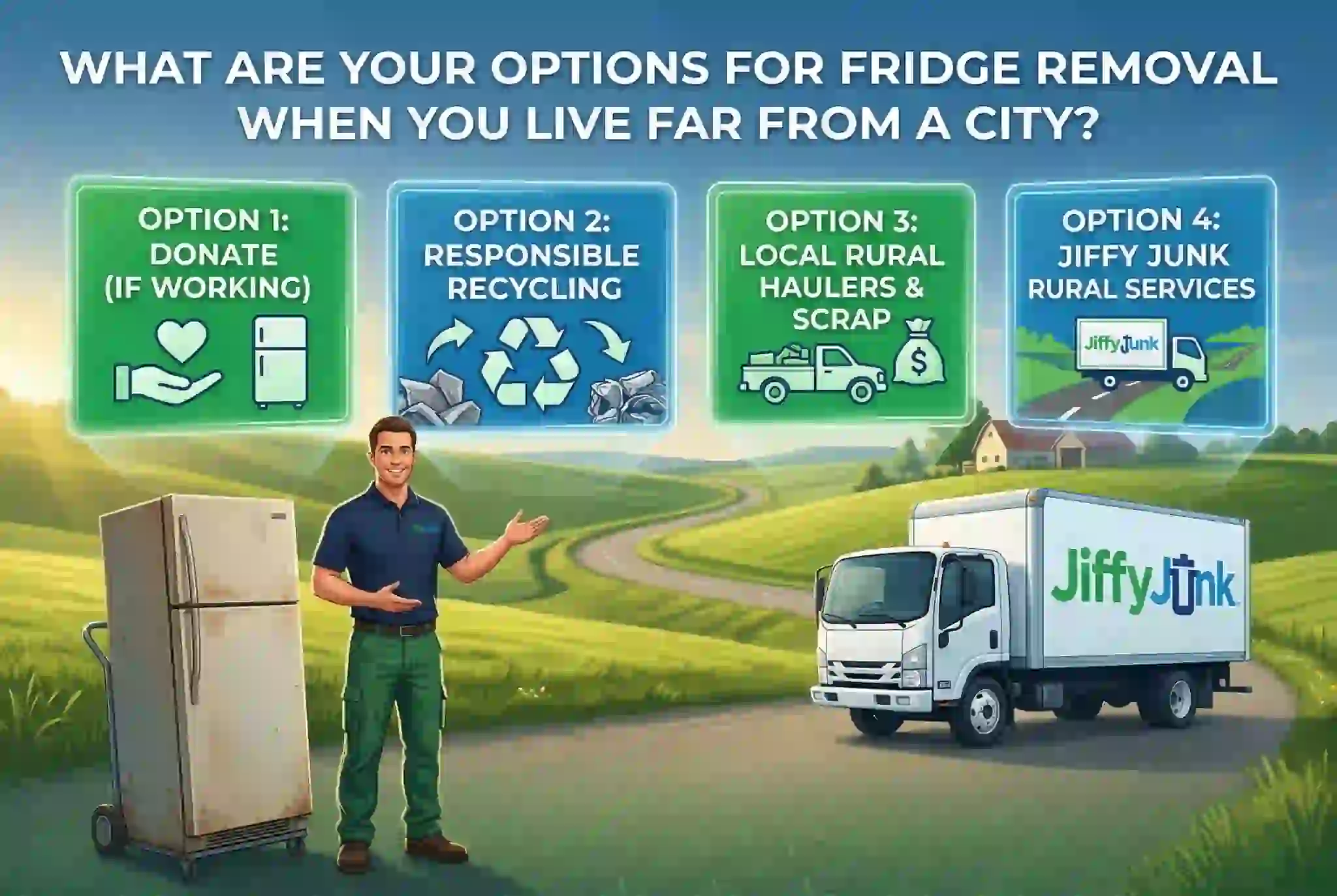
Retailer Haul-Away Programs
If you're buying a new refrigerator, this is the most overlooked rural option. Major retailers — including Home Depot, Lowe's, and Best Buy — offer haul-away of your old unit as part of appliance delivery. Coverage depends on the delivery contractor serving your area, but rural delivery zones are more common than most people assume. Confirm haul-away eligibility when you schedule delivery, and ask specifically whether your address qualifies.
Scrap Metal and Appliance Buyers
Working or not, a refrigerator has a recoverable metal value. Independent scrap buyers and appliance recyclers sometimes service rural routes, particularly if there's enough volume to justify the trip. Calling local salvage yards directly — rather than national aggregators — tends to surface options that don't show up in an online search. Some buyers will pick them up for free. Others pay a small amount depending on current metal prices.
Full-Service Junk Removal Companies
Companies like Jiffy Junk are equipped to handle rural and semi-rural appliance removals that standard services won't touch. That includes properties with limited driveway access, outbuildings, and locations that require additional travel. The advantage of a full-service team is that they handle disconnection, loading, and proper refrigerant disposal — no coordination required on your end. Service availability by zip code is worth confirming upfront, but coverage often reaches further than homeowners expect.
Manufacturer and Utility Takeback Programs
Several appliance manufacturers run recycling programs for old units. Separately, many electric utility companies operate refrigerator recycling initiatives — particularly for second units and chest freezers — as part of energy efficiency programs. These programs are underused in rural markets. Check your utility provider's website directly, as availability varies significantly by state and service territory.
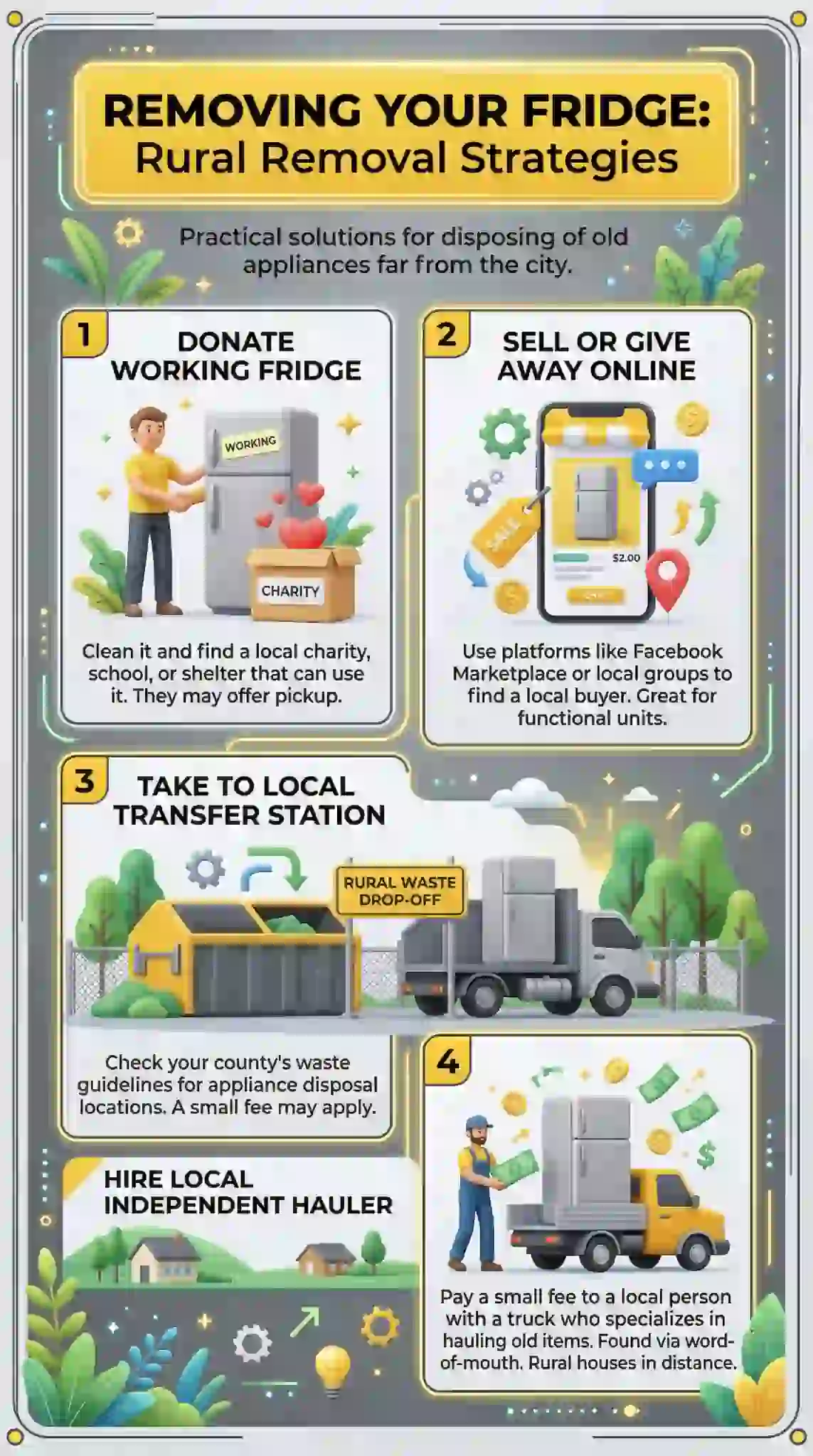
Local Charitable Organizations and Habitat for Humanity ReStores
If your refrigerator is still functional, donation is a legitimate removal path. Habitat for Humanity ReStore locations accept working appliances and sometimes offer pickup, though geographic coverage varies. Local community organizations, churches, and rural assistance nonprofits occasionally coordinate appliance pickups for households in need. A working fridge in good condition has real value to these organizations, and removal is often free.
County Hazardous Waste and Appliance Collection Events
Many rural counties run periodic collection events for large appliances and hazardous materials, including refrigerants. These events are infrequent — often once or twice a year — but they're free and compliant. Contact your county solid waste or public works office to find out when the next event is scheduled and whether refrigerators are accepted.
What to Do If Nothing Reaches Your Address
If standard options fall short, a combination approach often works. Renting a trailer and transporting the unit to the nearest certified appliance recycler is a reliable fallback. Refrigerants must be evacuated by a certified technician before the unit can be legally scrapped in most states — a step that's worth confirming before transport. Local HVAC and appliance repair shops sometimes offer this service and can point you toward the nearest compliant disposal facility.
"Rural appliance removal exposes a gap that most hauling services don't advertise — they'll take your booking, then cancel when they realize how far out you actually are. We've recovered refrigerators from properties with unpaved driveways, no cell service, and the nearest neighbor a mile down the road. The job isn't harder because of the distance. It's harder because most companies aren't set up for it. We are. Proper refrigerant handling, loaded and cleared in a single visit — that's the standard every rural homeowner deserves, regardless of their zip code."
Essential Resources
We've handled enough refrigerator removals to know where homeowners lose time: not in the hauling, but in the research. The resources below are the ones that actually matter — regulatory guidance, recycling locators, and donation options that cut through the noise and tell you what you need to do next.
EPA Appliance Disposal — Consumer Guidance Before anything gets moved, refrigerant has to be handled correctly. This is the EPA's plain-language breakdown of what the law requires, who's responsible at each stage, and what happens if disposal isn't done right. Read this first. https://www.epa.gov/section608/appliance-disposal
EPA Safe Disposal Requirements for Stationary Refrigeration The regulatory backbone behind every compliant fridge removal. Covers 40 CFR Part 82, technician certification requirements, and the legal chain of responsibility from your property to the final disposal point. https://www.epa.gov/section608/stationary-refrigeration-safe-disposal-requirements
ENERGY STAR — Find a Fridge or Freezer Recycling Program The most practical starting point for locating retailer haul-away partnerships and utility recycling programs by region. Some programs pay you to take the unit. Enter your zip code and see what's actually available in your area before making any calls. https://www.energystar.gov/products/recycle/find_fridge_freezer_recycling_program
Habitat for Humanity ReStore — Donate Goods If your fridge still runs, this is where it belongs. Most ReStore locations offer free large-item pickup, donations are tax-deductible, and the unit goes to someone who needs it rather than a landfill. A working fridge has real value — don't let it go to waste. https://www.habitat.org/restores/donate-goods
Habitat for Humanity — Does ReStore Offer Appliance Pickup? The direct answer on appliance pickup availability, with a zip-code locator to confirm coverage before you schedule anything. Rural homeowners should verify reach before assuming the nearest location won't come to them — many will. https://www.habitat.org/stories/does-habitat-offer-furniture-donation-pickup
ENERGY STAR — Recycle Other Appliances Goes beyond the standard retailer route. Covers utility-sponsored events, state-run turn-in programs, and contractor-based haul-away options — all relevant if your address sits outside typical service zones. https://www.energystar.gov/products/recycle/recycle_other_appliances
EPA — Prohibition on Venting Refrigerants This one matters whether you're moving the unit yourself or hiring someone to do it. Venting refrigerant is illegal, and the consequences are real. Know the rules before anything gets disconnected, loaded, or transported. https://www.epa.gov/section608/stationary-refrigeration-prohibition-venting-refrigerants
Supporting Statistics
The numbers behind fridge disposal tell a story most homeowners never hear — and the ones living furthest from city service zones are the least likely to know what those numbers mean for them personally.
11–13 Million Refrigerators Reach End-of-Life in the U.S. Every Year
An estimated 11 to 13 million refrigerated household appliances reach end-of-life in the United States annually. US EPA Here's what that volume looks like from the field:
Units left on rural properties for months with no compliant removal plan
Refrigerant vented improperly by haulers who don't know — or don't follow — federal law
Bookings accepted and abandoned when a hauler realizes the address is 40 miles off their route
Federal law requires refrigerant recovery before any refrigerator changes hands for disposal. Distance doesn't exempt anyone from that requirement. Neither does a county that doesn't offer pickup.
Source: U.S. Environmental Protection Agency — Appliance Disposal https://www.epa.gov/section608/appliance-disposal
9 Million Appliances Processed — But Rural Properties Still Fall Through the Gaps
Between 2006 and 2025, EPA's Responsible Appliance Disposal Program made measurable progress:
Over 9 million refrigerated appliances processed through verified recycling channels US EPA
1.5 billion pounds of metals, plastics, and durable materials diverted from landfills US EPA
Emissions avoided equivalent to powering 5 million homes annually US EPA
The infrastructure for responsible disposal exists. It just doesn't distribute itself evenly. Rural addresses are underserved by design — not by accident. That's the gap a qualified full-service removal team fills.
Source: U.S. Environmental Protection Agency — Appliance Disposal https://www.epa.gov/section608/appliance-disposal
Old Refrigerators Cost More Than Most Rural Homeowners Realize
On average, an old refrigerator uses about 20% more energy than a current ENERGY STAR certified model. Properly recycling an old unit and replacing it with a certified model can save approximately $150 over the 12-year lifetime of the product. ENERGY STAR On rural properties, that number compounds fast:
Secondary units running in detached garages or outbuildings are common
Multiple older units on a single property quietly drain energy year-round
Most haven't been evaluated — or scheduled for removal — in years
Getting those units out isn't just a logistical task. It's a straightforward financial decision with a return that starts the day the property is cleared.
Source: U.S. Environmental Protection Agency / ENERGY STAR — Refrigerators https://www.energystar.gov/products/refrigerators
Final Thoughts
Rural fridge removal gets ignored because the people dealing with it are spread out, not concentrated in markets that service providers prioritize. We've cleared refrigerators from properties an hour from the nearest city, on unpaved driveways, after a previous hauler already cancelled twice. That experience shapes everything below.
What years of rural appliance removals has taught us:
The coverage gap is real, but it's not permanent. Most rural homeowners assume nothing reaches their address. Full-service haulers with proper equipment extend further than most people expect. The first call is almost always worth making.
Compliance isn't optional regardless of location. Federal refrigerant recovery requirements apply whether you're in a metro area or a county with no municipal pickup. Venting refrigerant is illegal. An uncertified hauler creates liability for the property owner — not just the hauler.
A working fridge has more options than a dead one. Retailer haul-away, donation pickup, and utility recycling programs all favor units that still run. Move quickly — those doors close the moment the unit stops working.
The combination approach is underused. When one removal pathway doesn't reach a rural address, two often do. A scrap buyer who covers transport paired with a certified technician handling refrigerant evacuation is a solution most homeowners never consider.
The bottom line:
An old refrigerator on a rural property isn't just an eyesore. It's three problems in one:
A compliance exposure under federal refrigerant law
An energy drain if the unit is still running
A logistics problem that gets harder the longer it sits
Every rural removal we've handled started with a homeowner who assumed nobody would come out — a concern often shared in private home care situations where reliability matters most. Most of the time, we did.
FAQ on Fridge Pick Up, Removal, Haul Away, and Disposal
Q: Can someone pick up my old refrigerator if I live far outside city limits?
A: In most cases, yes. Rural homeowners are regularly surprised by how far compliant removal services reach. Options that extend beyond urban service zones include:
Full-service junk removal companies equipped for rural access
Scrap metal buyers who service outlying routes
Retailer haul-away programs tied to new appliance delivery
Utility-sponsored recycling initiatives by region
We've handled pickups on unpaved roads, remote acreage, and properties an hour from the nearest service hub. Make the call before assuming nobody comes out. You'll be right more often than not.
Q: Do I need to do anything to my refrigerator before it gets picked up?
A: One requirement cannot be skipped: refrigerant recovery. Federal law mandates it before any unit is moved for disposal. Key facts:
Required under Section 608 of the Clean Air Act
Applies to all units — working, non-working, and rural addresses alike
Must be performed using EPA-certified equipment
Skipping this step leaves compliance liability with the property owner
A qualified full-service team handles refrigerant recovery as part of the pickup. If coordinating independently, confirm certified evacuation happens before anything is loaded or transported.
Q: Will anyone pick up a refrigerator that no longer works?
A: Yes. A non-working refrigerator still has recoverable scrap value. Removal options by unit condition:
Working unit: Donation programs, utility recycling, retailer haul-away, full-service removal, scrap buyers
Non-working unit: Full-service removal companies, certified appliance recyclers, scrap metal buyers
Non-working doesn't mean unremovable. It narrows the field — it doesn't close it. Refrigerants must still be recovered regardless of whether the unit operates.
Q: Is there any way to get paid to have my old refrigerator removed?
A: Yes — in some cases. Payment options worth checking before scheduling removal:
Scrap metal buyers — may pay depending on current metal prices and route viability
Utility recycling programs — some offer cash incentives or bill credits for working units
ENERGY STAR recycling locator — fastest way to find paid or rebate programs by zip code
These programs are significantly underused in rural markets. A working fridge in good condition has real value. Know what it's worth before giving it away for nothing.
Q: How much does professional fridge removal and haul away typically cost?
A: Cost depends on several factors:
Unit condition and size
Property access — unpaved roads, outbuildings, limited clearance
Distance from standard service routes
Whether refrigerant recovery and disposal are included
What to ask for upfront:
An all-in quote covering disconnection, loading, refrigerant recovery, transport, and compliant disposal
Confirmation that no additional charges apply after the truck arrives
Verification that the hauler uses EPA-certified refrigerant recovery equipment
Jiffy Junk prices rural removals with all of the above included in a single visit — no separate coordination, no surprise add-ons. In some cases, donation pickup and retailer haul-away cover the cost entirely. Provide your address and unit details for an accurate quote.