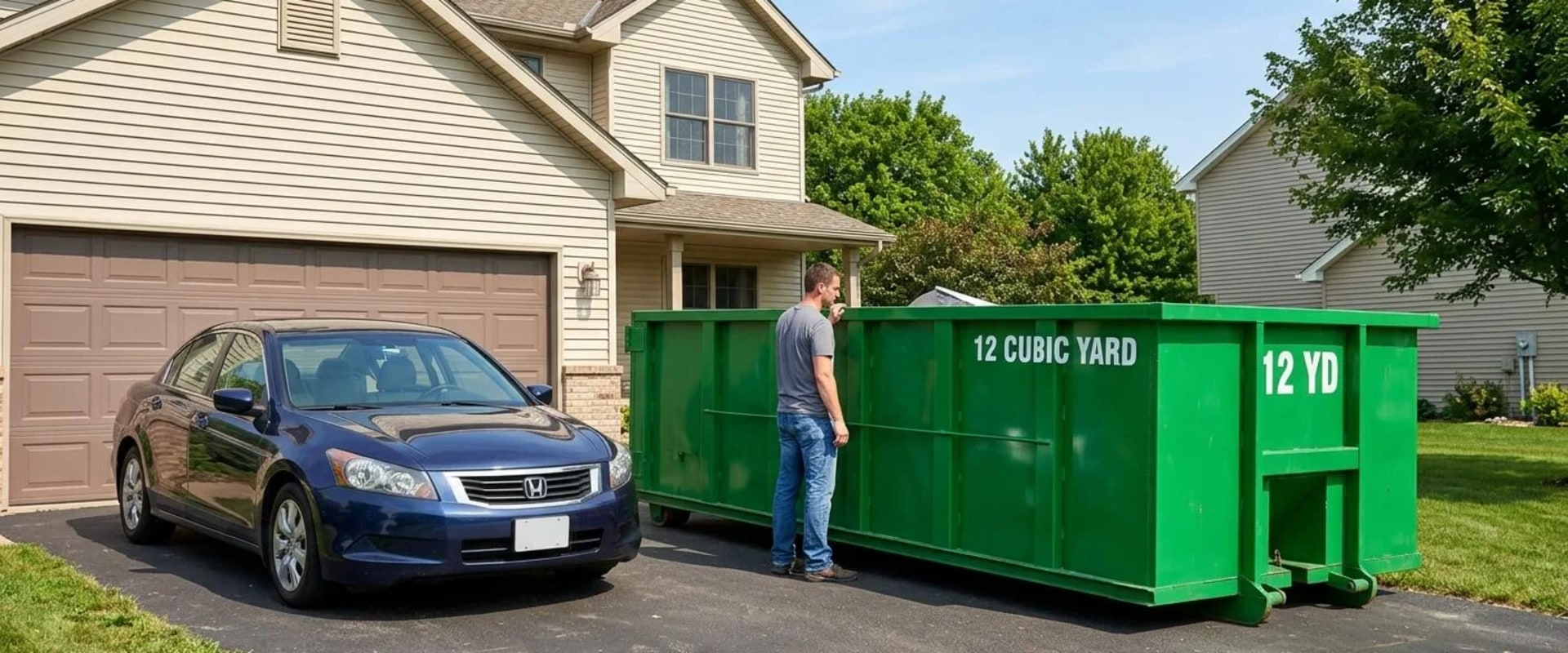
We get asked about the 12 yard dumpster size more than any other residential container. Homeowners underestimate its capacity nearly every time. It fits in a standard driveway without a permit conversation, holds the debris from most single-room renovations, and runs roughly half the cost of a full demo container. Before you book one, you should know which renovations it absorbs without trouble and which will leave you scrambling for a swap halfway through. The 12 yard dumpster itself is a mid-sized roll-off dumpster, about 14 feet long, 7.5 feet wide, and 4 feet tall, sized for the middle of the residential renovation range.
TL;DR Quick Answers
12 yard dumpster size
A 12 yard dumpster measures about 14 feet long, 7.5 feet wide, and 4 feet tall, roughly the footprint of a single parking space. The interior holds 4 to 5 pickup truck loads of debris, with a typical weight allowance of 2 to 4 tons.
Best for: single-room renovations, garage cleanouts, finished-basement teardowns, and small demo work
Skip if: the project crosses room boundaries or involves heavy materials like concrete or roofing shingles
Driveway fit: clears most residential driveways without a permit when placed entirely on private property
Watch the weight, not just the volume: dense materials hit the 2-to-4-ton cap before they fill the box
Top Takeaways
Size at a glance: A 12 yard dumpster measures about 14 ft × 7.5 ft × 4 ft, roughly the footprint of a single parking space, and holds 4 to 5 pickup truck loads.
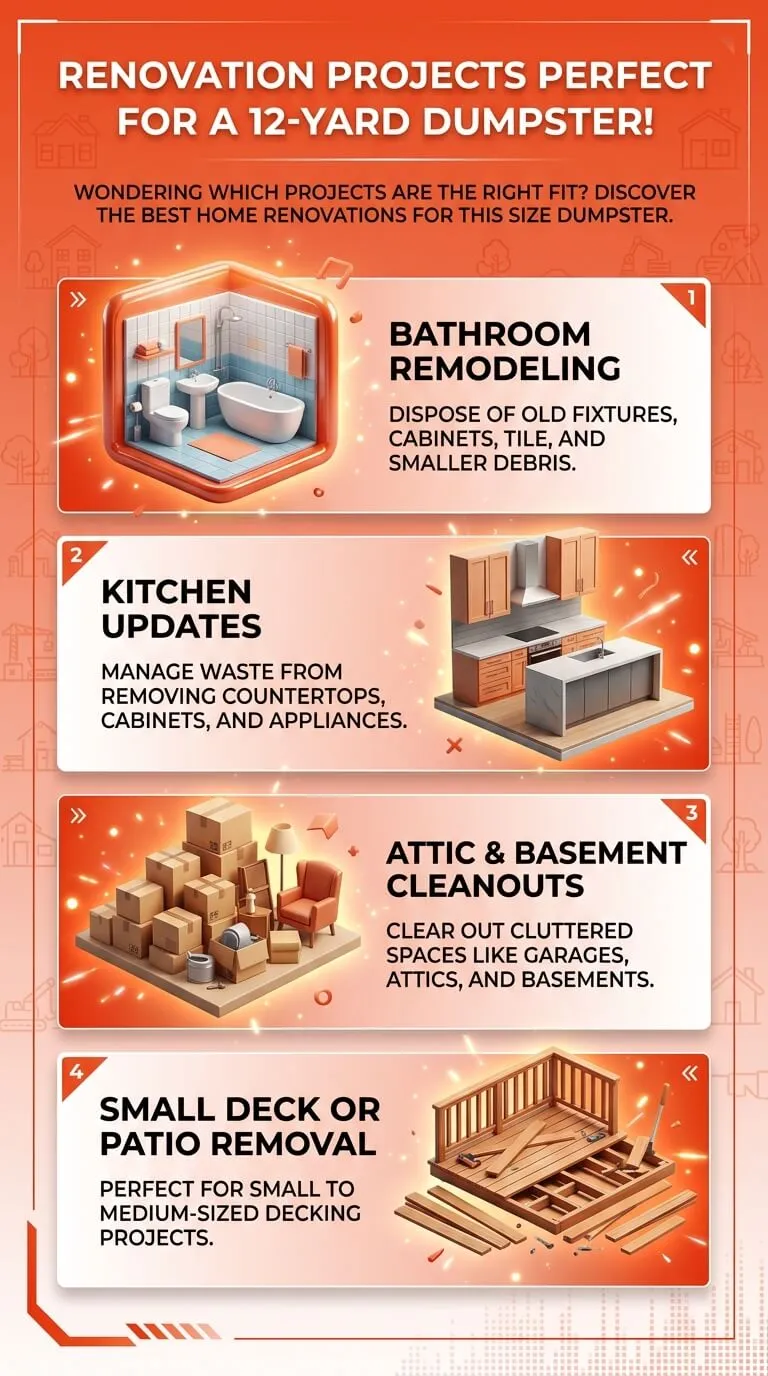
Best-fit projects: Single-bathroom remodels, single-room flooring jobs, garage cleanouts, finished-basement teardowns, cabinet swaps, small deck or shed demos, and moderate landscaping.
Size up when: The project crosses room boundaries, includes structural work, or involves heavy materials like roofing shingles, concrete, or significant soil.
Weight matters as much as volume: Most 12-yarders carry a 2- to 4-ton rating. Tile, concrete, and dense debris hit the weight cap before they fill the container.
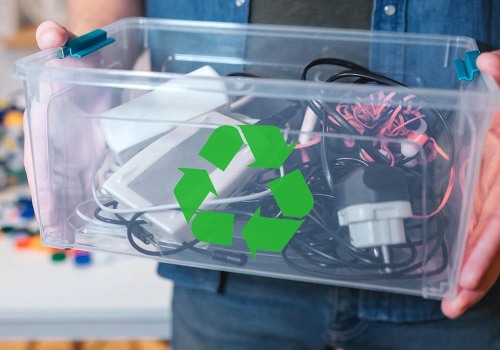
Plan prohibited items separately: Paints, oils, batteries, propane tanks, mattresses, and electronics fall outside what most rentals accept. Line up disposal channels before the container arrives.
Book ahead: Renovation spending is at record levels, and container availability tightens during peak season. Two to three weeks of lead time is the new minimum.
What a 12 Yard Dumpster Actually Holds
Picture a single parking space. That's the footprint of a 12 yard dumpster. The interior holds roughly four to five full pickup truck loads of debris. The 4-foot sidewall is the detail most rental sites skip past, and it's the one that matters most on a heavy-load day. You can throw tile, drywall, or cabinet pieces over the edge without a ramp or a ladder, which makes a real difference on tight project timelines.
For exact weight allowances, regional rental cost, and a side-by-side breakdown against other container sizes, this full 12 yard dumpster size and dimensions guide covers the technical specs. The piece you're reading focuses on the question specs guides usually skip: matching the container to the actual scope of work.
The 7 Renovation Projects That Fit a 12 Yard Dumpster Best
Seven renovation categories reliably fit a 12 yard dumpster, in our experience. Every one assumes the homeowner has been honest about scope from the start.
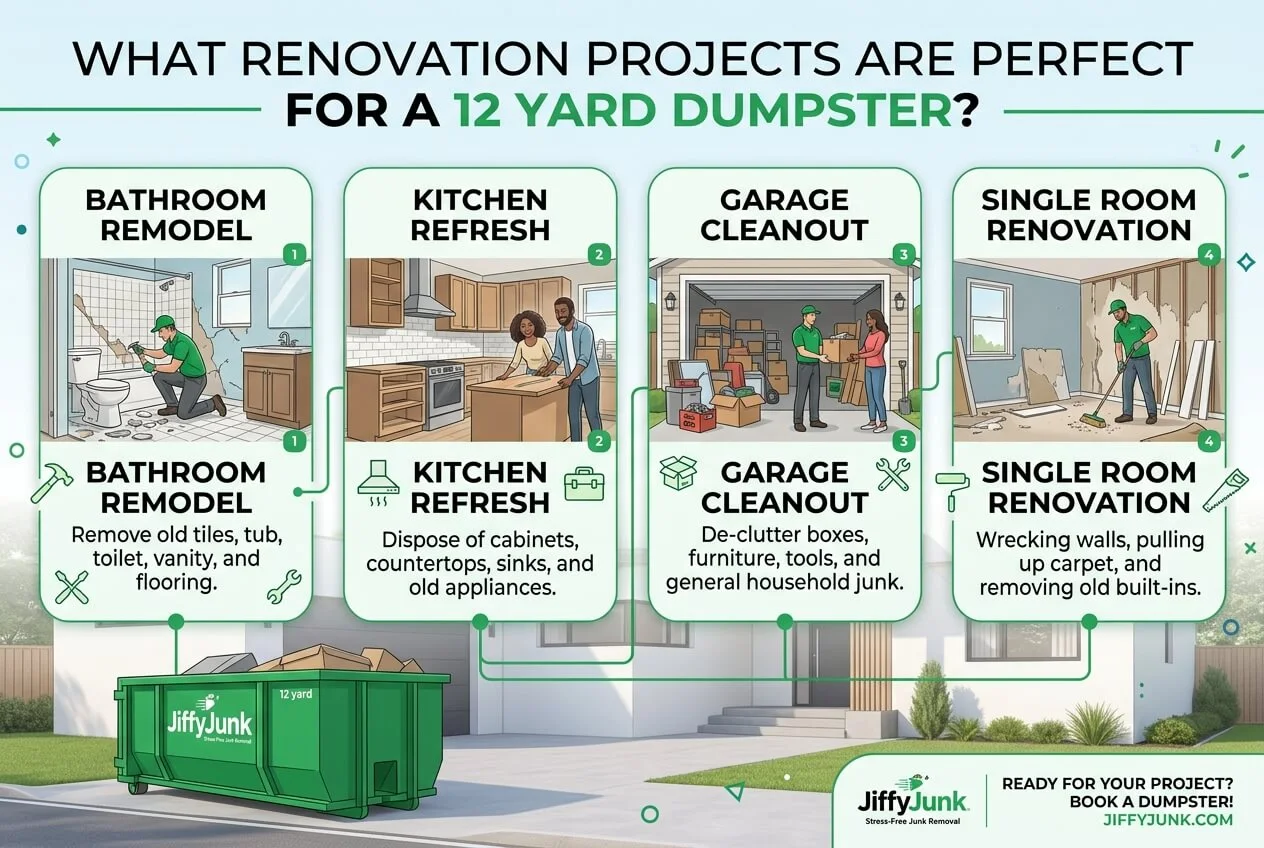
1. Single-Bathroom Remodel. A standard 5-by-8-foot bathroom gut produces around 8 to 10 cubic yards of debris — drywall, old tile, the vanity, the tub, fixtures, and the flooring underneath. The 12-yarder absorbs that with margin, and the typical rental window matches a 5- to 7-day bathroom timeline. Watch the weight if you're pulling out heavy ceramic tiles. Dense materials hit weight limits before they fill volume.
2. Single-Room Flooring Replacement. Tearing out 200 to 400 square feet of carpet, hardwood, or tile across a single room, including underlayment and tack strips, usually lands at 7 to 9 cubic yards. One detail that's saved several of our clients a driveway repair bill: lay a sheet of plywood under the dumpster on asphalt during summer months. Hot tar marks. The marks won't buff out.
3. Garage Cleanout. A two-car garage stripped to the walls fits comfortably with room to spare. Boxes, broken furniture, lawn equipment, old scrap wood — all standard for this container size. The trap is prohibited. Paint cans, used motor oil, propane tanks, and lead-acid batteries aren't allowed in standard rentals, and most homeowners discover at least three of them once they actually start digging through the back corner.
4. Basement Decluttering or Finished-Basement Teardown. For finished basements up to about 600 square feet, a 12-yarder handles old carpet, drop ceiling tiles, drywall, and water-damaged framing without issue. The exception is anything mold-related. Mold-contaminated materials require specialized disposal and shouldn't go in a standard dumpster. If you suspect mold, get an assessment before you book.
5. Cabinet and Countertop Swap (No Structural Work). Pulling out kitchen cabinets, countertops, backsplash, and old appliances fits a 12-yarder when the project stops there. The moment you add flooring removal or wall reconfiguration, you're pushing the upper limit and should size up to a 15- or 20-yard container.
6. Small Deck or Shed Demolition. A 10-by-12 deck or 8-by-10 shed teardown typically produces 6 to 9 cubic yards of pressure-treated lumber, roofing material, and concrete footings. Pressure-treated wood disposal rules vary widely by municipality. Some areas require haulers to separate it from general construction debris, so confirm before loading.
7. Moderate Landscaping Overhaul. Shrub removal, sod tear-out, and brush clearing fit well by volume, but they introduce the soil trap. Soil and dirt are heavier than they look. A dumpster only half-filled with topsoil can hit the 2-ton weight allowance on its own. If your project includes serious earth removal, talk to your provider about a separate dirt-only haul.
When 12 Yards Is Not Enough
The clearest signal you should size up: the project crosses room boundaries, especially when comparing 15 yard roll off dumpster rental prices against the cost of needing a second container later. A single-room gut fits a 12-yarder almost every time. A two-room renovation, a full kitchen with flooring, a roof tear-off, or anything involving structural demolition will overflow it. An empty dumpster costs the same to haul as a full one, but ordering a second container halfway through doubles your hauling expense and adds a delivery delay you didn't budget for.
10 yard: Small bathroom, single-room cleanout. Skip if the project includes flooring plus fixtures.
12 yard: Single-room renovations, garage cleanouts, small demo. Skip if the project is multi-room or involves structural work.
15 yard: Kitchen remodel with flooring, large deck demolition. Skip for whole-house renovations.
20 yard: Multi-room renovations, roof tear-off, mid-size demo. Skip if the driveway is tight.
30 yard: Whole-house renovation, new construction debris. Skip if there is no truck access to the site.
"Across the renovations we've worked on, homeowners who get sizing right have one trait in common: they describe the project honestly to the provider before a truck is dispatched. The 12 yard dumpster gets underestimated more than any other residential container because the number sounds smaller than the actual capacity feels. Most single-room remodels fit it with margin. The homeowners who book it and then unnecessarily upgrade to a 20-yarder usually do so from caution, not need. The opposite mistake, booking a 12-yarder when the job clearly calls for a 15 or 20, is less common but more expensive when it happens. Either way, the fix is the same conversation: walk the project room by room, list materials by weight class, and let the provider size from there."
7 Essential Resources
Smooth renovations have one trait in common: the homeowner did the disposal and compliance homework before the dumpster showed up. The seven resources below cover the territory most homeowners miss, from hazardous waste rules to donation channels that keep usable materials out of the landfill.
1. EPA — Sustainable Management of Construction & Demolition Materials
The federal clearinghouse on handling construction and demolition debris responsibly. The EPA's guidance covers source reduction, salvage, recycling, and rebuying. Worth reading before you book any container, since it shapes what does and doesn't belong inside. epa.gov/smm/sustainable-management-construction-and-demolition-materials
2. EPA — Household Hazardous Waste and Demolition
The single most-overlooked compliance issue on residential renovations. Paints, solvents, batteries, pesticides, and certain cleaners can't go in a standard dumpster. The EPA's page explains how to identify and route them. Worth reading before any garage or basement cleanout. epa.gov/large-scale-residential-demolition/household-hazardous-waste-and-demolition
3. EPA — Lead Renovation, Repair and Painting (RRP) Program
If your home was built before 1978, federal law requires a lead-safe certified contractor to handle any renovation that disturbs painted surfaces. This rule catches more homeowners off guard than any other compliance requirement we run into. The EPA's RRP page covers the rule, the contractor lookup tool, and the homeowner exemptions. epa.gov/lead/lead-renovation-repair-and-painting-program
4. Habitat for Humanity ReStores
Before you toss usable cabinets, fixtures, doors, or appliances, check whether your local Habitat for Humanity ReStore will pick them up. Donations support affordable housing in your community, may qualify for a tax deduction, and keep reusable materials out of the landfill. Most ReStores offer free pickup for large items. habitat.org/restores/donate-goods
5. Earth911 Recycling Center Search
Earth911 maintains one of the largest recycling databases in North America, with over 350 materials and 100,000-plus listings. Enter the material and your zip code, and it returns local recycling and disposal options. The tool is most useful for the items that can't go in a standard dumpster. search.earth911.com
6. EPA — Construction & Demolition Debris Material-Specific Data
The data backbone behind almost every credible article on construction waste. The EPA tracks generation, recycling, and landfill destinations for every major C&D material category. If you want to understand the disposal pathway for a specific material, this is the source. epa.gov/facts-and-figures-about-materials-waste-and-recycling/construction-and-demolition-debris-material
7. Harvard Joint Center for Housing Studies — LIRA
The Leading Indicator of Remodeling Activity from Harvard's Joint Center for Housing Studies tracks where the residential renovation market is headed each quarter. Useful context if you're weighing whether to renovate now or wait, and a credibility benchmark for any contractor or hauler quoting you against "market trends." jchs.harvard.edu/research-areas/remodeling/lira
3 Statistics
The data behind the renovation waste stream rarely shows up in homeowner planning conversations, which is exactly the problem. The three figures below explain why container sizing matters more than it looks, and why responsible disposal earns the extra five minutes of planning.
1. 600 Million Tons of C&D Debris Generated Annually
The EPA estimated that the United States generated 600 million tons of construction and demolition debris in 2018, more than double the volume of municipal solid waste from the same year. That number puts residential renovation waste in perspective. A single bathroom remodel feels small until you scale it across millions of homes a year, at which point C&D becomes the largest waste stream in the country. Source: U.S. EPA — Construction and Demolition Debris Material-Specific Data. URL: epa.gov/facts-and-figures-about-materials-waste-and-recycling/construction-and-demolition-debris-material
2. 76% of C&D Materials Are Recovered for Next Use
Of the 600 million tons of C&D debris from 2018, roughly 455 million tons went to recycling, manufacturing, or aggregate use, while around 145 million tons went to landfills. That's a 76 percent recovery rate. The implication for a single renovation: roughly three-quarters of what comes out of your project doesn't have to end up buried, as long as your hauler sorts and routes it correctly. Source: U.S. EPA — Sustainable Management of Construction and Demolition Materials. URL: epa.gov/smm/sustainable-management-construction-and-demolition-materials
3. $526 Billion Projected in U.S. Home Renovation Spending by Q1 2026
Harvard's Joint Center for Housing Studies projects that annual spending on improvements and maintenance to owner-occupied homes will reach a record $526 billion by the first quarter of 2026, a 2.5 percent year-over-year increase, showing how private home care is becoming a smarter, more proactive priority for homeowners who want safer, cleaner, and better-maintained living spaces. The takeaway for homeowners: renovation activity is rising, and dumpster availability tightens with it. Booking your container two to three weeks ahead during peak season isn't optional anymore. Source: Joint Center for Housing Studies of Harvard University — LIRA, October 2025 release. URL: jchs.harvard.edu/press-releases/continued-gains-projected-remodeling-amid-economic-uncertainty
Final Thoughts and Opinion
The single piece of advice that's saved our clients the most money on renovation hauling: when in doubt about size, go up one tier. A 12 yard dumpster you barely use still costs less than two 10-yarders. A 20 yard dumpster you fill comfortably costs less than a 12 yard plus a mid-project swap-out. The 12 yard dumpster size is the right answer for most single-room renovations, focused cleanouts, and small demolitions. It's the wrong answer for anything spanning more than one space or involving structural work.
Understanding dumpster rental prices starts with working through the actual materials and their weights so you can choose the right size with confidence and avoid surprise costs. Visual size estimates mislead almost everyone. Tile, concrete, and roofing shingles max out the weight before they fill the box. Drywall, cabinetry, and carpet fill the box long before reaching the weight cap. The difference between these two failure modes helps turn a rental into a smoother, more cost-effective, one-and-done cleanup instead of a mid-project swap.
Frequently Asked Questions
How big is a 12 yard dumpster in feet?
A 12 yard dumpster measures about 14 feet long, 7.5 feet wide, and 4 feet tall. The footprint matches a single standard parking space, which is why it fits in nearly every residential driveway without a permit conversation. The 4-foot sidewall sits lower than taller containers, making loading easier for most homeowners.
How much does a 12 yard dumpster hold?
A 12 yard dumpster holds roughly 4 to 5 full pickup truck loads of debris. That works for a single-room renovation or a moderate cleanout. Weight allowances typically run 2 to 4 tons depending on the provider, and with dense materials like tile or concrete, you'll hit the weight cap before the volume cap.
Can I fit a kitchen renovation in a 12 yard dumpster?
A cabinet-and-countertop swap with old appliances fits a 12-yarder. A full kitchen renovation that includes flooring removal, drywall work, or structural reconfiguration usually doesn't. That scope calls for a 15 or 20 yard container. The dividing line is whether you're stopping at the surfaces or going deeper into the room.
How does a 12 yard dumpster compare to a 15 or 20 yard?
A 12 yard dumpster fits single-room renovations and moderate cleanouts. A 15-yarder handles full kitchen remodels and larger demolition projects. A 20-yarder works for multi-room renovations, roof tear-offs, and mid-scale demolition. The footprint difference matters in real terms. A 20-yarder needs more driveway clearance and won't fit a tight residential lot.
What can't go in a 12 yard dumpster?
Standard rental agreements exclude paints and solvents, motor oil, batteries, propane and oxygen tanks, tires, mattresses in most markets, electronics including TVs and computers, large appliances containing refrigerants, and anything classified as hazardous household waste. Mold-contaminated materials and asbestos require specialized disposal and never belong in a general-purpose container.
Do I need a permit for a 12 yard dumpster?
Permit requirements come down to placement, not container size. A dumpster that stays entirely on private property, typically your driveway, usually doesn't need a permit. Any portion sitting on a street, sidewalk, or alley almost always triggers one. Some HOAs add their own restrictions, so confirm before delivery.
Next Step
Planning a renovation in the next 30 to 90 days? Walk the project once with the disposal end in mind before you book a container. List every material category coming out, estimate the weights honestly, and check the resources above for anything that needs to route separately. Homeowners who get sizing right the first time treat hauling as part of the project plan from the start.
For more renovation planning guides, contractor selection tips, and project-specific resources from our editorial team, explore the rest of our home services library. You can also reach out to a licensed local renovation specialist to walk through your project scope.