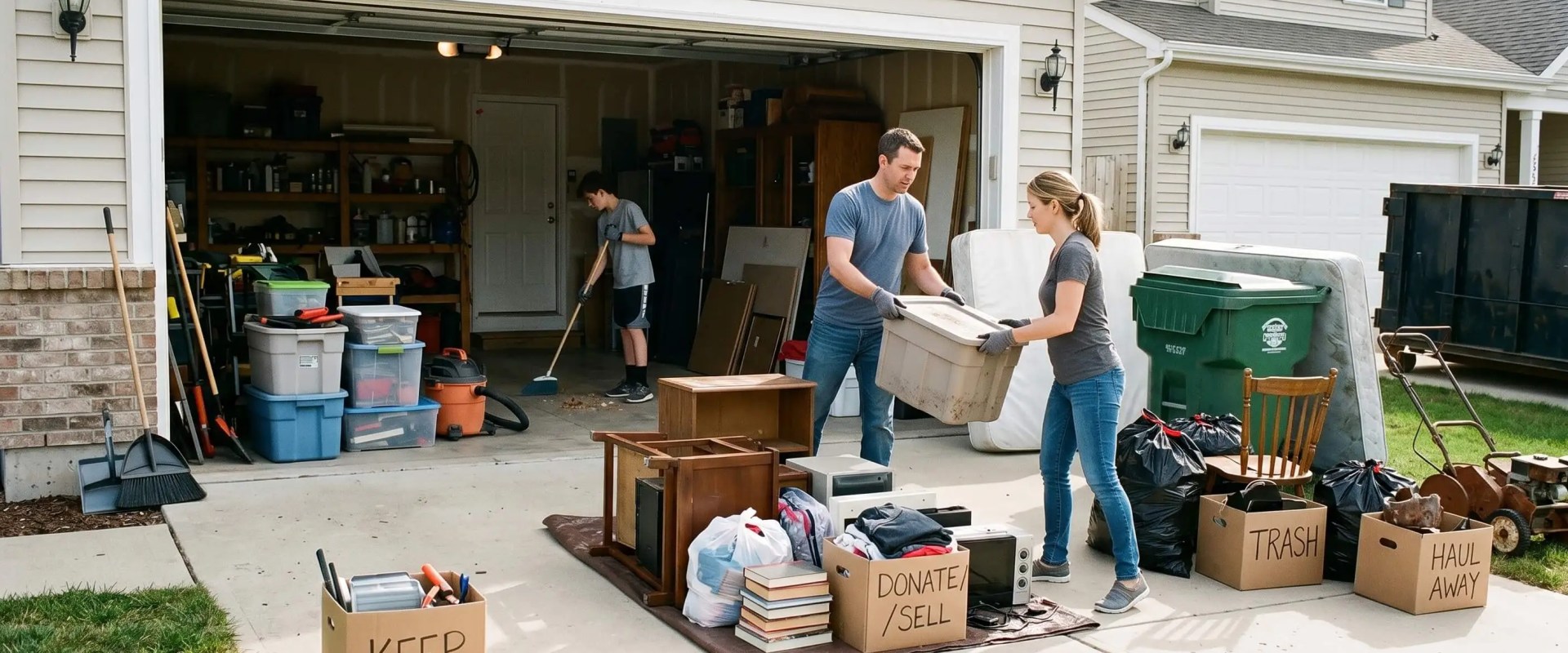
TL;DR Quick Answers
garage cleanout services cost
Most professional garage cleanouts cost $200 to $800. The average two-car job lands at $400 to $600. Garages used as long-term storage typically run higher, $500 to $900, because density rather than square footage is what professional haulers actually price.
What raises the final number:
Volume of items (priced by truck space, not floor area)
Special-disposal items: refrigerators, electronics, tires, mattresses
Hazardous materials (paint, propane, automotive fluids), which most crews won't haul at all
Site access factors like stairs, long carries, or detached garages
Peak-season demand in spring, which can raise rates 10 to 20 percent
Typical service time: 1 to 3 hours for standard cleanouts, and 3 to 5 hours for packed storage-style spaces.
Most useful tip: Photograph the garage and send images for a written quote. Phone-only estimates almost always get revised upward on arrival.
Top Takeaways
Most cleanouts of long-term storage garages cost $500 to $900. Heavily packed jobs reach $1,000 to $1,500.
Density drives price more than square footage. A packed two-car garage costs more than a sparse three-car garage.
Four cost levers move the price: volume, item type, labor intensity, geography and season.
Hazardous items aren't included in standard pricing and require separate handling through municipal programs.
Photo-based quotes prove 20 to 30 percent more accurate than phone-only estimates.
DIY makes sense for a single pickup load of light, non-hazardous items. For multi-load storage cleanouts, professional garage hauling services almost always win on cost-of-time.
Spring is the peak season. Late summer and fall offer the cheapest scheduling windows.
Up to 70 percent of typical garage contents can get diverted from landfill through donation and recycling.
How Much Does It Cost to Clean Out a Garage Used as a Long-Term Storage Unit?
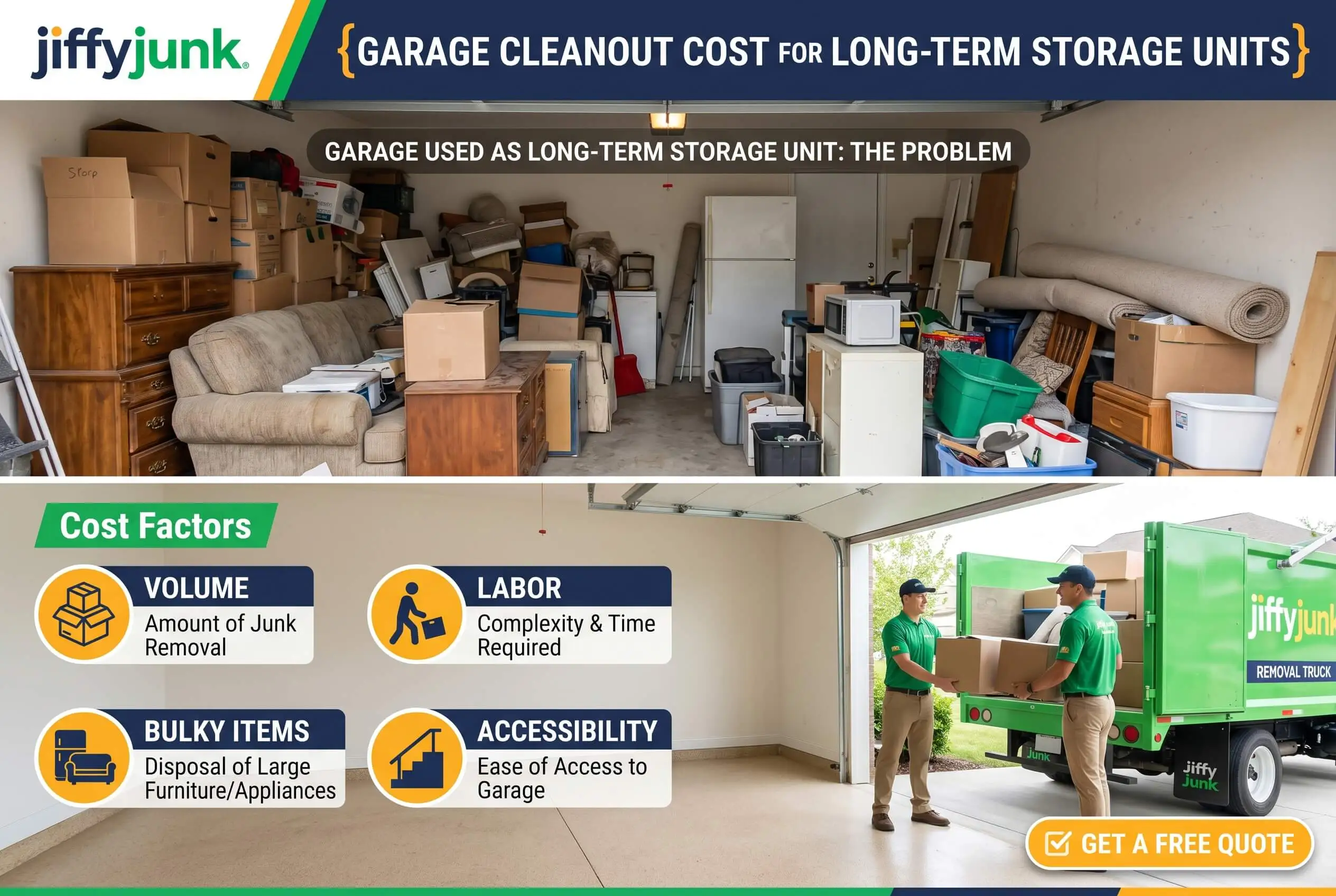
Most professional cleanouts of long-term storage garages run $500 to $900. The standard industry range sits at $200 to $800, but storage-style spaces land in the upper half because providers price by volume, not floor area.
Square footage is what most homeowners think they're paying for. They're not. The bill reflects truck volume, sorting time, and the disposal fees attached to the contents, which can be especially important when a cleanout supports private home care needs by making the space safer and easier to navigate. A two-car garage packed floor-to-ceiling with cardboard boxes contains far more cubic feet of material than a two-car garage with a workbench, a riding mower, and some lawn tools, even though both have identical floor plans.
Cost Breakdown by Garage Type
Single-car, light storage: 1/4 truck of volume, $200–$400, 1–2 hours of service time.
Single-car, packed long-term: 1/2 truck of volume, $400–$650, 2–3 hours.
Two-car, moderate storage: 1/2–3/4 truck of volume, $500–$800, 2–4 hours.
Two-car, packed long-term: full truck or more, $700–$1,100, 3–5 hours.
Three-car or detached, packed: 1.5–2 trucks of volume, $1,000–$1,500+, 4–6 hours.
These ranges reflect what professional garage hauling crews quote across U.S. metros. Your number will land somewhere in the band based on the four cost levers below.
What Drives Garage Cleanout Services Cost Up
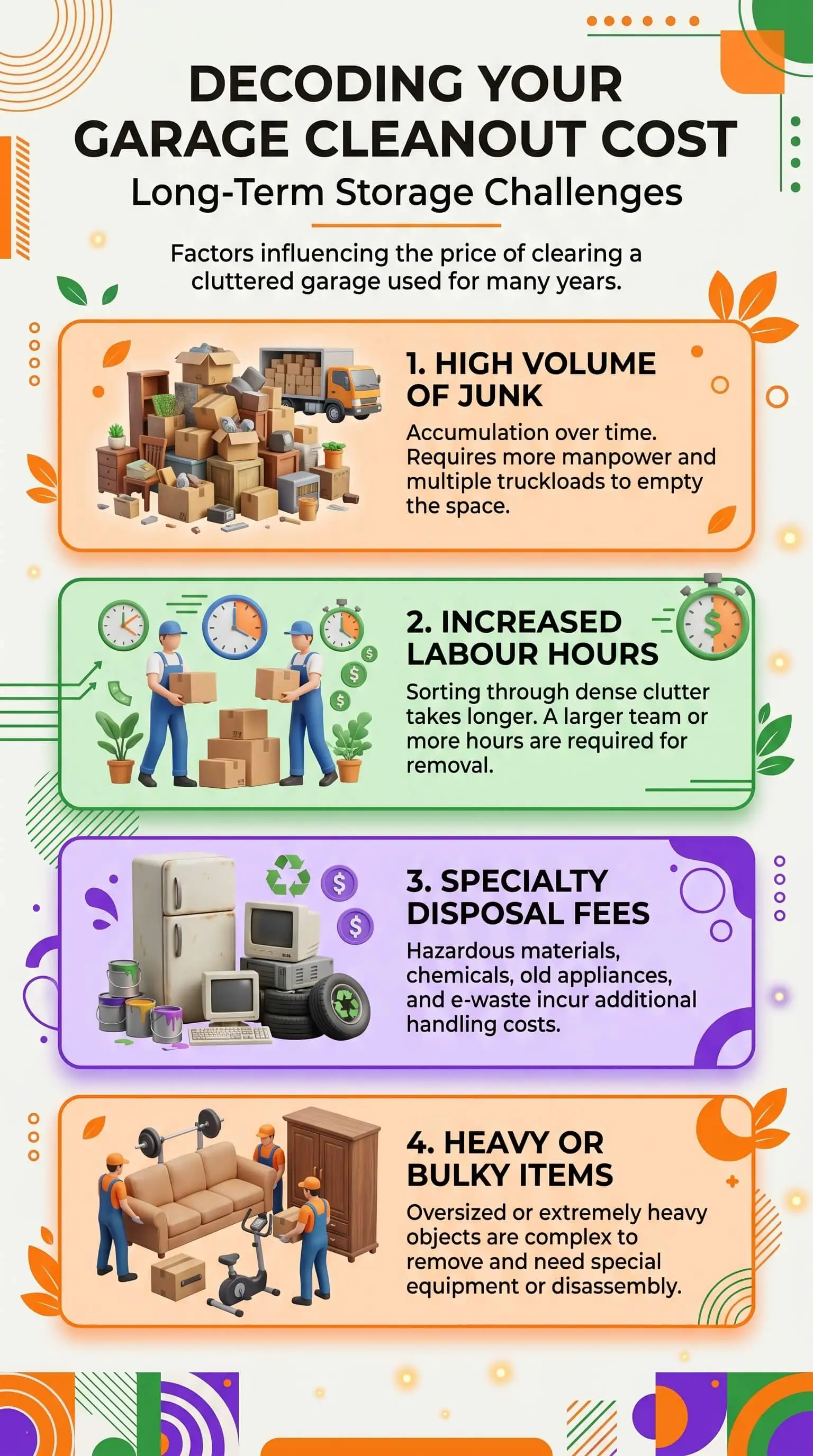
Four factors move the final price more than any others.
Volume and density. Most providers price by truck space: quarter, half, three-quarter, or full load. Long-term storage garages routinely require 1.5 to 2 times the truck space owners estimate. That "half-full" garage almost always becomes a full truckload once the crew pulls everything into the daylight.
Item type and special disposal. Refrigerators and freezers carry refrigerant recovery fees of $25 to $75 per unit. Old CRT TVs and monitors trigger e-waste surcharges. Most landfills refuse tires, so per-tire disposal fees apply. Mattresses carry disposal fees in many municipalities. Crews generally don't haul hazardous materials such as paint, solvents, propane cylinders, or automotive fluids at all, and these require separate handling through your local household hazardous waste program.
Labor intensity and site access. Stacked, layered storage takes excavation, not just removal. Long carry distances from the garage to the truck add labor hours. Stairs, sloped driveways, and detached garages reduce truck proximity. Heavy items like safes, gun cabinets, full workbenches, or exercise equipment can require larger crews or extra time.
Geography and season. Regional dump fees vary by 2 to 3 times across U.S. metros. Spring (March through May) is peak demand, and some providers raise rates 10 to 20 percent during this window. Late summer and fall offer the cheapest scheduling windows. For a deeper benchmark on national pricing tiers and what "white-glove" service actually includes, this professional garage cleanout services cost guide is a useful cross-reference.
Hidden Costs to Watch For
Editorial honesty matters here, because brand service pages won't always lay this out:
Hourly billing without a price cap. Jobs mysteriously expand.
"Disposal fees" the provider only discloses after loading begins.
Stair, distance, or access surcharges that appear on service day.
Overweight load fees on dumpster rentals.
Short-notice cancellation or rescheduling penalties.
Phone-only quotes that skip a photo review. The provider almost always raises them on arrival.
The single best protective question to ask any provider: "Is the price you quote the price I'll pay?" A trustworthy provider answers yes without hesitation.
How to Get an Accurate Garage Cleanout Estimate Before Booking
Photograph the garage from three or four angles before pulling anything out.
Walk through and note items requiring special disposal: appliances, paint, tires, propane.
Estimate truckload volume. A standard pickup truck load equals roughly a quarter of a hauling company's truck.
Ask the provider directly whether the quoted price is the final price.
Request the quote in writing and confirm what disposal fees are included.
Verify license and insurance. Ask for documentation.
Ask about donation and recycling practices to gauge how the provider handles diversion.
DIY vs. Hiring a Pro
DIY makes sense when you have a single pickup-truck load of light items, nothing requires special disposal, and you have a free weekend with truck access. For everything else, math usually favors hiring help. A typical DIY cleanout runs $50 to $150 per day for truck rental, $30 to $80 per dump fee with multiple trips standard for storage-style garages, plus fuel, mileage, and your weekend. By Sunday afternoon, the savings have usually evaporated.
"After a decade following this industry, I've come to see garage cleanouts differently. Most people assume the cost reflects truck volume and physical labor. Those matter, but the real driver is decision time: what to keep, donate, dump, or treat as hazardous. Once the crew pulls items into the light, every single one needs a decision, and that's what most homeowners underestimate when they get a quote. A storage-garage cleanout reflects ten years of deferred decisions, and resolving them is really what you're paying for. The most useful thing I tell homeowners researching garage cleanout services cost: density, not square footage, is the lever. Send photos before booking. Name your hazardous items upfront. Price the job by truck volume, not floor area. Do those three things, and you'll usually come within 10 percent of the quoted number, instead of the 30 percent overrun that's standard when you go in cold."
7 Essential Resources
When cleanout day approaches, these are the resources worth bookmarking. Each one solves a specific piece of the disposal puzzle that a standard hauling service won't handle for you.
EPA Household Hazardous Waste Guide. The federal source on what qualifies as hazardous and how to find local collection programs for paint, solvents, pesticides, and chemicals.
Earth911 Recycling Locator. Enter your ZIP code and the item, and the database returns drop-off locations from hundreds of materials and tens of thousands of sites nationwide.
Habitat for Humanity ReStore. Accepts donated furniture, appliances, and surplus building materials. Many locations offer free pickup for larger donations.
Salvation Army Donation Pickup. Free pickup of gently used furniture, appliances, and household goods, with a tax-deductible receipt provided.
Best Buy Electronics Recycling Program. Accepts up to three electronics per household per day at any store, regardless of where the items were originally purchased.
EPA Scrap Tire Resources. Locates retailers, recycling centers, and community collection events that accept used tires. Many tire shops also accept old tires when you buy new ones.
IRS Publication 561: Determining the Value of Donated Property. The official guide for valuing donated furniture, appliances, and household goods on your tax return.
3 Statistics
Federal data confirms what hauling crews see every day: the line between "junk" and "donatable" is thinner than most homeowners assume.
In 2018, U.S. residents generated 12.1 million tons of furniture in municipal solid waste. That figure represents 4.1 percent of total MSW, and 80.1 percent of those furniture and furnishings landed in landfills. Source: U.S. EPA, Durable Goods: Product-Specific Data
Only 5.6 percent of small appliances get recycled. Of the 2.2 million tons of small appliances generated in 2018, recyclers processed 5.6 percent, energy-recovery facilities combusted 18.5 percent, and landfills received 75.9 percent. Source: U.S. EPA, Durable Goods: Product-Specific Data
Habitat for Humanity ReStores divert hundreds of tons of reusable goods from landfills each year. ReStores accept hard-to-dispose-of items including used furniture, appliances, and surplus building materials, and many locations offer free pickup for larger donations. Source: Habitat for Humanity, Donate Goods to Habitat ReStore
The pattern stays consistent: a meaningful share of what's in a long-term storage garage doesn't have to land in a dump. Routing it through donation and recycling channels is what separates a cleanout from a contribution.
Final Thoughts and Opinion
Cleanouts rarely fail because of the physical work. The failure point is decisions: what to keep, what to donate, what to dump. Indecision pads the time, the volume, and the final bill.
Better preparation closes the gap. Photograph your garage before you book. Mark sentimentals with painter's tape so the crew knows what stays. Pull hazardous items into a separate corner so they get flagged on arrival. Price the job by truck volume rather than square footage. And get two or three written quotes, because phone-only estimates are almost always wrong by 20 to 30 percent in either direction.
For the storage-garage situation specifically, my opinion is direct: hire it out. The math almost always favors a professional once you factor in truck rental, multiple dump runs, your time, and the disposal fees you didn't know you'd owe. Doing it yourself saves real money on a single pickup load of light items. It rarely saves money on a decade of accumulated storage. The cost to clean out a garage that's quietly absorbed your life for ten years is, fairly, a job worth handing off.
Frequently Asked Questions
What's the average garage cleanout services cost for a long-term storage garage? Most fall between $500 and $900. Garages packed for a decade or more can reach $1,000 to $1,500 because they require multiple truck trips and significantly more sorting time on service day.
Why do storage-style garages cost more than standard cleanouts? Density. A two-car garage tightly packed with boxes contains far more volume than the same footprint with bulky-but-sparse contents. Volume drives the truck-load pricing model, and storage garages routinely require 1.5 to 2 times the truck space owners initially estimate.
How long does a long-term storage garage cleanout take? Typically three to five hours on service day, compared with the one to three hours quoted for standard cleanouts. The difference is sorting decisions and crew load time, not the haul itself.
Can I get a free garage cleanout estimate? Most reputable providers offer free, no-obligation quotes. Photo-based or in-person estimates rank as the most accurate, and phone-only estimates typically get revised upward on arrival.
What items can't get hauled away in a standard garage cleanout? Paint, solvents, propane tanks, automotive fluids, pool chemicals, and other household hazardous waste. These items require dedicated municipal programs. See the EPA's hazardous waste guide above for what qualifies and where to take it.
Is the cost of a packed garage cleanout tax-deductible? The cleanout itself isn't, but donations of usable items (furniture, appliances, tools) routed through the provider can be. Keep documentation. IRS Publication 561 explains how to determine fair market value.
How do I lower garage cleanout services cost without compromising quality? Schedule outside the spring rush. Photograph the space for an accurate quote. Pre-sort hazardous items so they don't slow the crew down. And get two or three written estimates for direct comparison.
CTA
Garage cleanouts feel expensive when homeowners walk in unprepared. After this guide, you're not unprepared. Tap here to bookmark it for cleanout day, share it with anyone who's been deferring theirs, and when you're ready, get two or three written quotes from licensed local providers. Photo-based, in writing, with disposal fees included upfront.