Unlicensed HVAC contractors in Florida are harder to spot than most homeowners expect. They show up in local search results. They answer calls quickly. They quote prices that feel competitive. What they don't volunteer is the license they don't have — or the reality that every dollar spent on unlicensed work transfers full legal and financial exposure onto the homeowner the moment work begins.
Here's what that exposure actually looks like in practice:
Unpermitted work that must be removed or corrected at the homeowner's expense.
Property liens placed by unpaid subcontractors the homeowner never hired.
Homeowner's insurance complications when unlicensed work is discovered during a claim.
No legal recourse through Florida's DBPR complaint process — because unlicensed operators fall outside its jurisdiction.
Florida law is unambiguous: every HVAC contractor working on a Deltona home must hold an active DBPR license before a single tool touches the system — a standard that defines top HVAC system repair near Deltona FL. Verifying that license takes less than sixty seconds. What it protects you from can take years to untangle.
TL;DR Quick Answers
Top HVAC System Repair Near Deltona FL
Finding trustworthy HVAC repair in Deltona comes down to verification, transparency, and understanding what Florida's climate demands from both your system and your contractor.
Verify before you call anyone back. Confirm active Florida DBPR license at myfloridalicense.com and Volusia County registration at volusia.org — two separate requirements, both non-negotiable.
Permits are not optional. Volusia County requires permits for HVAC replacements and significant repairs. Unpermitted work voids insurance, complicates resale, and transfers contractor risk onto the homeowner.
Florida's climate sets a higher bar. AC accounts for 28% of Florida home energy use — more than three times the national average. Systems here need contractors who understand this market, not just contractors who are legally permitted to work in it.
Honest estimates are always itemized. A single bundled number is not an estimate. A trustworthy contractor provides a written, line-item breakdown before a single panel is removed.
Repair patterns matter more than repair costs. Recurring component failures signal systemic decline. Before committing to another repair on an aging system, check Duke Energy Florida rebate eligibility — replacement often makes more financial sense than it first appears.
Twice-yearly service is the Deltona standard. Once-a-year national guidance wasn't written for a market where systems run most of the year. Spring and fall maintenance catches the issues that become emergency calls.
Top Takeaways
Verify two credentials, not one.
Florida DBPR license confirms legal state operation
Volusia County registration confirms local authorization
Both are required. Both take under 60 seconds to check.
Florida's climate changes every calculation.
AC accounts for 28% of Florida home energy use vs. 9% nationally
Systems here run harder, longer, and under more humidity stress
Proper installation and maintenance matter more in Deltona than most markets
Improper installation is the hidden cost most homeowners never see.
65%+ of U.S. residential HVAC systems were improperly installed
Result: 20–30% more energy consumed than necessary
Symptoms: bills that don't add up, uneven cooling, premature system wear
Permits protect you — not the contractor.
Unpermitted work can void homeowner's insurance coverage
Creates complications at resale
Leaves you responsible for bringing non-compliant work up to code
A contractor who resists permits is transferring their risk onto you
The best outcomes go to the most informed homeowners.
Verify credentials before the first call back
Confirm permits before work begins
Request an itemized estimate in writing
Check Duke Energy rebate eligibility before committing to repair or replacement
None of these steps cost anything — and all of them change the outcome
Why Florida's HVAC Licensing Requirement Exists — and What It Actually Covers
Florida's contractor licensing system exists for one reason: to protect homeowners from the financial, legal, and physical consequences of work performed by unqualified operators. An active DBPR license confirms that an HVAC contractor has met Florida's minimum requirements for technical training, passed the required examinations, carries the insurance the state mandates, and operates under a legal framework that holds them accountable if something goes wrong. It is not a guarantee of exceptional work. But it is the legal baseline below which no contractor in Deltona should be operating — and the first filter every homeowner should run before a repair conversation goes any further.
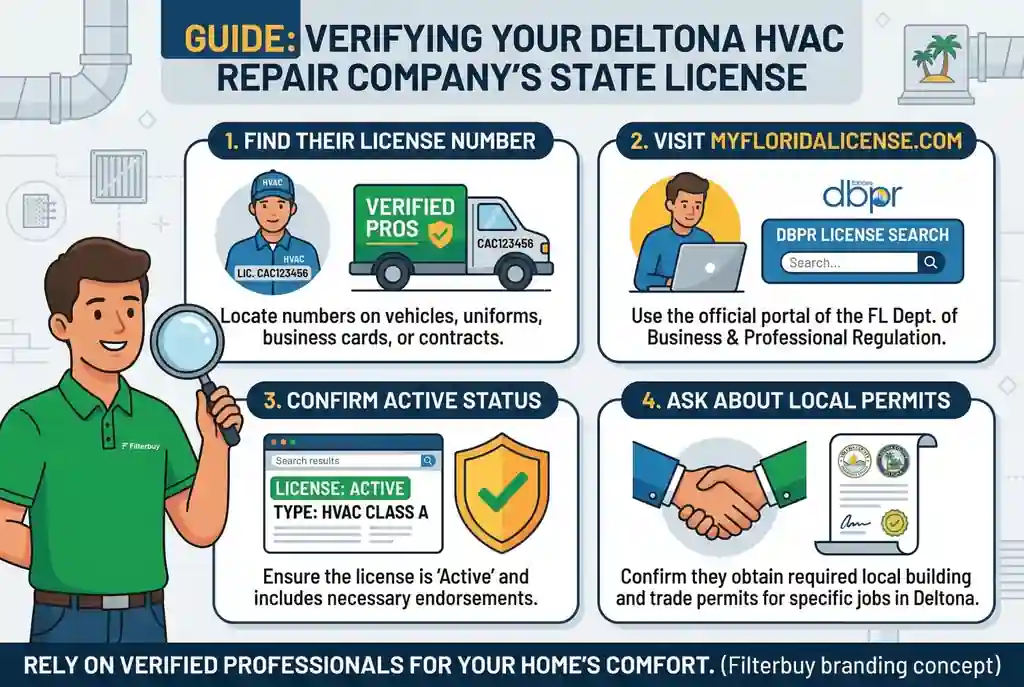
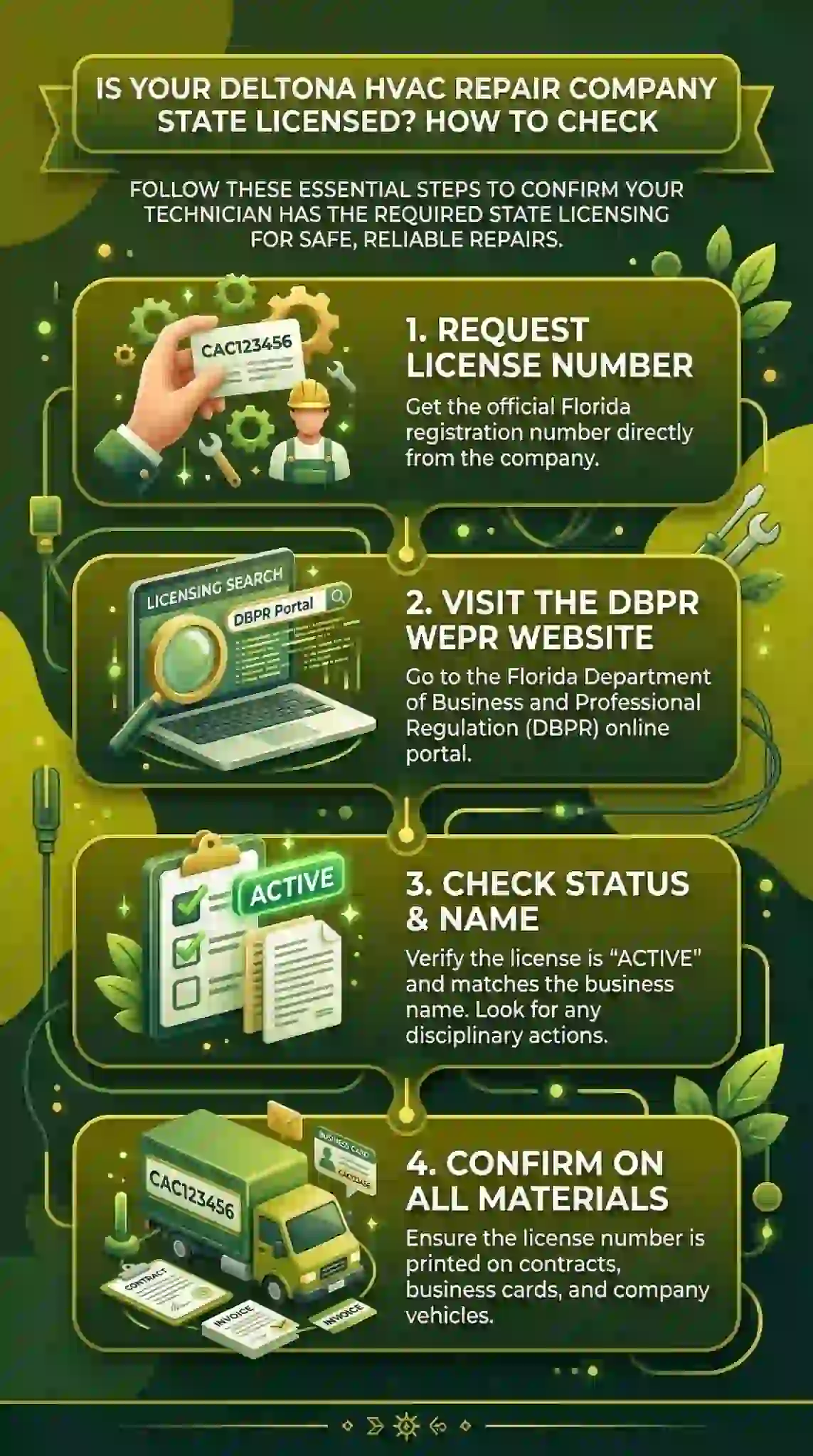
How to Verify an HVAC Contractor's Florida License in Four Steps
The verification process is simpler than most homeowners expect. Here's exactly how to run it:
Go to myfloridalicense.com — the official Florida DBPR license lookup portal.
Select "Contractor" from the profession dropdown menu.
Search by the contractor's name, company name, or license number — any of the three will return results.
Review the license status carefully — confirm the license is listed as "Current, Active" and that the license type covers mechanical or HVAC contracting specifically.
The entire process takes less than sixty seconds when verifying an HVAC repair specialist, helping homeowners confirm they’re working with a qualified professional before anyone sets foot in their home. If a contractor's license doesn't appear, appears as inactive or suspended, or covers a different trade than the work being proposed, that information is available to you right away.
What to Look For in the License Results — and What Raises Concern
Pulling up a license record is only half the check. Knowing what the results mean is equally important. When reviewing a contractor's DBPR record, confirm the following:
License status reads "Current, Active." Expired, suspended, or inactive licenses are not valid for work.
The license type matches the scope of work. A general contractor's license does not cover HVAC work. Confirm the license specifically covers mechanical or HVAC contracting.
The license is held by the company — or the individual performing the work. In Florida, the license must be held by the qualifying agent responsible for the work being performed.
No disciplinary history appears on the record. DBPR records include public complaint history. A pattern of disciplinary actions is worth reviewing before authorizing work.
Why a State License Is Necessary — But Not Sufficient
A valid Florida DBPR license confirms a contractor is legal. It does not confirm they are the best choice for your home. From our experience serving the Deltona market, three additional credentials meaningfully separate licensed contractors from trustworthy ones:
Volusia County registration. State licensing and county registration are separate requirements. Contractors working in unincorporated Volusia County must be registered locally in addition to holding a state license. Verify county registration through the Volusia County Building and Code Administration division.
NATE certification. Florida's licensing exam tests a contractor's knowledge of state regulations. NATE certification tests a technician's real-world diagnostic and installation knowledge — the skills that determine whether a repair is performed correctly. These are meaningfully different bars, and both matter.
Active liability insurance and workers' compensation coverage. A licensed contractor without current insurance coverage leaves the homeowner exposed to property damage liability and workers' compensation claims. Request proof of both before work begins — and verify directly with the insurer that the policy is current.
What Happens When You Hire an Unlicensed HVAC Contractor in Florida
The consequences of unlicensed HVAC work in Florida extend well beyond a substandard repair. In our experience working in this community, the outcomes we've seen most frequently include:
Unpermitted work that fails to meet Florida Building Code and must be corrected or removed at the homeowner's expense.
Property liens placed by subcontractors or suppliers the homeowner never hired, when the unlicensed operator fails to pay them.
Insurance complications when unlicensed work is discovered during a claim — potentially voiding coverage for the affected system or property damage it caused.
No DBPR complaint recourse — Florida's formal complaint and disciplinary process applies to licensed contractors. Unlicensed operators are referred to the State Attorney's Office for criminal prosecution, which provides limited direct relief to the homeowner.
Florida law treats unlicensed contracting as a criminal offense. During a declared state of emergency — which Florida activates regularly following hurricanes and major weather events — the penalty for unlicensed contracting is elevated from a misdemeanor to a third-degree felony.
How to Report a Suspected Unlicensed HVAC Contractor in Deltona
If you suspect an HVAC contractor operating in Deltona is unlicensed, Florida's DBPR provides multiple reporting channels:
Phone: Call the Unlicensed Activity Hotline at 1-866-532-1440.
Online: Submit a complaint at myfloridalicense.com.
Mobile: Use the DBPR Mobile App and select "Report Unlicensed Activity."
Reports may be submitted anonymously. DBPR investigators are required by law to forward unlicensed activity cases to the local State Attorney's Office for prosecution — and the department conducts proactive enforcement operations across Florida counties on an ongoing basis.
The Sixty-Second Check That Every Deltona Homeowner Should Run
License verification is not a step that requires legal expertise, industry knowledge, or more than a minute of a homeowner's time. It requires a contractor's name and a browser window. What it protects against — unpermitted work, property liens, insurance voids, and repairs performed by operators with no legal accountability — can take significantly longer to untangle than sixty seconds.
Before any HVAC contractor in Deltona starts work on your system:
Verify the Florida DBPR license at myfloridalicense.com — confirm "Current, Active."
Confirm Volusia County registration through the county's Building and Code Administration division.
Request proof of active liability insurance and workers' compensation coverage.
Ask whether the technician performing the work holds NATE certification.
Confirm permit requirements for the proposed scope of work before authorizing anything.
A contractor who delivers a top HVAC repair service supports every one of these steps without hesitation. A contractor who pushes back on any of them has already told you what you needed to know.
"The calls that stay with us longest aren't the ones where a system failed — they're the ones where a Deltona homeowner did everything they thought was right and still ended up unprotected. They found a contractor online. They got a written quote. The price felt fair. The work got done. And it wasn't until a home inspection before resale, or a property damage claim, or a neighbor's offhand comment about permits that they discovered the contractor who worked on their system was never licensed to touch it. By that point, the contractor is unreachable, the work is unpermitted, and every consequence falls on the homeowner. That sixty-second license verification at myfloridalicense.com doesn't feel significant until you're sitting across from someone who skipped it. We've had that conversation enough times in this community that we'd rather have the uncomfortable one first — before anyone picks up a tool."
Essential Resources
We put together this list because we live here too. These are the exact resources we'd share with a neighbor standing in their driveway, wondering who they can actually trust to work on their home.
1. Run This Lookup Before You Call Anyone Back
Florida DBPR License Verification — myfloridalicense.com
This is the first thing we tell every Deltona homeowner before authorizing any HVAC work. The Florida Department of Business and Professional Regulation's license portal confirms whether a contractor holds an active, current license — and whether that license actually covers HVAC and mechanical contracting. It takes under 60 seconds and it's the single most important step between you and the kind of contractor who disappears the moment something goes wrong.
What to confirm: License status reads "Current, Active" and the license type specifically covers HVAC work — not just general contracting.
2. Understand What You're Actually Risking When You Skip the Verification Step
Florida DBPR Unlicensed Activity FAQs — myfloridalicense.com/unlicensed-activity-frequently-asked-questions
We've had the hard conversations with Deltona homeowners who didn't know this resource existed until it was too late. Florida's official guidance on unlicensed contracting explains exactly what happens when something goes wrong — unpermitted work that has to be torn out at your expense, property liens from subcontractors you never hired, and insurance claims that get denied. Read this before anyone touches your system.
What you'll learn: Why the department can discipline a licensed contractor but has almost no tools to help you once an unlicensed one takes your money and walks away.
3. State License Isn't Enough — Volusia County Requires This Second Step Too
Volusia County Contractor Licensing — volusia.org/contractor-licensing
Something most Deltona homeowners don't know: Florida state licensure and Volusia County registration are two completely separate requirements. A contractor can hold a valid DBPR license and still not be properly registered to work in this county. This is the official county portal to verify local registration — and it's a step we always confirm before sending one of our own technicians out to a job.
What to confirm: That your contractor is listed with Volusia County's Building and Code Administration, not just the state.
4. The Warning Signs Volusia County Wants You to Know Before You Hire Anyone
Volusia County Unlicensed Contractor Guidance — volusia.org/unlicensed-contractors
This page from Volusia County covers the red flags that show up before work begins — the ones that tend to cost homeowners the most money when they're missed. Permit requirements, payment warning signs, what a legitimate estimate looks like, what an unlicensed one looks like. It's the county's own guidance, written for exactly the situation you're navigating right now.
Local note: If a contractor tells you the job doesn't require a permit, check with the county yourself before proceeding. Almost all HVAC repairs and replacements in Deltona require one.
5. A Florida License Tells You a Contractor Can Work Here — This Tells You They're Actually Good at It
NATE Certified Contractor Directory — natex.org/find-a-contractor
Years of working on Deltona systems has taught us that licensing and skill are not the same thing. A Florida DBPR license confirms a contractor met the legal minimum to operate. NATE certification confirms the individual technician has passed nationally recognized exams on real-world HVAC diagnostics, installation, and repair. This directory helps you find contractors who employ NATE-certified technicians — and when you call, ask for the certified tech specifically, not just anyone on their roster.
Why it matters in this market: Central Florida's heat and humidity puts demands on HVAC systems that require a technician who genuinely knows what they're doing, not just one who's legally allowed to try.
6. Before You Decide Between Repair and Replacement, Check Whether Duke Energy Will Help Pay for It
Duke Energy Florida Home Energy Improvement Rebates — duke-energy.com/home/products/home-energy-improvement
This one changes the math on a lot of repair-vs-replace decisions for Deltona homeowners in Duke Energy's service area. Qualifying HVAC replacements can receive up to $1,000 back. Duct test and repair work may qualify for additional rebates. The catch: you need to complete a free Home Energy Check before work begins to qualify — so this is a resource to check first, not after the decision's already been made.
Practical tip: A replacement that seemed financially out of reach often looks different once a rebate offsets part of the cost. Run the numbers before committing to another repair on an aging system.
7. The Federal Standard That Belongs in Every Repair-or-Replace Conversation
EPA ENERGY STAR Heating and Cooling — energystar.gov/products/heating_cooling
When a contractor recommends repair or replacement, this is the independent federal benchmark that should be part of that conversation. SEER ratings, HSPF ratings, system lifespan guidelines, and ENERGY STAR qualification thresholds are the standards no contractor can dispute — because they didn't write them. We share this resource with neighbors facing major HVAC decisions because good decisions are informed ones, and the EPA's guidance exists entirely outside of what any company is trying to sell you.
What to look for: Where your current system's efficiency rating falls relative to today's ENERGY STAR-qualified equipment — and what that gap means for your monthly bill in a climate where your system runs most of the year.
These essential resources help Deltona homeowners verify contractor licenses, confirm county registration, recognize warning signs, and review repair-versus-replacement guidance so they can work with a top HVAC repair service that meets proper standards before any work begins.
Supporting Statistics
The numbers behind why credential verification, quality installation, and consistent maintenance matter more in Central Florida than almost anywhere else in the country.
Air conditioning accounts for 28% of total home energy use in Florida — more than three times the national average of 9%.
We think about this number every time we pull up to a Deltona home.
National average for residential AC energy use: 9%
Florida's residential AC energy use: 28%
That's not a rounding difference — it's a fundamentally different relationship between a home and its HVAC system
From our years working in this market, that load produces patterns we recognize immediately:
Capacitors failing earlier than manufacturers project
Refrigerant depleting faster than it should
Condensate drains backing up on schedules that would surprise a technician trained in a cooler climate
When a system here is installed incorrectly or maintained inconsistently, the penalty isn't abstract. It shows up on every utility bill, every month, for as long as that system runs.
Source: U.S. Energy Information Administration — 2020 Residential Energy Consumption Survey (RECS)
More than 65% of residential HVAC systems in the U.S. have been improperly installed, causing them to consume 20–30% more energy than necessary.
This is the statistic that explains the calls we dread most — not the ones where a system failed, but the ones where a Deltona homeowner has been paying quietly for a problem they never knew existed.
What improper installation looks like in the field:
Improper refrigerant charge
Inadequate airflow across indoor coils
Duct leakage from poor sealing or disconnected runs
None of these show up on a thermostat reading. They show up as:
Bills that never quite make sense
Rooms that never quite reach temperature
Systems that seem to age faster than they should
After working on homes throughout Volusia County, we can usually tell within the first few minutes of a service call whether a system was installed by someone who understood this market — or someone who was just legally permitted to try.
Source: U.S. Department of Energy — Optimizing the Installed Performance of Residential HVAC Systems (NREL)
Following a regular HVAC maintenance schedule can reduce heating and cooling costs by 10% or more and prolongs the life of equipment.
The homeowners we worry about most aren't the ones who call us when something breaks. They're the ones who don't call anyone until a system that could have run for 16 years gives out at 10 — a situation that prіvаtе hоmе саrе for HVAC systems helps prevent.
What consistent professional maintenance delivers in Deltona's climate:
10% or more in annual energy cost reductions
Extended equipment lifespan — measurably
Early identification of refrigerant, airflow, and drain issues before they compound
What skipping maintenance actually costs:
A failed compressor in August
A drain line backup that damages a ceiling
An emergency call on the system's schedule instead of yours
Preventive maintenance doesn't just save money on energy. In a climate where systems run most of the year, the difference between a well-maintained system and a neglected one is rarely dramatic — until it is.
Source: U.S. Department of Energy — Home Heating and Cooling Energy Saver Guide
Final Thoughts
After years of serving this community, here is the honest observation we keep coming back to: Deltona doesn't have an HVAC contractor shortage. It has an information shortage.
There are licensed, skilled, trustworthy technicians working in this market every day delivering top HVAC system repair service. There are also contractors operating without proper credentials, skipping permits, and delivering installations that were never going to perform the way a Deltona home demands. The gap between those two groups is rarely visible on the surface:
Same search results
Same trucks
Same confident phone manner
Same willingness to show up tomorrow
What separates them is what happens before the first tool comes out of the truck.
In our experience, the homeowners who get the best outcomes share one thing in common — not the largest budgets, not the most HVAC knowledge, but the willingness to ask the right questions first. Four steps that filter out most of the risk before a single panel is removed:
License verified at myfloridalicense.com
Volusia County registration confirmed
Permits discussed upfront
Estimate itemized in writing
What no statistic fully captures is that Central Florida's climate creates a category of HVAC problem that doesn't exist in most of the country:
Systems here run harder, longer, and under more humidity stress than almost anywhere else
That changes what proper installation means
It changes what adequate maintenance looks like
It changes what a trustworthy contractor needs to understand before they touch your system
The DOE's 65% improper installation figure isn't an industry indictment. It's a reminder that technical competence and legal licensure are different thresholds — and that Florida homeowners deserve contractors who clear both.
Our opinion, offered as neighbors who happen to do this work every day: the most expensive HVAC decision most Deltona homeowners make isn't choosing the wrong system. It's authorizing work before they had the full picture.
The resources on this page exist because we'd rather you have that picture going in — whether you call us or not.
FAQ on Top HVAC System Repair Near Deltona FL
Q: How do I know if an HVAC repair company in Deltona is legitimate before I let them in my home?
A: Two verifications most Deltona homeowners skip — and the ones we consider non-negotiable:
Confirm active Florida DBPR license at myfloridalicense.com
Status must read "Current, Active"
License type must specifically cover HVAC or mechanical contracting
General contracting license does not qualify
Confirm Volusia County registration at volusia.org
State license and county registration are separate requirements
We've seen valid DBPR license holders who weren't properly registered to work in this county
Both checks take under 60 seconds. Any contractor worth calling back completes both without pushback.
Q: What are the most common HVAC repairs needed in Deltona FL and what do they typically cost?
A: Central Florida's heat and humidity accelerates component wear faster than most of the country. After years of service calls throughout Volusia County, these are the repairs we see most consistently:
Capacitor replacement: $150–$350
Contactor replacement: $150–$350
Condensate drain line clearing: $75–$250
Thermostat replacement: $150–$450
Blower motor replacement: $350–$700
Evaporator coil replacement: $700–$1,500
Refrigerant recharge: $200–$600
Compressor replacement: $1,200–$2,500
What concerns us more than any single repair cost is the pattern:
Capacitor one year. Contactor the next. Refrigerant recharge the year after.
That sequence isn't bad luck. It's a system in systemic decline.
A trustworthy contractor provides a written, itemized estimate — and is honest about what the pattern means.
Q: When does it stop making sense to repair an HVAC system in Deltona and make more sense to replace it?
A: The standard industry threshold is 50% of replacement cost. But the calculation we've found more useful in Deltona isn't cost alone — it's frequency.
Key indicators that replacement makes more sense than repair:
Repair cost approaches or exceeds 50% of full replacement cost
Multiple component failures within 12–24 months
System age exceeds 10–12 years in Central Florida's climate
Energy bills rising despite repairs
Why age matters differently here:
A 12-year-old system in Deltona has accumulated runtime stress a same-age system in a cooler climate simply hasn't faced
Central Florida's sustained heat and humidity accelerates wear on every major component
Before committing to a major repair on an aging system:
Check Duke Energy Florida rebate eligibility at duke-energy.com
A replacement that seemed out of reach financially often looks different once a rebate enters the equation
Q: Why do HVAC permits matter for repairs and replacements in Deltona FL?
A: Permits are the protection Deltona homeowners think about least and need most. Volusia County requires permits for HVAC replacements and significant component work. Permitted work is inspected work — it confirms the installation meets Florida Building Code.
What we've seen happen without permits:
Insurance coverage for HVAC-related damage voided
Non-compliant work corrected at the homeowner's expense
Unpermitted work surfacing as a complication during home sale
Property liens from subcontractors the homeowner never hired
The simplest test we share with every Deltona neighbor:
Ask the contractor directly whether a permit is required
A contractor who hesitates, discourages the question, or suggests you pull it yourself has told you everything you need to know about how they operate
Q: How often should an HVAC system be serviced in Deltona compared to other parts of the country?
A: Twice per year. Standard national guidance recommends annual service — but that guidance wasn't written for a market where systems run the majority of the year under sustained heat and humidity.
What twice-yearly maintenance catches in Deltona's climate:
Refrigerant drift before it becomes a recharge call
Airflow degradation before it becomes a blower motor call
Condensate buildup before it becomes a water damage call
What the numbers confirm:
DOE: regular maintenance reduces heating and cooling costs by 10% or more
Florida AC accounts for 28% of total home energy use — that 10% adds up faster here than almost anywhere else in the country
The cost of skipping a service call in Deltona almost always exceeds the cost of the call itself.
Before allowing any contractor to service your system, homeowners should understand how to verify credentials and avoid unlicensed work, which is exactly what How to Check If Your Deltona HVAC System Repair Company Is State Licensed helps explain. The article walks through the simple steps for confirming a contractor’s DBPR license and why that verification protects homeowners from unpermitted or poorly performed repairs. It also highlights how proper maintenance—like replacing clogged air filters—can reduce unnecessary service calls and keep systems running efficiently. Installing 16x20x1 pleated furnace air filters helps maintain healthy airflow and prevent system strain that can lead to avoidable repairs. Similarly, 10x30x1 MERV 8 HVAC AC furnace air filters support consistent filtration and airflow, especially in Florida’s demanding climate. Homeowners can also explore replacement HVAC furnace air filters to keep their systems operating smoothly between maintenance visits. Maintaining proper filtration complements the contractor verification steps discussed in the article and helps Deltona homeowners protect both their HVAC system and their investment.