The good news is that for most residential cleanout and remodel projects, a 10-yard dumpster is the right call. It holds roughly three pickup-truck loads of debris — enough to handle a single-room cleanout, a small bathroom remodel, a roofing tear-off under 1,500 square feet, or a thorough garage purge. Sizing up to a 20-yarder typically adds $50 to $150 to your bill without giving you back any real value if your project genuinely sits inside the 10-yard envelope.
This guide walks through what a 10 yard dumpster size actually looks like in practical terms, when it's enough, when it isn't, and how to estimate your debris before the truck shows up — so you book once and book right.
TL;DR Quick Answers
10 yard dumpster size
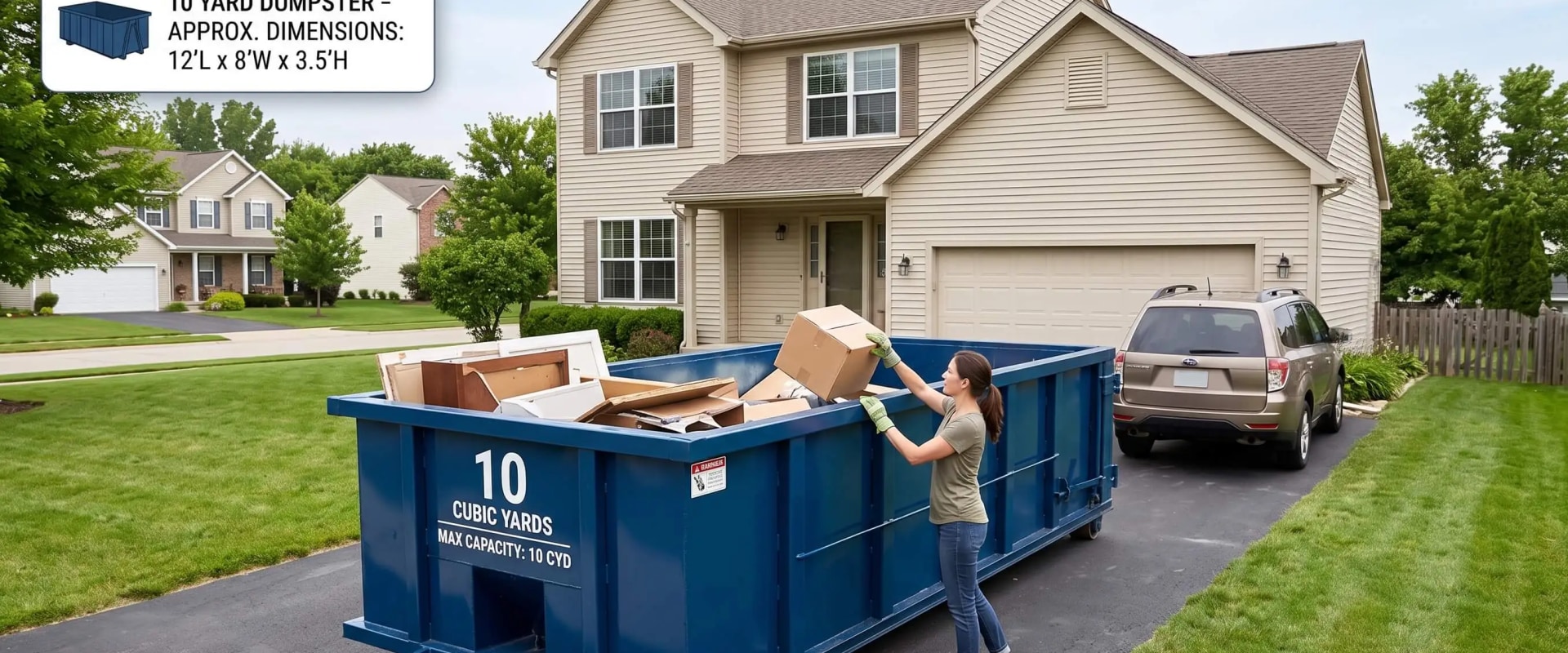
A 10-yard dumpster holds 10 cubic yards (270 cubic feet) of debris, with typical external dimensions around 14 ft long, 7.5 ft wide, and 3.5 ft tall — about the footprint of two parking spaces, with walls coming up to roughly waist height.
Capacity: ~270 cubic feet, equal to about 3 pickup-truck loads or 80–90 standard 30-gallon contractor bags
Weight allowance: typically 1 to 2 tons (2,000–4,000 lbs) included; overage fees usually run $40–$100 per additional ton
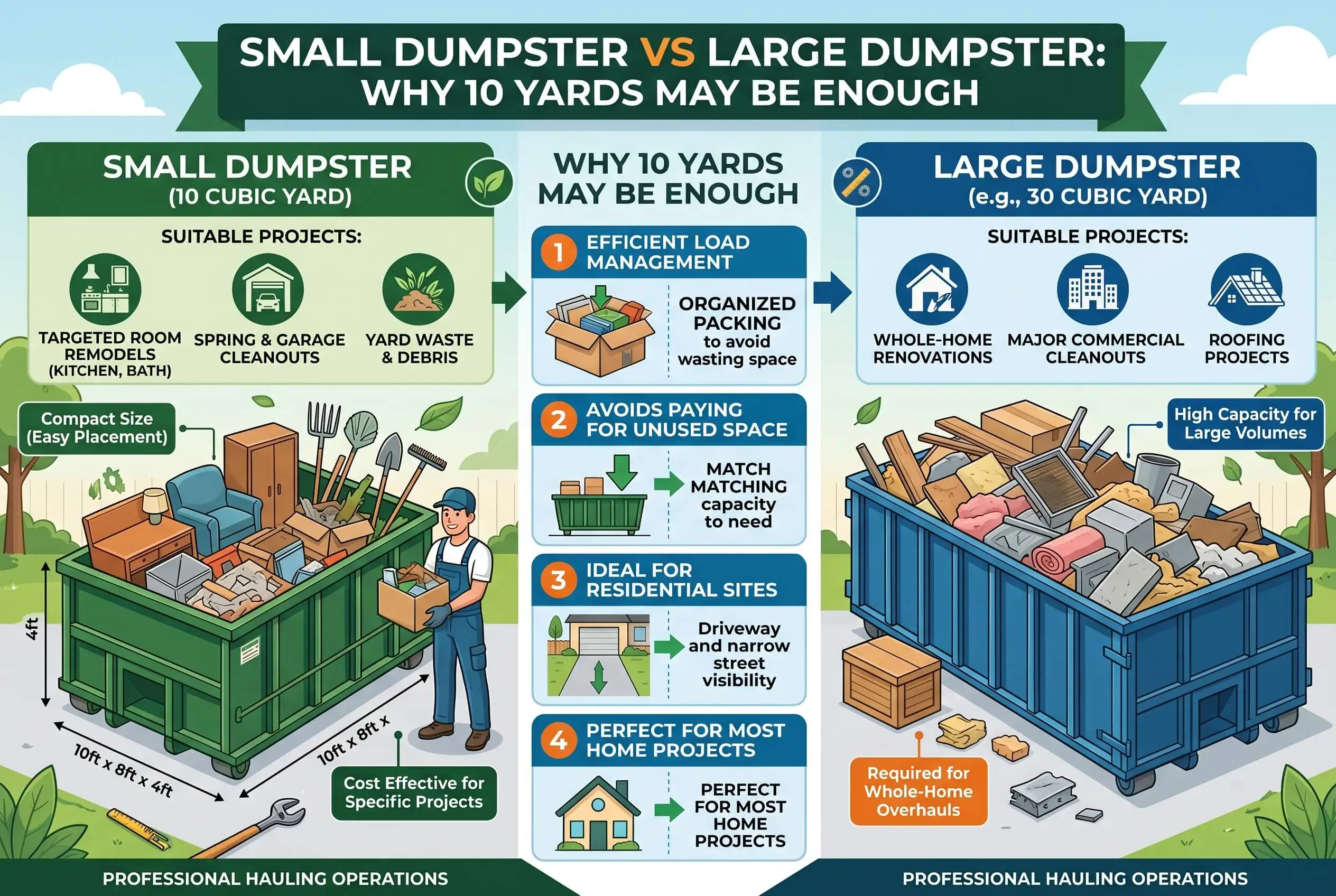
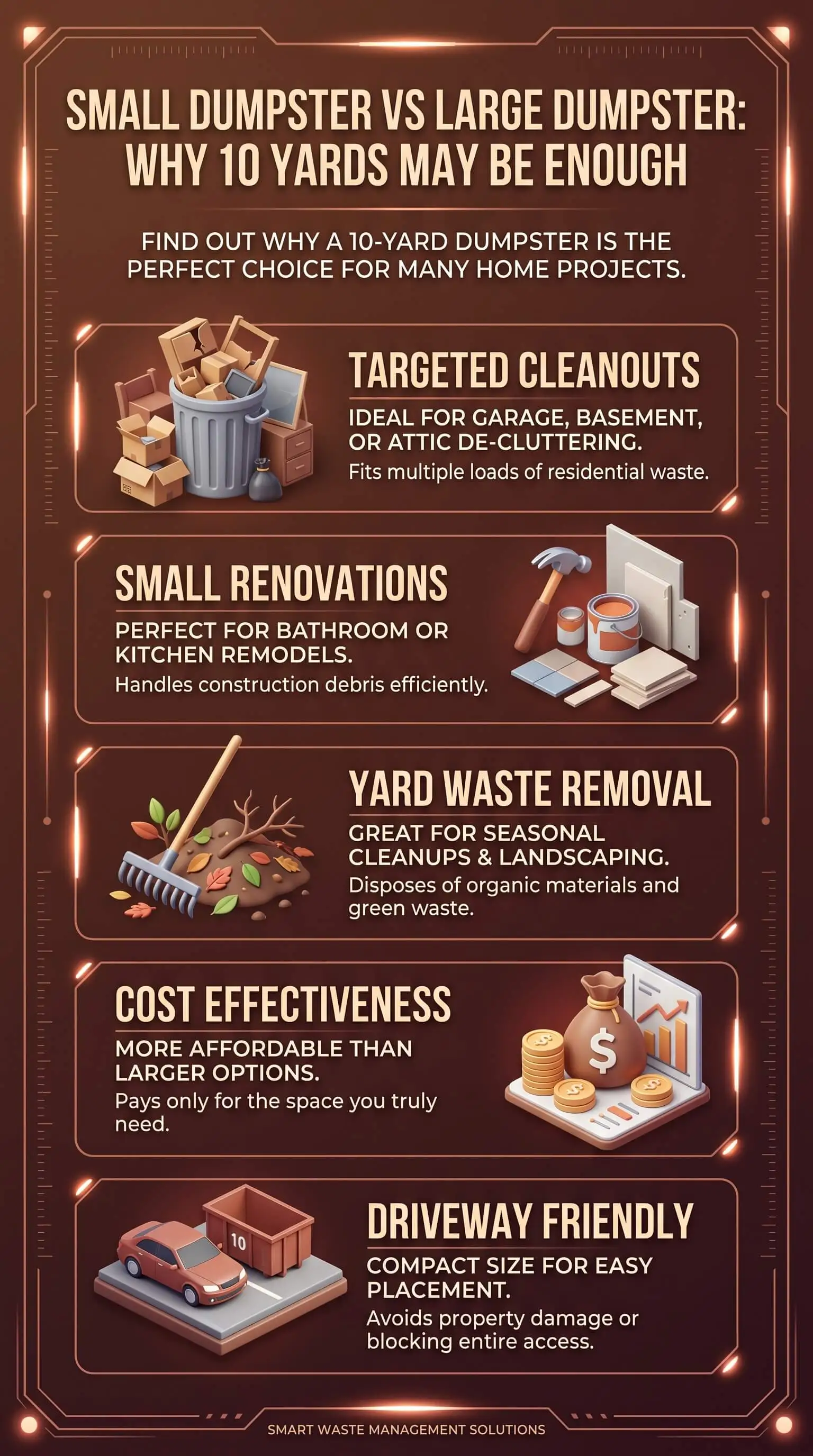
Best for: single-room cleanouts, small bathroom remodels, garage purges, roofing tear-offs under 1,500 sq ft, light estate cleanouts
Footprint needed: ~22 ft of clear length and 10–12 ft of width to allow truck loading clearance
If your debris pile fits in roughly three pickup-truck loads, a 10-yarder is your size.
Top Takeaways
A 10-yard dumpster holds roughly 3 pickup-truck loads, or about 270 cubic feet, of debris.
Typical external dimensions: 14 ft long × 7.5 ft wide × 3.5 ft tall — the footprint of two parking spaces.
Most projects in the single-room, single-trade, residential category fit comfortably inside 10 yards.
Whole-house cleanouts, multi-room renovations, and large roof tear-offs usually require 20+ yards.
Weight limits (typically 1–2 tons) are often the binding constraint, not volume — heavy debris like shingles, concrete, or tile triggers overage fees fast.
The cheapest insurance against the wrong size is fifteen minutes of pre-rental debris piling, plus a 20% buffer.
Driveway placement usually doesn't require a permit. Street placement almost always does.
What a 10-Yard Dumpster Actually Is
A 10-yard dumpster is a roll-off dumpster sized to hold 10 cubic yards — about 270 cubic feet — of debris. Typical external dimensions land around 14 feet long, 7.5 feet wide, and 3.5 feet tall. Picture two parking spaces side by side, with steel walls coming up to about waist height. Most haulers include 1 to 2 tons of weight in the base price, with overages billed per ton beyond that.
For a full breakdown of dimensions, weight allowances, and rental cost ranges, this 10 cubic yard dumpster size guide walks through the specs in detail.
How the Sizes Compare
10-yard dumpster (~14′ × 7.5′ × 3.5′): about 3 pickup-truck loads. Best for single-room cleanouts, small remodels, and roofing tear-offs under 1,500 sq ft.
15-yard dumpster (~16′ × 7.5′ × 4.5′): about 4.5 pickup loads. Best for mid-size cleanouts and flooring jobs.
20-yard dumpster (~22′ × 8′ × 4.5′): about 6 pickup loads. Best for whole-garage cleanouts and larger remodels.
30-yard dumpster (~22′ × 8′ × 6′): about 9 pickup loads. Best for new construction and full-home cleanouts.
40-yard dumpster (~22′ × 8′ × 8′): about 12 pickup loads. Best for commercial work and major demolition.
Smaller dumpsters cost less in absolute dollars but more per cubic yard. Bigger isn't safer — bigger is just bigger. The right call is matching size to job, not chasing the lowest sticker or the biggest container.
When a 10-Yard Dumpster Is Enough
These are the projects we see fit comfortably inside a 10-yarder, time after time:
Single-room cleanouts (bedroom, home office): typically 4–6 cubic yards
Small bathroom remodel — tub-out, vanity, tile demo: 5–8 cubic yards
Garage purge without major furniture: 6–9 cubic yards
Single-layer roof tear-off, ≤1,500 sq ft: 7–9 cubic yards (weight limit is usually the constraint, not volume)
Small deck or fence demo: 5–7 cubic yards
Light estate cleanout: 6–9 cubic yards
Yard waste and landscaping debris: 6–10 cubic yards
A useful gut check: if your debris pile fits in roughly three pickup-truck loads, a 10-yard dumpster is your size.
When 10 Yards Isn't Enough
Honest answer: a 10-yard dumpster is not the right pick for every job. Size up when:
You're doing a whole-house cleanout (estate, foreclosure, hoarder cleanout): jump to 20 or 30 yards
You're renovating multiple rooms at once with drywall and flooring debris: 20-yard minimum
You're tearing off a roof over 2,000 square feet, or stripping multiple shingle layers: 20 yards, weight-aware
You're handling new-construction demo: 30 to 40 yards
Watch for overage fees. Most haulers charge $40 to $100 per additional ton over the included weight, and visibly overfilled dumpsters — anything piled above the fill line — may not be picked up at all until you redistribute the load.
How to Estimate Your Debris Without Guessing
Five rules of thumb that have held up across hundreds of jobs:
The pile method. Stack your debris in the driveway before you book. A 4 ft × 4 ft × 4 ft pile is roughly 2.4 cubic yards.
The trash bag method. About nine standard 30-gallon contractor bags equals one cubic yard.
The pickup truck method. A heaped full-size pickup bed is around three cubic yards.
The room method. A fully cleared 12 × 12 bedroom of mixed household debris yields four to six cubic yards.
Add a 20% buffer. Almost everyone underestimates. The buffer is cheaper than upgrading mid-rental.
Will It Fit in My Driveway?
A loaded 10-yarder can exceed 5,000 pounds, and you'll need about 22 feet of clear length plus 10 to 12 feet of width to allow truck clearance. Sealcoated driveways, paver driveways, and weak concrete are at risk under that weight — sliding plywood under the wheels is standard practice. Driveway placement usually doesn't require a permit. Street placement almost always does.
"After watching homeowners size dumpsters for cleanouts and remodels for years, the pattern is consistent: when people guess, they guess up. They picture the worst-case pile, then add a safety margin on top of that. The 20-yarder shows up, sits half-empty for a week, and they've paid an extra $100 to $150 for steel they didn't fill. The fix isn't a calculator — it's spending fifteen minutes piling debris in a corner of the garage or driveway before you book. Three pickup loads of debris fits a 10-yarder. If your pile is bigger than that, you'll know by looking at it. The eyeball test is more accurate than most people give it credit for."
7 Essential Resources
For deeper context on dumpster rentals, waste regulations, and home-cleanout planning:
EPA — National Overview: Facts and Figures on Materials, Wastes and Recycling — the federal source for U.S. waste-generation data, broken down by material type and disposal method.
EPA — Construction and Demolition Debris: Material-Specific Data — tonnage breakdowns on what ends up in the C&D waste stream and where it goes.
EPA — Resource Conservation and Recovery Act (RCRA) Overview — the regulatory framework that governs how non-hazardous solid waste is managed, hauled, and landfilled in the U.S.
Wikipedia — Dumpster — a plain-language overview of dumpster types, including the roll-off containers used for residential rentals.
Jiffy Junk — How Big Is a 10 Cubic Yard Dumpster: Size, Dimensions, and Rental Cost — a detailed walk-through of 10-yard specs, weight limits, and rental pricing.
EPA — Sustainable Management of Construction and Demolition Materials — guidance on diverting renovation and demolition debris from landfills.
ASCE — 2025 Infrastructure Report Card: Solid Waste — a snapshot of how the U.S. waste and recycling industry is performing, including landfill capacity and tipping-fee trends.
3 Statistics
The U.S. generated 292.4 million tons of municipal solid waste in 2018 — about 4.9 pounds per person per day. That baseline is what every household contributes before you add a renovation, cleanout, or roofing job on top. (U.S. Environmental Protection Agency)
Construction and demolition debris hit 600 million tons in 2018 — more than twice the national municipal-waste total. Renovation and demo work is by far the heaviest contributor to the U.S. waste stream, which is exactly why dumpster sizing matters so much for remodelers and homeowners alike. (U.S. Environmental Protection Agency)
54% of U.S. homeowners undertook a renovation project in 2024. Cleanouts and remodels are happening in more than half of all U.S. households each year — and a meaningful share of those projects involve a dumpster rental. (Houzz 2025 U.S. Houzz & Home Study)
Final Thoughts and Opinion
Honest opinion after years of watching this play out: the dumpster-rental industry has trained homeowners to overshoot. The marketing on rental sites tilts toward bigger sizes because the upcharge from 10 to 20 yards is high-margin, and "just to be safe" is an easy script. But for the majority of single-project, residential jobs, that safety margin is false comfort. You're paying a tax for steel you don't need.
The 10-yard size exists for a reason. It's the right tool for the bulk of single-room remodels, garage purges, light estate work, and small roofing jobs. Where it falls short is real and worth respecting: whole-home cleanouts, multi-room renovations, and big roof tear-offs all genuinely need a larger container. But the gap between I might need bigger and I actually need bigger is usually about fifteen minutes of debris piling and a willingness to trust the eyeball test.
If you want to make this decision well, do the smart, value-focused thing: stack your debris before you book, add a 20% buffer, use dumpster rental prices to compare the best size for your budget, and pick the smallest size that honestly fits the job.
Frequently Asked Questions
Is a 10-yard dumpster enough for a garage cleanout? Yes, for most single-bay garages. Plan for 6 to 9 cubic yards of debris, which leaves a comfortable buffer in a 10-yard container. Two-car garages packed with heavy storage may push closer to 15 yards.
How many trash bags fit in a 10-yard dumpster? Roughly 80 to 90 standard 30-gallon contractor bags, depending on what's inside and how densely they're packed.
What is the weight limit on a 10-yard dumpster? Typically 1 to 2 tons (2,000 to 4,000 pounds). Overage fees usually run $40 to $100 per additional ton beyond the included limit.
Can a 10-yard dumpster handle roofing shingles? Yes, for tear-offs under about 1,500 square feet, single-layer. Shingles are heavy, so weight — not volume — is usually the limiting factor.
Is it cheaper to rent a small dumpster or hire a junk hauler for two trips? For projects above roughly three pickup-truck loads, a 10-yard dumpster is typically cheaper than per-load junk-removal pricing. Below that threshold, a hauler may be the better deal.
How long can I keep a 10-yard dumpster? Standard rental windows are 7 to 10 days. Most haulers will extend by the day for a small additional fee.
Do I need a permit? Driveway placement: usually no. Street placement: usually yes. Permit cost and process vary by municipality, so check with your local public-works office before booking.
CTA
Have a project on deck? Stack your debris, run the eyeball test, and add a 20% buffer before you book. Most homeowners need less dumpster than they think — match the size to the job, not to your worry, especially when planning clean, organized spaces that support private home care in Florida. Tap the comments below to share what you're working on, and we'll weigh in on the right size for your cleanout.