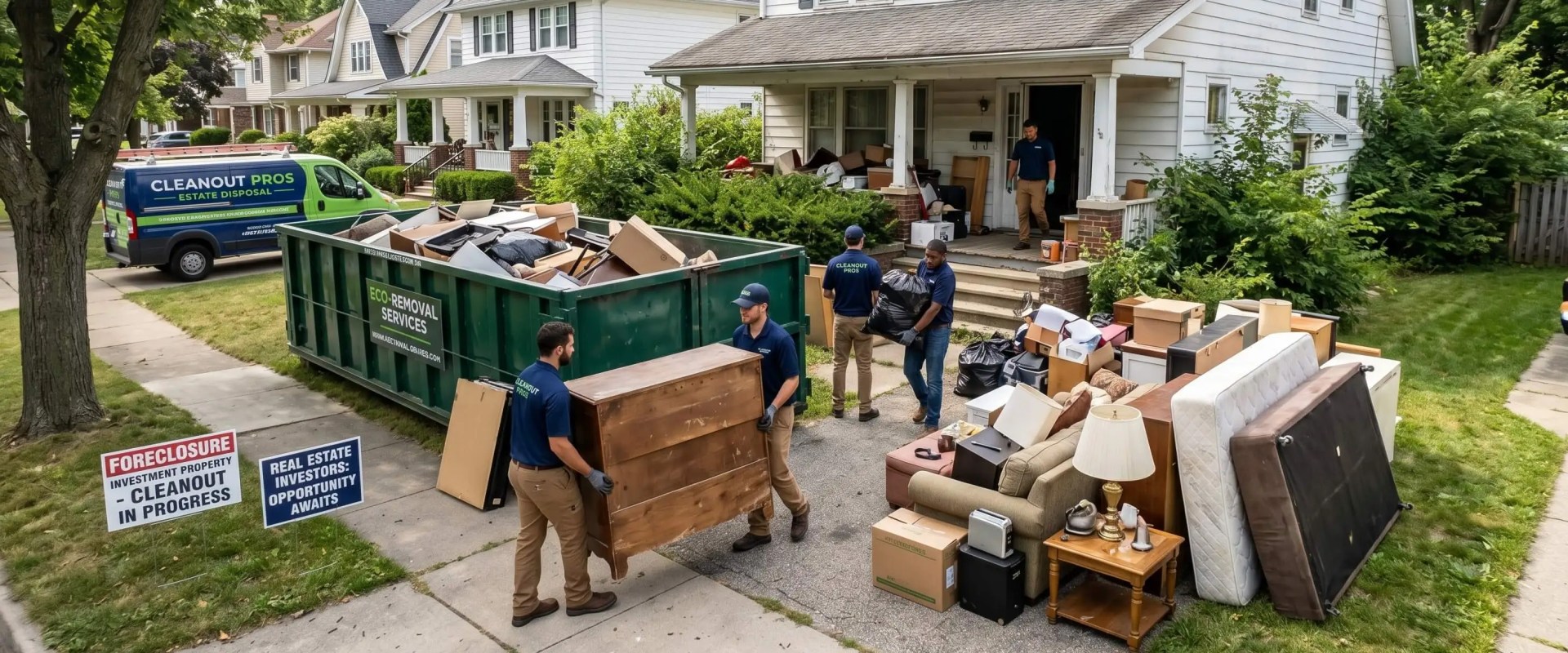
A foreclosure adds variables that an arm's-length sale does not have. Properties sit vacant longer, personal belongings stay behind, and hazardous items like old paint, expired chemicals, and the occasional prescription medication appear far more often than in conventional turnovers. Hoarding conditions are over-represented across the foreclosed inventory we have tracked on this site.
The four variables I just named carry equal weight at the offer stage when evaluating estate foreclosure cleanouts pricing. Get them right and the final invoice rarely surprises. Miss one and the spread between budget and bill can run into four figures.
TL;DR Quick Answers
Estate Foreclosure Cleanouts Pricing
Estate and foreclosure cleanouts use the same pricing model, typically running $1,500 to $10,000 for a whole property and averaging $3,000 to $5,500 for mid-size homes.
Crews quote by truckload, with most properties taking 1 to 4 full loads regardless of square footage.
Accessibility surcharges (stairs, no elevator, narrow access) add $300 to $700.
Special handling for refrigerators, pianos, mattresses, and hazardous items adds $50 to $400 per item.
Biohazard or hoarding-condition cleanouts move to a separate tier at $1,500 to $5,000 or higher.
Foreclosed properties skew higher than estates on the special-handling line because of extended vacancy and pest exposure.
Get three written quotes from in-person or video walkthroughs. Phone-only quotes cause most post-close invoice surprises.
Top Takeaways
• $1,500 to $10,000 covers the typical whole-property foreclosure cleanout range, with mid-size properties averaging $3,000 to $5,500.
• Truckload volume is the load-bearing variable in any quote, regardless of how the square footage looks on the listing sheet.
• Hidden-fee categories to surface before signing: minimum charges, accessibility surcharges, specialty-item surcharges, and disposal fees buried under “labor only” pricing.
• DIY math breaks even or loses for mid-size and larger properties once you count multiple dump runs, truck rental, time off work, and injury risk.
• Donation coordination through Habitat ReStore reduces disposal volume and produces a tax receipt that offsets investor cleanout cost against the year's tax liability.
• REO inventory is up 27 percent year over year, and investor demand for cleanout vendors will tighten in 2026 in markets where filings are concentrated.
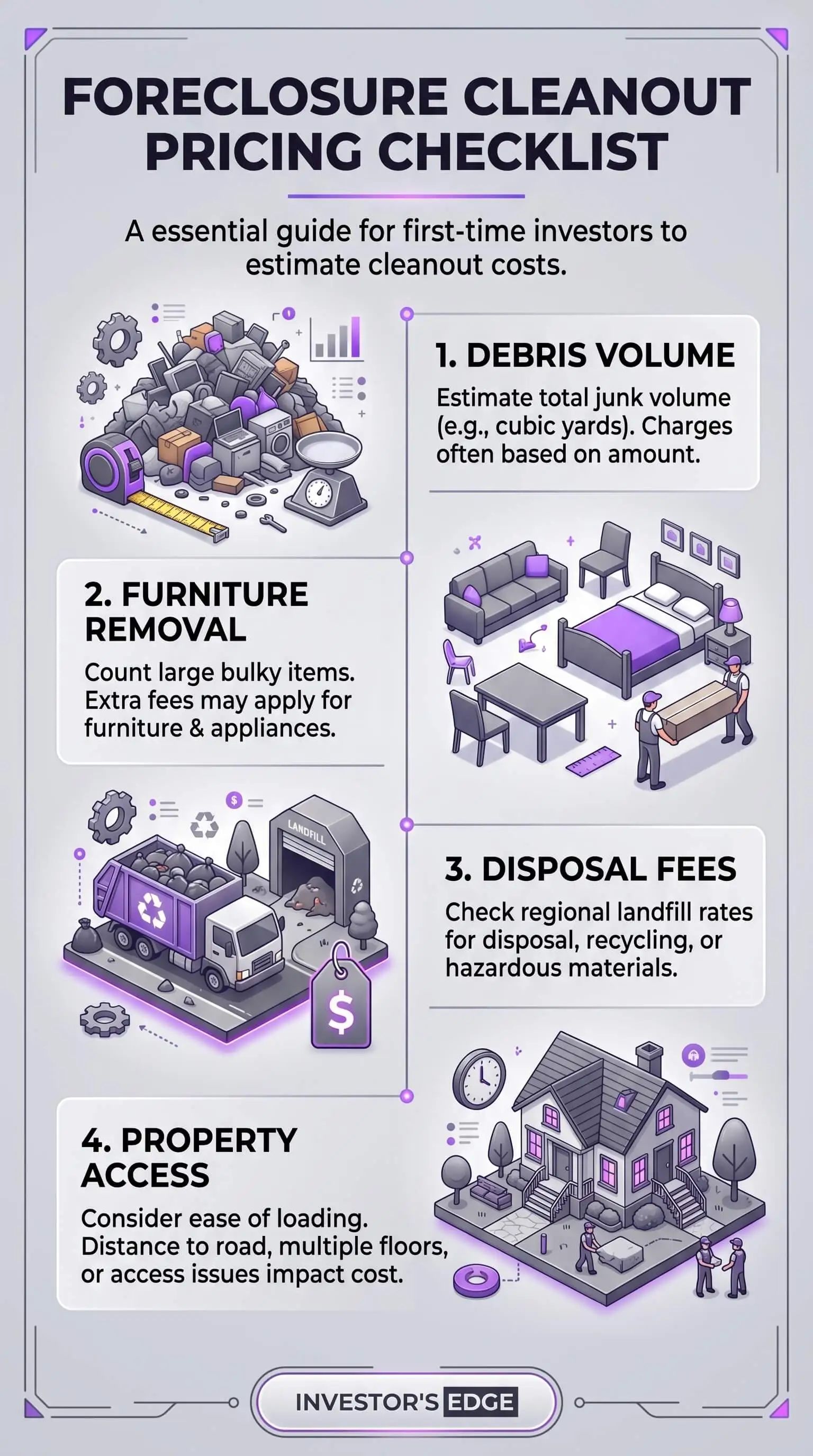
The Foreclosure Cleanout Pricing Checklist
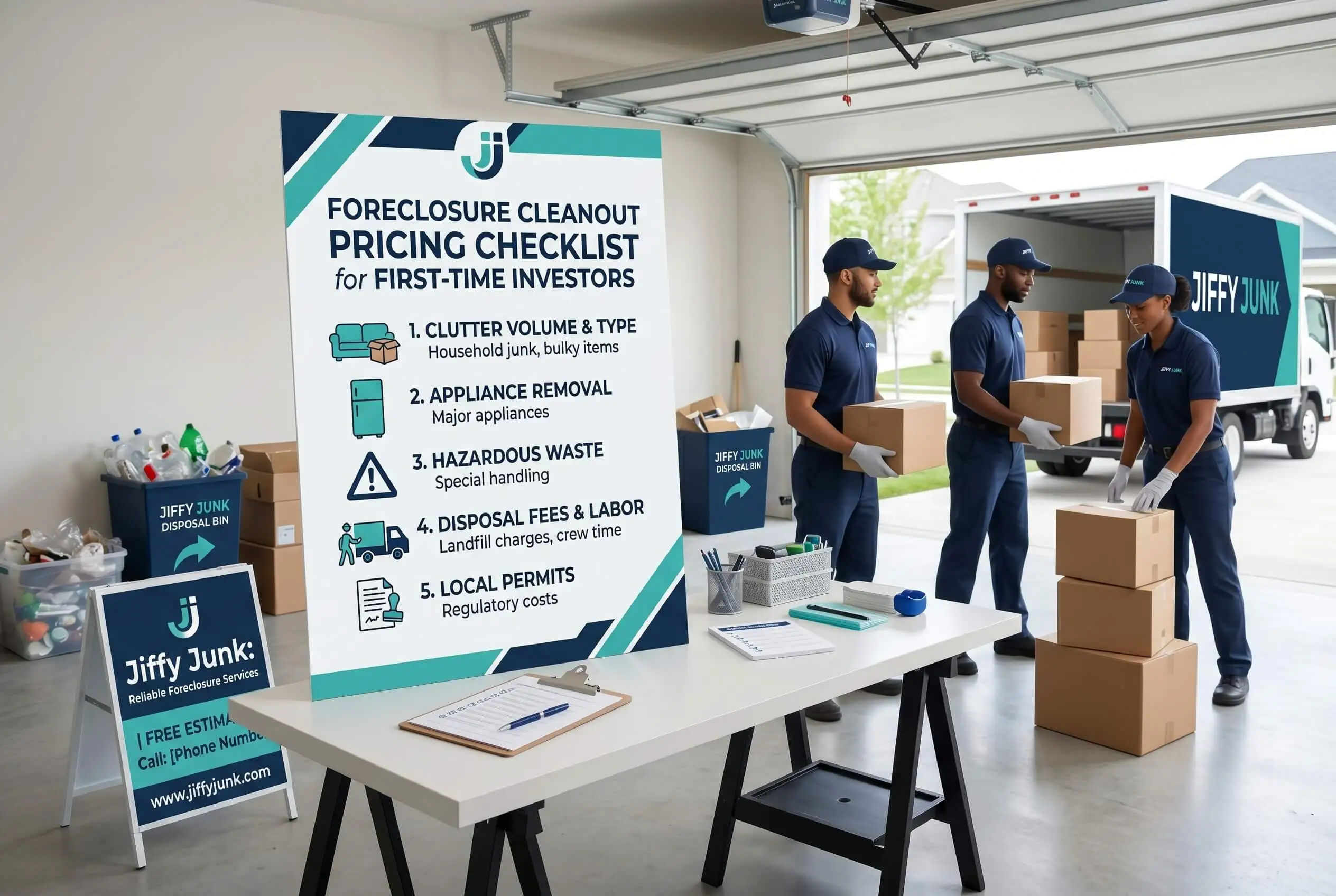
Work through this list before you submit your offer. Each item maps to a question the cleanout crew should answer at the walkthrough, and to a number that belongs in your pro forma.
1. Volume of belongings, measured in truckloads
Square footage is the first number every investor asks about, and the least reliable predictor of the final quote. A 1,500-square-foot home lived in for forty years almost always holds more than a 3,500-square-foot home occupied for five. Cleanout crews price by the truckload, which is what your quote actually measures.
Most whole-property foreclosure cleanouts land between $1,500 and $10,000, with average properties running $3,000 to $5,500. The Jiffy Junk team's estate cleanout cost per square foot guide gives a deeper benchmark on how this volume math translates by property type, and the underlying pricing model is identical to what foreclosure cleanouts use. For the operational view behind the truckload math, our breakdown of how junk removal pricing actually works step by step covers the volume measurement system in full.
2. Accessibility surcharges
Stairs, narrow hallways, no elevator access, and long driveways all add labor time to the job. Two identically sized properties can quote $300 to $700 apart on accessibility alone. Walk the property before you request quotes. Note every third-floor unit, narrow doorway, and yard access issue, then volunteer those details up front so they land in the initial estimate instead of as add-ons after the work is done.
3. Special handling for appliances, mattresses, and bulky items
Refrigerators with refrigerant, pianos, hot tubs, and exercise equipment carry per-item surcharges between $50 and $400 each. Mattresses sit in their own category. Many states regulate mattress disposal separately, and the rules vary by jurisdiction. California, Connecticut, and Rhode Island run mattress recycling programs with their own fee structures, and other states are working through their own versions. For any property with multiple bedrooms, factor mattress disposal in as its own line item rather than rolling it into the general furniture haul. Our breakdown of mattress disposal regulations by state covers the major variations.
4. Hazardous materials disposal
Foreclosure cleanouts surface old paint, expired pesticides, batteries, and household chemicals far more often than standard moves do. Most municipalities run Household Hazardous Waste programs that accept those items at no charge or for a small fee, and using the program instead of paying a contractor's hazardous-disposal surcharge can save $100 to $400 per property. If anyone on the crew suspects asbestos, lead paint, or anything friable, stop work and bring in licensed remediation. That is not a corner to cut.
5. Biohazard and hoarding-condition cleanouts
If the property has sat vacant for months or shows signs of hoarding, you are no longer pricing a standard cleanout. You are pricing remediation. Biohazard work runs a separate tier, typically $1,500 to $5,000 or higher, and it requires specialized contractors with the right licensing and personal protective equipment. The properties most likely to need this tier are also the properties most likely to receive a phone-only quote that drastically under-prices the work. That is one more reason to insist on an in-person or video walkthrough. Bed bug infestations in upholstered furniture are routine in long-vacant foreclosures, and our guide to bed bug furniture removal tools and protocol is worth reviewing before the crew touches anything soft.
6. Dumpster rental as a DIY alternative
A dumpster runs around $380 per week, with sizes from a 10-yard at roughly $75 per week up to a 40-yard roll-off near $800. Dumpsters work for investors who own a truck, can give the project several weekends, and operate in a market where dump runs are reasonable. They do not work for tight closing timelines or for properties where the volume requires multiple swap-outs.
7. Per-item junk removal for partial cleanouts
Some properties need only partial work: a garage, an attic, a single floor of furniture the previous occupant left behind. Per-item junk removal runs an average of $241 per job nationally, with most jobs falling between $60 and $700. That pricing model fits any finish-the-job scenario where most belongings have already cleared, but it underprices whole-property foreclosure cleanouts and should not be used as the primary benchmark for one. For a partial-clearout reference, our guide to garage cleanout methodology covers the work most often left behind in foreclosed properties.
8. Regional disposal and landfill tipping fees
Urban properties typically run 20 to 40 percent higher than rural ones on the disposal side, and that delta shows up whether you hire a service or rent a dumpster. Investors operating across multiple metros should not assume a $4,200 quote in Houston translates to $4,200 in San Francisco. It usually does not.
9. Donation coordination as a cost reducer
Every truckload diverted to donation is a truckload you do not pay landfill fees on. Habitat for Humanity ReStore offers free pickup at over 900 locations nationwide for qualifying furniture and appliances. Coordinating donation pickup before the cleanout crew shows up can shave $200 to $600 off the final invoice and earn a tax receipt for the investor's records.
“After several years tracking cleanout invoices across investor deals on this site, I have learned that the spread between offer-stage estimate and final number almost always traces back to one of two failures. The crew gave a phone quote on a property that needed an in-person walk, or the original estimate missed a line item for hazardous or specialty disposal. Get the walkthrough every time, and ask the crew to itemize anything that will not go in a standard dump truck. That alone closes most of the gap.”
7 Essential Resources
These seven references are the ones we keep open when pricing a deal. Bookmark them before your first walkthrough.
1. ATTOM Year-End 2025 U.S. Foreclosure Market Report
ATTOM publishes state-level inventory data on foreclosure starts, completions, and REO repossessions. Read it before you decide which markets to source deals in, and which markets are already saturated with investor competition for cleanout vendors.
Source: https://www.attomdata.com/news/market-trends/foreclosures/2025-year-end-foreclosure-market-report/
2. EPA Household Hazardous Waste Guide
The EPA names the items that need special disposal when you pull them out of a foreclosed property: paint, batteries, pesticides, automotive fluids, cleaning chemicals. The same guide points to municipal HHW programs that accept those items, often free of charge. Use the municipal route instead of a contractor's hazardous surcharge. The line item drops by hundreds of dollars in most markets.
Source: https://www.epa.gov/hw/household-hazardous-waste-hhw
3. IRS Publication 526: Charitable Contributions
IRS Publication 526 spells out the documentation rules for claiming deductions on furniture, appliances, and household goods donated during a cleanout. Investors who coordinate donation pickup get a tax receipt that offsets cleanout cost against the year's tax liability. Most first-timers do not know this option exists.
Source: https://www.irs.gov/publications/p526
4. Habitat for Humanity ReStore Donation Program
Habitat for Humanity ReStore takes free-pickup donations of qualifying furniture, appliances, and building materials at more than 900 locations nationwide. The diverted volume reduces both the cleanout invoice and the disposal surcharge buried inside it. ReStore proceeds also fund local affordable-housing builds, which is worth knowing if a client or partner asks where the donations went.
Source: https://www.habitat.org/restores/donate-goods
5. FTC Consumer Advice: How to Avoid a Home Improvement Scam
The FTC's home-improvement scam guide lists warning signs of fraudulent contractors, license verification steps to take before signing, and contract red flags worth refusing to accept. It is most useful in markets you do not know yet. New investors hiring cleanout providers without a vetted vendor list need exactly this kind of screen.
Source: https://consumer.ftc.gov/articles/how-avoid-home-improvement-scam
6. Better Business Bureau Junk Removal Directory
The BBB directory verifies accreditation, customer reviews, and complaint history for cleanout providers in any market. For investors without local referral relationships, it is the fastest screen available before a phone call.
Source: https://www.bbb.org/near-me/junk-removal
7. HUD Homes for Sale (REO Property Information)
HUD's Homes for Sale page covers FHA-insured foreclosed properties sold by HUD, including condition disclosures and what investors can expect at handover. The page is a useful baseline for anticipating how much personal property will be left behind in HUD-disposition deals.
Source: https://www.hud.gov/topics/homes_for_sale
3 Statistics
367,460 U.S. properties had foreclosure filings in 2025, up 14% year over year
The 2025 figure represents 0.26 percent of all U.S. housing units and reverses several years of historically low foreclosure activity tied to pandemic-era moratoriums. Cleanout-eligible inventory is expanding for the first time in a decade. Vendor capacity in concentrated-filing markets will tighten through 2026.
Source: ATTOM Year-End 2025 U.S. Foreclosure Market Report
Lenders repossessed 46,439 properties through completed foreclosures in 2025, up 27% year over year
REO is the segment most likely to need full cleanout, because the property has usually sat vacant or distressed through the entire foreclosure timeline. Five states account for most of the 27 percent year-over-year increase: Texas, California, Pennsylvania, Florida, and Illinois. Investors targeting these markets should lock in cleanout vendor relationships ahead of the seasonal volume peak.
Source: ATTOM Year-End 2025 U.S. Foreclosure Market Report
National average professional junk removal cost: $241 per job, with most jobs falling between $60 and $700
That figure is the per-job benchmark for partial cleanouts and single-item removals. Whole-property foreclosure cleanouts run substantially higher, because crews price by the truckload rather than by job. Where the $241 number does work is for line items inside a larger cleanout: a single appliance, a garage clearout, an attic.
Source: Angi / HomeAdvisor — How Much Does Junk Removal Cost? (2026 data)
Final Thoughts and Opinion
Build cleanout into your offer math. That is the single change separating first-time investors who underestimate by $4,000 from those who close on schedule and on budget. Phone-only quotes on foreclosed properties produce more post-close invoice surprises than any other quoting practice we have seen, because the conditions that push a cleanout estimate up (hoarding, vacant-period damage, hazardous items left behind) are exactly the conditions an estimator cannot see over the phone.
Insist on an in-person or video walkthrough before signing any cleanout contract. Once the crew is on site, open every closet, walk the garage, and mention the shed in the back yard. Hidden information raises the final bill more than volunteered information ever raises the quote, so over-disclosure is the safer choice. Investor reputation in a market gets built on closings that finish where they were supposed to finish, and the cleanout line item is one of the easiest places to lose that reputation if you treat it as a rounding error. Property managers running REO portfolios have been refining this calculation for decades, and our breakdown of how property managers coordinate cleanout pricing is a useful reference for the operational playbook most investors are otherwise reverse-engineering.
The market is also moving. Foreclosure activity has risen for nine straight months year-over-year through late 2025, and REO repossessions are up 27 percent annually. Vendor capacity tightens before pricing rises. The investors who build cleanout vendor relationships now will pay 2025 prices on 2026 inventory.
Frequently Asked Questions
How much does a foreclosure cleanout cost on average?
Most whole-property foreclosure cleanouts run between $1,500 and $10,000, with mid-size properties averaging $3,000 to $5,500. Truckload volume, accessibility, special-handling items, and regional disposal fees account for almost all of the variance between properties of similar size.
What does a foreclosure cleanout estimate include?
A complete estimate covers labor, hauling, standard disposal fees, donation coordination, and a sweep-out of every room after removal. Quotes that say “labor only” are missing the disposal line item, which can run 20 to 40 percent of the total bill. Always confirm in writing whether disposal is included.
Who pays for the cleanout on a foreclosed property?
After the foreclosure closes, the new owner pays for the cleanout. Some lenders running large REO portfolios coordinate cleanout in-house before listing, but on most direct purchases the cost falls to the investor. That is why the cleanout line item belongs in your offer math, before you submit the offer rather than after closing.
How is foreclosure cleanout pricing different from estate cleanout pricing?
Both rely on the same pricing model: volume, accessibility, special handling, and regional disposal. You will see “estate foreclosure cleanouts pricing” used as a catch-all phrase in industry quotes covering either situation. Where the two diverge is on the special-handling line. Foreclosed properties more often involve extended vacancy, pest exposure, hazardous items left behind, and hoarding-condition rooms, and all of those push the quote higher than a straightforward estate clearout.
What hidden fees should first-time investors look for in cleanout quotes?
Four categories cause most of the surprises: minimum charges (the truckload costs $400 but the company minimum is $600), stair and accessibility surcharges added after a ground-floor estimate, specialty-item surcharges on appliances and mattresses, and disposal fees broken out separately when the original quote said “labor only.” Ask about each category before signing.
Is it cheaper to handle a foreclosure cleanout DIY?
Yes, sometimes. Small lightly-furnished properties with flexible timelines can come out cheaper on DIY than on a hired crew. The math breaks even or loses against a professional service for most mid-size and larger properties once you count multiple dump runs at $50 to $150 each, truck rental, time off work, and the injury risk that comes with heavy lifting. Foreclosed properties also frequently include items DIY operators are not licensed to dispose of properly.
How fast can a foreclosure cleanout be completed before resale?
Most whole-property cleanouts finish in one to two days once the crew is on site. Larger or hoarding-condition properties may need three to five days. Build a one-week cleanout window into your post-close timeline as a baseline, especially when coordinating private home care services that support a smoother transition for occupants or families, and treat anything faster as a bonus.
Get Three Quotes Before You Make the Offer
Get three written cleanout quotes before you submit any offer, all from in-person or video walkthroughs. Phone-only quotes produce most of the post-close invoice surprises we have seen in the foreclosure market, and the spread between the lowest and highest legitimate quote tells you more about local vendor competition than any directory listing. Before the crew arrives, our guide to sorting items before the crew arrives walks through the pre-cleanout sort that consistently shaves several hundred dollars off the final invoice.