That surprises a lot of homeowners. People who care about waste look for a recycler who can keep their couch out of a landfill. The honest answer in 2026 is that those programs have gotten harder to find, not easier. Public-health agencies and waste haulers now understand the reinfestation risks better, and the rules have tightened to match.
TL;DR Quick Answers
companies that remove bed bug infested furniture
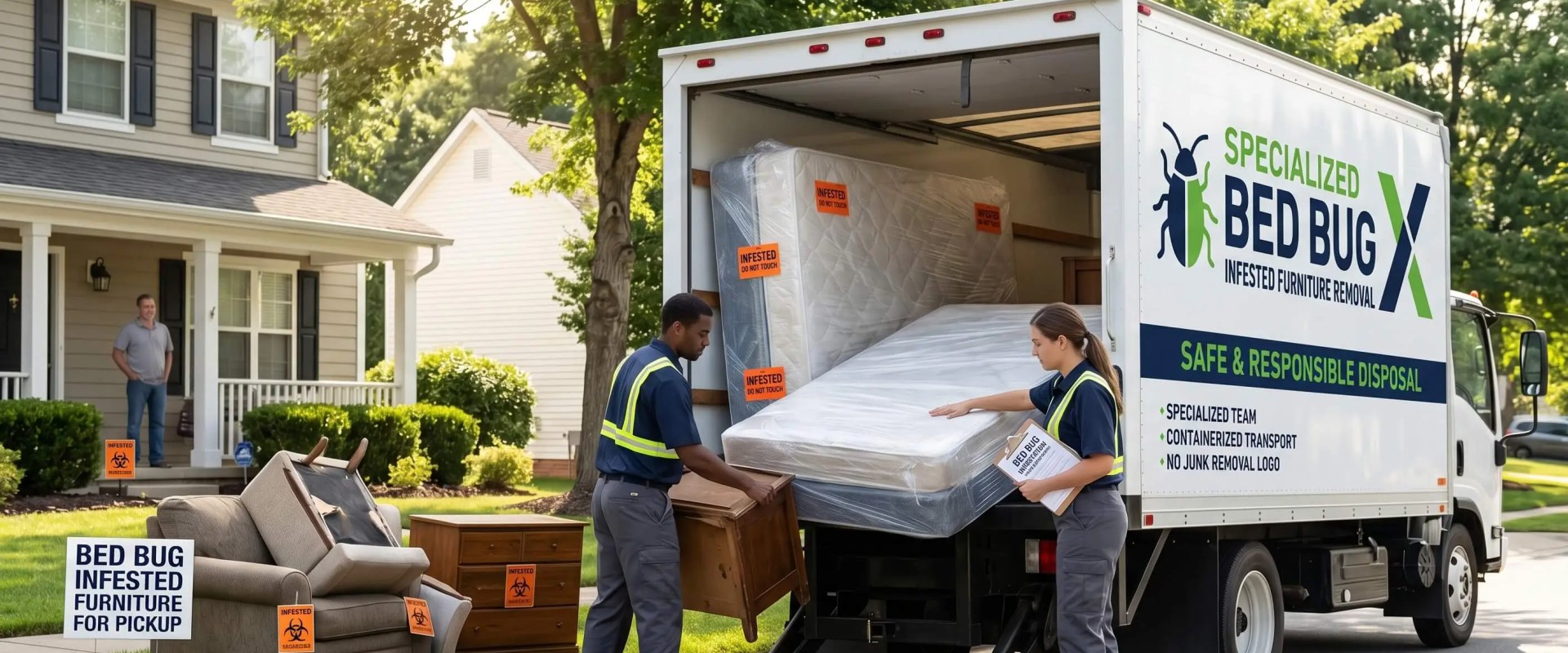
The companies that actually remove bed bug infested furniture are specialty junk removal services with documented bed bug protocols. Standard haulers refuse the job once you disclose the infestation, donation centers won't accept the items at all, and most municipal bulk pickup programs require advance preparation and labeling. That gap is why specialty providers exist as a distinct service category.
Three options will take the work:
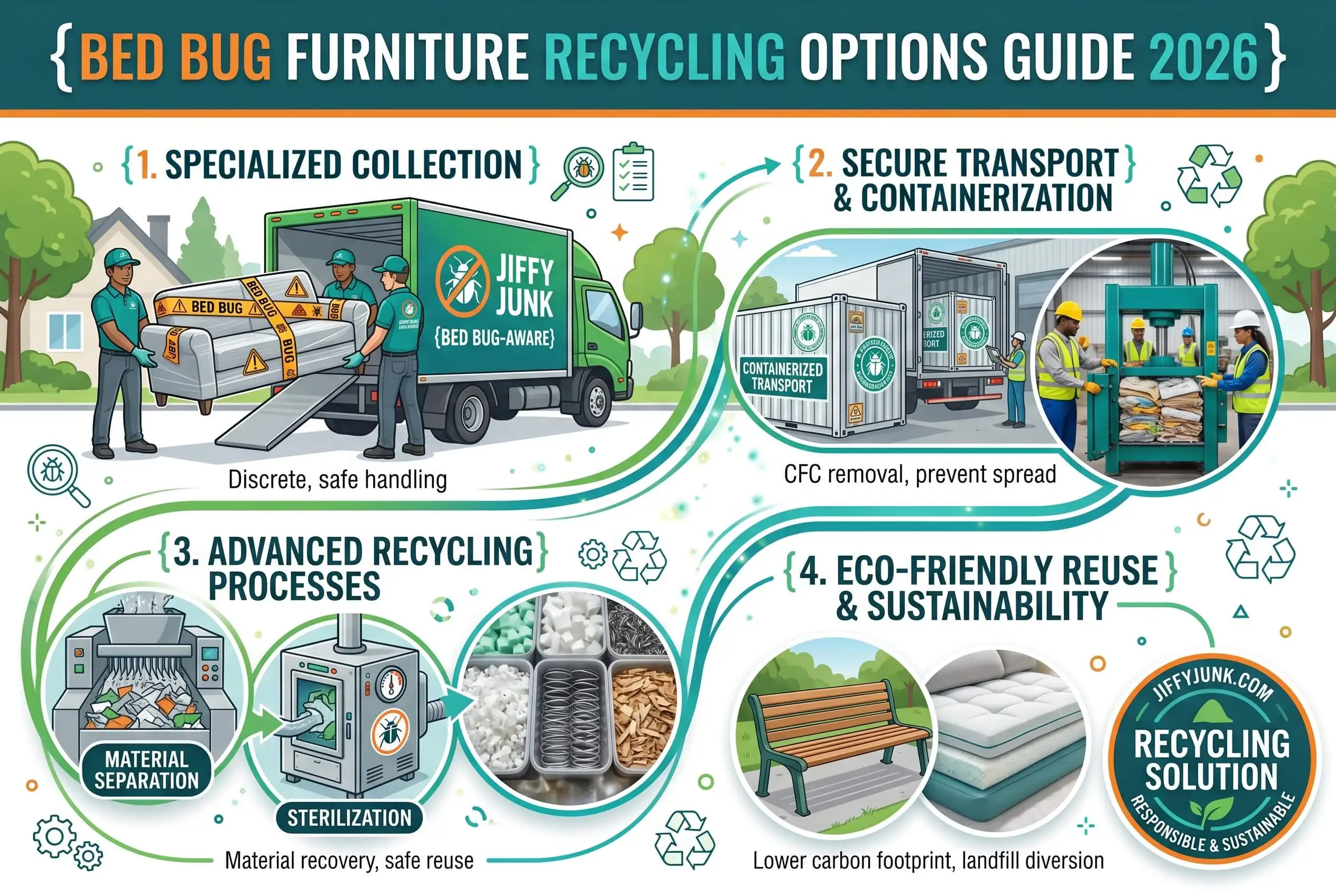
National specialty junk removal services: Jiffy Junk is the most established, with crews trained in sealed-transport protocols, dedicated trucks sanitized between jobs, and disposal at approved waste facilities. Typical cost: $150–$500 per piece.
Local junk haulers with bed bug experience: Quality varies by city. Ask whether they wrap items on-site, sanitize the truck between jobs, and provide a disposal receipt before booking.
Pest control companies offering disposal alongside treatment: Less common as a standalone service, but worth a call if you're already booking extermination.
Before any pickup, wrap the piece in heavy plastic, tape the seams, and label it "BED BUGS" so neighbors don't scavenge the item from the curb.
Top Takeaways
Most traditional recycling programs in 2026 reject bed bug furniture. Donation centers, thrift stores, and standard curbside recycling won't take it.
A narrow set of options still exists: heat-treatment recyclers, municipal special-waste programs, and a small number of manufacturer take-back programs. Each comes with strict conditions.
Preparation isn't optional. Wrap the piece, seal it, mark it "BED BUG INFESTED," and damage it enough that nobody else picks it up. The EPA and Purdue Extension protocols spell this out.
For most households, professional removal beats the recycling pathway on speed, safety, and cost.
Companies that remove bed bug infested furniture should carry biohazard insurance, transport items in sealed vehicles, and provide disposal documentation.
Local rules matter. Call 311 or your municipal solid-waste authority before you put anything outside.
Speed reduces cost. Every day you delay, the bill grows.
The Real State of Bed Bug Furniture Recycling in 2026
Why Bed Bug Furniture Is Treated Differently from Regular Furniture Disposal
Standard furniture has plenty of disposal paths in 2026. Curbside programs collect it. Thrift networks accept it. Municipal bulky-item pickups handle most pieces. Modern furniture is built from materials like wood, foam, springs, and textiles, and recyclers can recover usable portions of what households throw out.
Bed bug furniture breaks every part of that model. The bugs survive in joints, upholstery seams, and crevices for months without feeding, and one infested piece can seed a new infestation in a thrift store, a recycling facility, or another family's home. That's why nearly every donation center, recycler, and curbside program now turns away anything confirmed or suspected to be infested.
2026 Recycling Options That Actually Exist
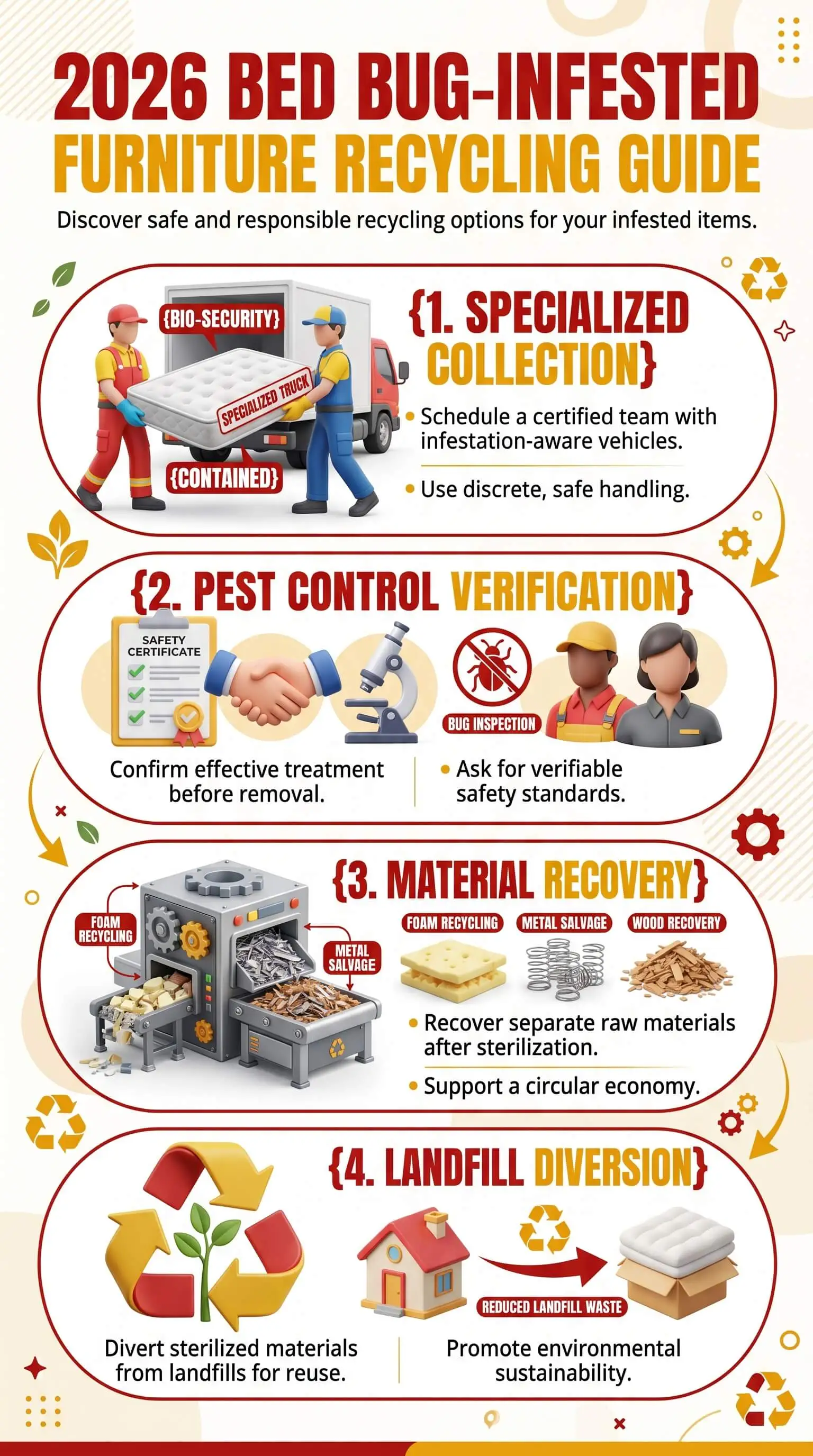
Three recycling pathways still work for bed bug furniture, with real limits on each:
Heat-treatment recycling programs. A handful of specialty facilities, most of them in larger metro areas, run commercial thermal chambers that bring furniture core temperatures to 120°F or higher for sustained periods. The heat kills bed bugs at every life stage, and the materials can then enter standard recycling streams. The catch is capacity: most U.S. homeowners don't have a heat-treatment recycler within practical driving distance.
Municipal hazardous and special waste programs. A small number of cities and counties accept infested furniture as a special-handling category. Programs vary a lot from one zip code to the next. Call 311 (or your local solid waste authority's equivalent) before you move anything. Rules change annually, and most programs require documentation, sealing, and visible marking.
Manufacturer take-back programs. IKEA's circular furniture program and a small number of mattress manufacturers will accept items back under specific conditions. Almost all of these programs explicitly exclude infested or biologically contaminated returns, though. Get the answer in writing before you commit.
What You Cannot Do with Bed Bug Furniture in 2026
The list of things you can't do is longer than the list of things you can. Do not:
Donate the furniture to charity, thrift, or a buy-nothing group
Leave it at the curb without sealing it and marking it "BED BUGS"
Sell it on Facebook Marketplace, Craigslist, or any resale platform
Dump it in a shared apartment dumpster without proper wrapping
Drop it at a recycling center without disclosing the infestation
Several U.S. cities will fine you for some of these. NYC's Local Law 69 and similar municipal rules require landlords to disclose bed bug history to prospective tenants, and they require homeowners to mark infested furniture clearly before placing it at the curb.
Preparing Bed Bug Furniture Before Recycling or Removal
Once you've confirmed an infestation and decided to remove the piece, preparation does more work than people expect. The EPA and Purdue University Extension recommend the same core protocol:
Wrap the item completely in heavy-duty plastic (3-mil minimum) and seal every seam with packing tape.
Mark the item clearly with the words "BED BUG INFESTED" or "INFESTED" using bold marker or spray paint.
Damage the item enough that no one will pick it up from the curb. Slash the upholstery. Break the frame. Purdue is direct on this point: render the furniture unusable so nobody else carries the problem home.
Keep treatment records and any pest-control documentation. Some haulers and municipal programs require proof of treatment.
When Professional Removal Beats DIY Recycling
For most readers, recycling isn't actually a realistic option. Heat-treatment facilities are sparse. Municipal special-waste programs vary wildly by zip code. And preparing furniture for any of these pathways takes real legal and physical work. That's the gap a professional bed bug furniture removal company fills.
What to look for when you're hiring companies that remove bed bug infested furniture:
Insurance and biohazard handling. Confirm liability coverage that explicitly includes pest-related claims.
Sealed-truck transport. The hauler should move infested items inside a closed vehicle, not an open bed.
Disposal-site documentation. A reputable hauler can produce a paper trail showing where the items ended up.
Transparent pricing. Single-item bed bug furniture removal in 2026 usually runs between $75 and $300, depending on item size, building access, and your local regulations.
Four questions worth asking any company you're considering: Where do the items go? Do you provide disposal documentation? Are your trucks sealed? Are you insured for biohazard removal?
Safe DIY Disposal When Recycling Isn't an Option
If hiring help isn't workable for you, the DIY route still exists, but it demands discipline:
Confirm the infestation. Don't guess.
Wrap, seal, mark, and disable the furniture using the protocol above.
Call your local solid waste authority for special-handling instructions specific to your address.
Schedule curbside pickup or drop-off during the window the authority specifies. Don't stage the item early.
Treat the room and the area around it before you bring in any replacement furniture.
Environmental and Health Considerations in 2026
Bad disposal creates real downstream harm. Sanitation workers handle exposed items and can carry bed bugs across collection routes. Recycling-facility staff face the same risk. Pesticide-treated furniture is a separate concern: it can introduce chemical residues into recycling streams that weren't designed to handle them. The CDC and EPA flagged these issues in their joint statement on bed bug control over a decade ago, and the same concerns still drive modern handling protocols.
"After watching this play out across hundreds of household consultations and reader cases, the pattern is the same every time: the families who get through a bed bug episode fastest are the ones who stop trying to recycle their way out. We get it. Saving the couch feels like the right move. But the recycling options for genuinely infested furniture in 2026 are narrow, vary by region, and come with conditions most people can't meet. The cleanest path looks like this: professional removal, certified disposal, and a clean, verified room before you bring in anything new. Every week of delay raises your eventual cost of remediation and the chance that your neighbor inherits the problem."
7 Essential Resources
Every resource below is verified and active as of April 2026. They cover the federal, academic, and state-level guidance referenced throughout this article. Bookmark them before you start any disposal project.
EPA: Do-It-Yourself Bed Bug Control. Federal guidance on inspection, treatment, and disposal protocols. https://www.epa.gov/bedbugs/do-it-yourself-bed-bug-control
EPA: Top Ten Tips to Prevent or Control Bed Bugs. Practical homeowner guidance with disposal cautions. https://www.epa.gov/bedbugs/top-ten-tips-prevent-or-control-bed-bugs
CDC and EPA Joint Statement on Bed Bug Control in the United States. The foundational federal document on bed bug response, including disposal context. https://stacks.cdc.gov/view/cdc/21750/cdc_21750_DS1.pdf
Purdue University Extension: Bed Bug Furniture Inspection and Disposal Protocol. The most thorough public-domain protocol for safely disposing of infested furniture. https://www.extension.entm.purdue.edu/bedbugs/furnitureDisposal.php
New York State Department of Health: Bed Bugs. State-level guidance with tenant-rights notes and disposal cautions. https://www.health.ny.gov/environmental/pests/bedbugs.htm
Georgia Department of Public Health: Bed Bug Handbook. A detailed PDF handbook covering identification, treatment, and disposal, useful in any state. https://dph.georgia.gov/document/document/bedbughandbookv2022pdf/download
National Pest Management Association: Bed Bug Facts and Statistics. Industry-survey data and homeowner tips from NPMA / PestWorld. https://www.pestworld.org/all-things-bed-bugs/bed-bug-facts-statistics/
3 Statistics
All three statistics below come from primary-source research published in 2025 and a state public-health handbook. Together they explain why the recycling path keeps narrowing and why professional removal has become the default for most U.S. homeowners.
01. Only 29% of Americans can correctly identify bed bugs.
This finding from a Harris Poll commissioned by the National Pest Management Association in April 2025 explains why so many infestations get misidentified or underestimated until they spread.
Source: NPMA / PestWorld, 2025 Bed Bug Facts
02. Over 82% of pest control professionals reported treating bed bugs in the past year.
A 2025 survey from NPMA and the University of Florida confirms that bed bug work is now routine across the pest management industry. Trained help is available in most U.S. markets.
Source: NPMA, Bed Bugs Exposed Press Release (June 2025)
03. Adult bed bugs can travel over 16 feet in five minutes.
This figure from the Georgia Department of Public Health Bed Bug Handbook explains why "just throw it away" rarely works as a clean solution. Bugs migrate during transport, which is why sealing, marking, and damaging the furniture all matter.
Source: Georgia DPH, Bed Bug Handbook (PDF)
Final Thoughts and Opinion
If you're reading this, you probably came in hoping there'd be a recycling option that lets you handle this responsibly without sending material to a landfill. That instinct is good. After looking honestly at the 2026 landscape, here's where we land:
A small share of homeowners can make recycling work. They live near a heat-treatment facility, or they're in a city with a strong special-waste program, or they have manufacturer take-back access. For everyone else, the math has shifted. Narrow program availability, strict prep requirements, rising municipal fines, and the actual risk of reinfestation all push professional removal into the position of the better default. It costs less than people expect (often under $300 for one item), it produces disposal documentation, and it ends the cycle in one visit.
The wrong move is to freeze. Every extra day a confirmed-infested piece of furniture stays in your home, especially in a private home care setting, the eventual remediation bill grows, and so does the chance the problem spreads. Within 48 hours of confirmation, pick your path. If your zip code supports recycling, take that route. Otherwise, hire a professional remover. Then move.
Frequently Asked Questions
Can you recycle a bed bug mattress?
Almost never, at least not through standard mattress recycling. Most facilities refuse infested items outright. A small number of heat-treatment programs do accept mattresses after sealed transport, but those programs only operate in certain regions. For most homeowners, the realistic path is professional removal or your city's special-handling program.
Do thrift stores accept bed bug furniture?
No. Goodwill, Salvation Army, Habitat ReStore, and almost every reputable charity in the U.S. now refuses items with any bed bug history. Donating an infested piece harms the recipient, and in some jurisdictions you can face legal action for it.
Is it illegal to throw out bed bug furniture?
It depends on where you live. NYC, Chicago, Philadelphia, and several other large U.S. cities require homeowners to wrap, seal, and mark infested furniture clearly before placing it at the curb. Cities can fine you if you skip those steps. Check your local ordinances before any disposal.
How much do companies that remove bed bug infested furniture charge?
Single-item bed bug furniture removal usually runs $75 to $300 in 2026, depending on item size, building access, and your local regulations. Multi-item or whole-room jobs scale up from there. Ask whether the price includes disposal documentation before you book.
Can heat-treated furniture be recycled?
Yes, sometimes. After commercial thermal treatment kills bed bugs at every life stage, the materials can usually enter standard recycling streams. The catch is that only facilities equipped to verify the treatment will accept them. DIY heat treatment, like a household freezer or steam cleaner, doesn't reliably qualify.
What is the safest way to get rid of bed bug furniture?
Professional removal by a company with biohazard handling experience is the safest path for most households. It cuts the spread risk, produces disposal documentation, and removes the item completely in one visit.
Will my regular trash service take it?
Sometimes, but only with proper preparation. Most municipal trash services will collect bed bug furniture if you wrap, seal, and label it, but many require advance notice and specific placement. Don't assume. Call ahead.
Ready to Move Forward?
Bed bug furniture rarely earns the recycling gamble.
If you'd rather have it gone today, sealed, hauled, and disposed of according to your local regulations, click or tap here to compare professional bed bug furniture removal services and see live pricing.