Ninety-six. That's the number my phone showed me on the morning my house started smelling like a campfire.
Smoke had drifted in overnight from a fire four states west, the sky had gone the color of weak tea, and the weather app sat there in cheerful yellow telling me conditions were moderate. I believed it for about six hours.
What I hadn't figured out yet is the thing this whole page exists to explain. AQI meaning boils down to a health risk score for outdoor air on a 0 to 500 scale, where a higher number means a better chance the air gives your lungs or your heart a hard time. It isn't a percentage, it only ever reports the single worst pollutant of the day, and it comes from a monitor that might sit miles from your street. Once those limits clicked for me, the number stopped being confusing and started being genuinely useful.
TL;DR Quick Answers
aqi meaning
AQI means Air Quality Index, a 0 to 500 score for how risky outdoor air is to breathe right now. Higher numbers mean higher health risk. It reports only the single worst pollutant of the day, and it measures outdoors, never the air inside your house.
0 to 50, green: Good. Normal outdoor activity is fine.
51 to 100, yellow: Moderate. Fine for nearly everyone.
101 to 150, orange: Kids, older adults, and anyone with a heart or lung condition should ease off outdoor exertion.
151 and above: Everyone cuts back, and more so as the number climbs.
Not a percentage: An AQI of 100 sits near the federal health standard for that day's worst pollutant, not at 100 percent dirty air.
Check the pollutant, not just the score: Ozone fades after sundown. Smoke particles can sit on your street for days.
Indoors is on you: Close the windows, recirculate, and look at the filter rather than the calendar.
Top Takeaways
The AQI scores health risk, not percentage of pollution. A value of 100 sits near the federal short-term standard for that day's worst pollutant.
Only the single highest pollutant gets reported. Ozone at 65 alongside PM2.5 at 118 shows up as 118, and nothing gets averaged.
Always check which pollutant is driving the score. Ozone fades after sundown. Smoke particles can hold for days.
The measurement is outdoor and regional. Only metros above 350,000 people have to report a daily index, and the monitor may be nowhere near you.
Indoors, you control ventilation and filtration. Close the windows, recirculate, and make sure the filter is clean and rated for what you're facing.
The Short Definition of AQI Meaning, and Where It Bends
The index is a conversion, plain and simple. Pollutant levels get measured in units nobody carries around in their head, like parts per million and micrograms per cubic meter, and the index turns each of those into a value on one shared 0 to 500 scale tied to federal health standards. Other countries build their own versions on their own standards, so a score you see while traveling may not mean what you'd assume (how national air quality indices differ).
Six pollutants make up the American index: ground-level ozone, the fine particles called PM2.5, the coarser ones called PM10, carbon monoxide, sulfur dioxide, and nitrogen dioxide.
Now for the misreading I run into most. People treat 100 as the halfway mark on some kind of dirtiness meter. It isn't. An index value of 100 lines up roughly with the short-term national standard for whichever pollutant is running highest that day, and that standard marks the point where health scientists expect effects to start showing up. Under it, you're generally fine. Over it, the air starts causing trouble for people who are already sensitive, then for everybody else as it keeps climbing.
Six Pollutants Go In, One Number Comes Out
Each pollutant gets its own index value, and the AQI you see is simply the highest of them. Nothing gets averaged. Federal reporting rules also require agencies to name the driving pollutant right beside the score, which makes it the most underused piece of information in the whole system.
Say ozone comes in at 65, PM2.5 at 118, and carbon monoxide at 20. Your app shows 118. The other two disappear from the report even though you're still breathing them.
The reason to hunt down that pollutant name is that the two usual suspects behave nothing alike. Ozone forms in sunlight, builds through hot afternoons, and falls off once the sun does. Smoke particles don't keep office hours, which is also why understanding what causes dust and other airborne particles matters when interpreting pollution levels. That 96 I ignored turned out to be particle-driven and it parked on my street for three days, and if ozone had been behind it, an evening walk would have been perfectly reasonable.
Where Your Number Sits on the 0 to 500 Scale
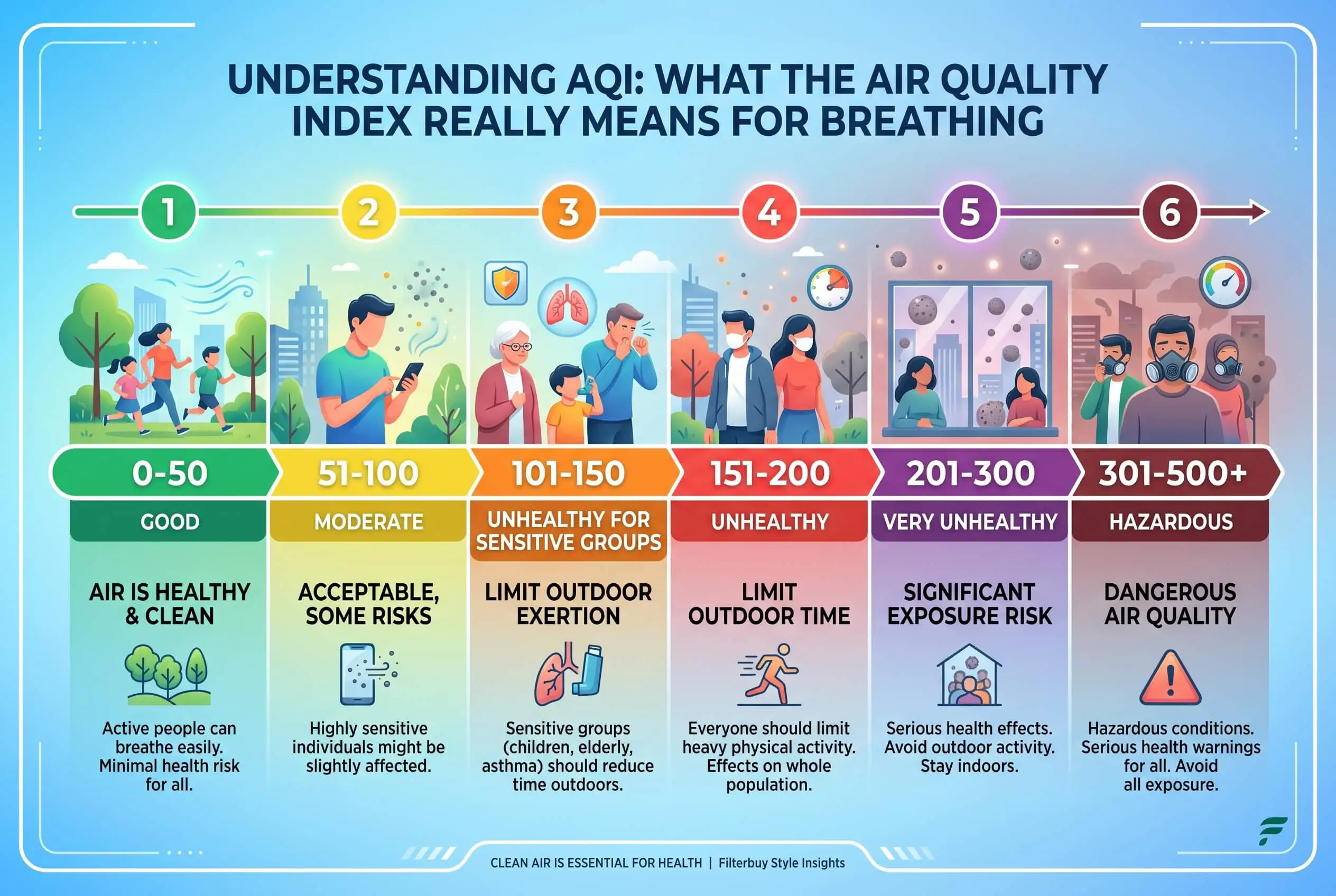
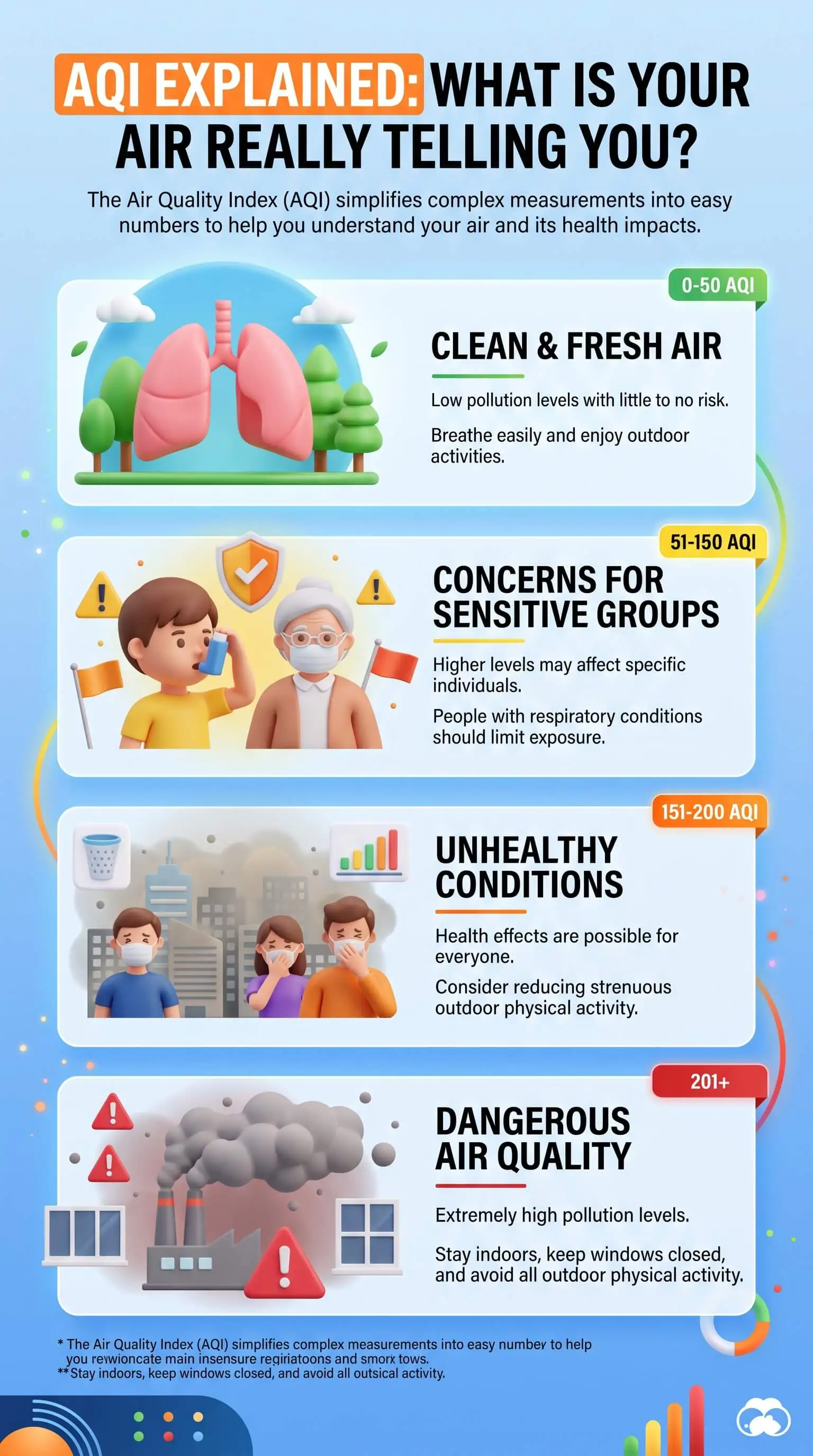
Six categories split the range, each with its own color. Zero to 50 is green and carries little risk, and yellow runs to 100 and works for nearly everybody. Orange kicks in at 101, which is where kids, older adults, and anyone with a heart or lung condition should ease off hard outdoor effort. Red starts at 151 and extends that same advice to everyone else. Purple begins at 201, and maroon covers 301 and above, which agencies treat as an emergency.
Memorizing six bands never stuck for me. Watching one hinge did. A hundred is where the index quits describing your day and starts handing you instructions.
For the level-by-level version, including what each color is actually asking you to do, this full explanation of the AQI scale from 0 to 500 walks through all six.
The Monitor Sits Outside, and So Does Everything It Measures
Regulatory monitors report by metropolitan area, and only metros above 350,000 residents have to publish a daily index at all. So the figure on your screen may be describing air from a station well outside your neighborhood. It can't see the highway two blocks over. It has no idea your neighbor burns brush on Saturdays.
It also has no reading whatsoever on your house, and that's the part people take for granted. Outdoor air moves indoors all day long, through open windows, gaps around doors, the building envelope itself, and the return side of your HVAC system. Past that point the index has nothing left to tell you.
What you actually control once the air is inside comes down to whether the windows are open, whether the system is pulling in outdoor air or recirculating it, and what's loaded in the filter slot. On a bad day I close up early, run the fan, and pull the filter out to look at it rather than trusting the calendar. The MERV rating on that filter sets how much of the fine particle load it pulls out on each pass, and a filter already packed with three months of dust can't do what a clean one does, whatever the rating printed on the frame says.
None of this replaces medical advice. For anything about your own breathing or a diagnosed heart or lung condition, talk to a qualified healthcare professional, even if you're also using MERV 8 pleated HVAC furnace air filters to help manage everyday airborne particles indoors.
“People call us confused because the app said moderate while their eyes were burning at the kitchen table, and nine times out of ten the score was right about outdoors and irrelevant to their floor plan. I've cut open filters after a smoke week and found the pleats packed solid at the return end while the far side still looked new, which tells you exactly how much air was moving and how fast that filter gave up.”
7 Essential Resources
1. Tell Apart the Daily Index, the Forecast, and the Current Hour
Three different numbers all get called the AQI, and they answer different questions. This page separates them and explains the NowCast method, which leans harder on the most recent hours when conditions are shifting. That's why your score can move between breakfast and lunch.
Source: AirNow, U.S. Environmental Protection Agency https://www.airnow.gov/aqi/aqi-basics/using-air-quality-index/
2. Go Straight to the Regulation That Defines the Index
This is the primary source rather than somebody's summary of it. The appendix fixes the six categories and their colors, states outright that the highest pollutant index becomes the reported AQI, requires agencies to identify the driving pollutant, and publishes every breakpoint concentration behind the math.
Source: Electronic Code of Federal Regulations, 40 CFR Part 58 Appendix G https://www.ecfr.gov/current/title-40/chapter-I/subchapter-C/part-58/appendix-Appendix%20G%20to%20Part%2058
3. Reschedule an Orange Day Instead of Cancelling It
Useful reframing if you've got kids, an outdoor job, or a running habit you don't want to lose. A Code Orange forecast asks you to move the activity to a better hour or a better place. It isn't telling you to write off the day.
Source: Centers for Disease Control and Prevention https://www.cdc.gov/air-quality/about/index.html
4. Know Your First Moves When an Alert Goes Out
Short and operational. Stay informed, stay inside where you can, hold outdoor time to what's essential, cut your own emissions, and burn nothing while the alert stands. Read it once and it'll be there when you need it.
Source: National Weather Service, NOAA https://www.weather.gov/safety/airquality-during
5. See Why Indoor Air Is Its Own Problem With Its Own Sources
Covers everything the outdoor index never touches: mold, tobacco smoke, household products, radon, carbon monoxide, and off-gassing from building materials. It makes a strong case that ventilation and filtration are the controls you personally operate.
Source: MedlinePlus, U.S. National Library of Medicine https://medlineplus.gov/indoorairpollution.html
6. Read the Research on Indoor Exposure and Lung Health
Findings on how indoor pollutants affect asthma symptoms and lung development, including work tying frequent indoor wood burning to reduced lung function in adults with asthma. Solid grounding for why the indoor half of a high AQI day deserves your attention.
Source: National Institute of Environmental Health Sciences https://www.niehs.nih.gov/health/topics/agents/indoor-air
7. Look at the Instruments Behind the Numbers
Something physical has to measure a pollutant before it ever becomes an index value. This walks through ozone, visibility, smoke, and particulate monitoring with photographs and video of the equipment, and it notes how many sites feed the national picture.
Source: National Park Service, U.S. Department of the Interior https://www.nps.gov/subjects/air/air-monitoring.htm
3 Statistics
Americans spend roughly 90 percent of their time indoors. Indoor concentrations of some pollutants run 2 to 5 times higher than outdoor levels. The AQI describes the other 10 percent.
Source: U.S. Environmental Protection Agency, Report on the Environment https://www.epa.gov/report-environment/indoor-air-quality
152.3 million Americans live in counties with failing air grades. That's 44 percent of the country, graded F for unhealthy ozone or particle pollution in the 2026 report.
Source: American Lung Association, State of the Air 2026 https://www.lung.org/research/sota/key-findings
In 2019, 99 percent of the world lived above the health guideline. Outdoor air pollution was estimated to cause 4.2 million premature deaths globally that year.
Source: World Health Organization https://www.who.int/news-room/fact-sheets/detail/ambient-(outdoor)-air-quality-and-health
These statistics show why indoor air quality testing matters: Americans spend about 90% of their time indoors, where some pollutant levels can be 2 to 5 times higher than outdoors, while unhealthy air pollution continues to affect millions of people across the U.S. and worldwide.
Final Thoughts and Opinion
My honest read is that the AQI is an excellent instrument getting asked to answer a question nobody designed it for.
What it pulls off is real. Six pollutants, six sets of units, six different health thresholds, all compressed into one integer you can read while pouring coffee. And it means the same thing everywhere, so a 150 in Sacramento and a 150 in Cleveland describe the same level of risk to your body. That took decades to standardize and it works, while high quality filters can help reduce how much particle pollution makes its way into the indoor air you breathe.
My reservation is resolution, in two senses. Geographic, because a monitor sitting miles away can't know your street. And informational, because reporting only the maximum flattens differences that matter. A day with four pollutants at 90 and a day with three at 20 and one at 90 produce an identical score, and those aren't identical days to spend outside.
So here's the habit I'd push, and it's a small one. Read the number, read which pollutant produced it, then decide. Three extra seconds. It changes the right answer often enough to earn its place in your morning.
Frequently Asked Questions
What does AQI mean?
AQI stands for Air Quality Index. It converts measured outdoor concentrations of six pollutants into one number between 0 and 500 that reflects health risk. Lower means cleaner. Higher means a greater chance of health effects, hitting sensitive groups first and widening to everyone as the score climbs, which can also be a useful context when planning private home care for people who may be more sensitive to poor air quality.
Is an AQI of 50 good?
Yes. Zero through 50 is the Good category, shown in green, and it represents little or no risk for the general public. You don't need to adjust anything outdoors at that level, including exercise and long stretches outside.
What does an AQI of 100 mean?
One hundred marks the top of the Moderate band. It corresponds roughly to the short-term national health standard for whichever pollutant leads that day. Most people won't notice a thing, though unusually sensitive individuals may want to start paying attention as the score approaches it.
Does AQI measure indoor air quality?
No. The index reports outdoor air only. Outdoor pollution does reach indoors through windows, doorways, envelope gaps, and HVAC systems, which is also why decisions around HVAC replacement can matter for how effectively a home manages incoming air and filtration, but the score can't see your rooms and it ignores indoor sources like cooking, candles, wood burning, and mold.
Which pollutant sets the AQI number?
Whichever of the six scores highest. Every tracked pollutant gets its own index value and the largest one becomes the reported AQI. Reporting rules require agencies to publish the name of that driving pollutant alongside the figure.
Why does the AQI change during the day?
Wind, traffic, heat, and drifting smoke all move air quality hour to hour. Current ozone and particle readings also use a weighted average that leans on the most recent hours instead of a flat 24-hour figure, so the number reacts faster when conditions turn.
CTA
The score tells you what's happening outside, and your filter decides how much of that ends up in the air you're actually breathing indoors. Pleated furnace filters can help capture airborne particles before they circulate through your home. Read the number and the pollutant sitting next to it in the morning, then go look at what's loaded in your return.