Two paths exist when a large appliance needs to go. The first runs through your local municipal program. The second runs through a private service that schedules around you, not around a bulk waste calendar. Both move the same home appliance from your floor to a disposal facility. The cost, speed, and eligibility rules are where they split. This guide lays out both, honestly, so you can pick the one that fits your situation.
Cost gets most of the attention in this comparison, but it's not the only variable worth checking. Timing, eligibility, and how much of the work lands on you are just as likely to determine which option you actually use. Here's how each one works.
TL;DR Quick Answers
What is an appliance pick up?
Appliance pick up is a scheduled removal service for large household appliances — refrigerators, washing machines, dryers, dishwashers, ovens, and HVAC units — that are too heavy or hazardous to dispose of in regular household trash. Two options exist:
City pick up — free or low-cost through your local municipal bulk waste program. Requires advance scheduling (typically 3–14 days), curbside placement, and appliance eligibility. Most programs do not accept units containing refrigerants.
Private pick up — on-demand service through a licensed junk removal company. Available same-day or next-day, handles refrigerant-containing appliances, and loads from inside your home. Costs average $60–$180 per item.
The deciding factor: check whether your appliance contains refrigerant and when your city's next pickup date falls. If either is a problem, book a private service.
Top Takeaways
City pickup is free or low-cost with real conditions attached: fixed scheduling windows, eligibility restrictions, and no in-home service. Check your local program before you commit. (See: Wikipedia: Home Appliance)
Private appliance pickup runs $60 to $180 per item on average. It offers on-demand scheduling, in-home loading, and handles refrigerant-containing appliances that city programs typically won't accept.
Refrigerators, window air conditioners, and dehumidifiers contain refrigerants regulated under Section 608 of the Clean Air Act. The final disposer is legally required to ensure refrigerant is recovered before the appliance is scrapped. Confirm what your city program does on this before scheduling.
Over 18 million large appliances are discarded in the U.S. every year. Services that route units to certified recyclers rather than landfills make a measurable difference in what gets recovered.
Prep before any pickup: disconnect power and utilities, defrost refrigerators and freezers completely, and clear the path to the door.
The most common mistake is staging the appliance at the curb without confirming it’s eligible. Five minutes of checking prevents weeks of rescheduling.
What City Appliance Pick Up Looks Like in Practice
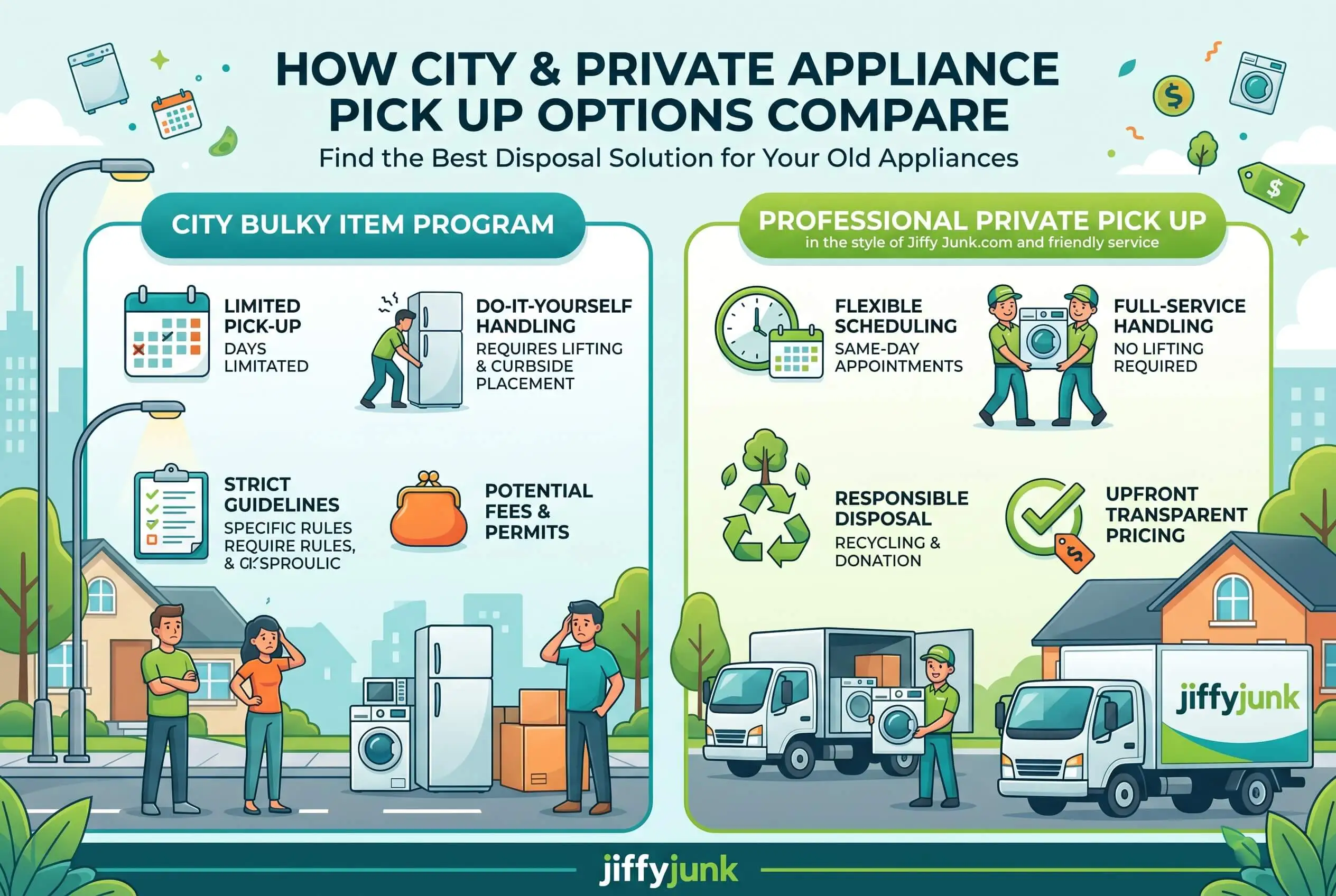
Municipal bulk waste programs follow the same basic structure regardless of city: you contact your local sanitation or public works department, schedule a bulk pickup appointment, and put your appliance at the curb on the assigned day. For most residents, there's no charge or a minimal one.
The limitations are real and worth knowing up front. Scheduling windows run days to weeks out. Many programs only run bulk pickup once a month per neighborhood. And the list of accepted appliances is shorter than most people expect. Refrigerators, window air conditioners, and dehumidifiers are frequently excluded unless the refrigerant has already been removed — because under Section 608 of the Clean Air Act, the EPA requires certified refrigerant recovery before any of those units can be legally disposed of.
If your timeline is open, your appliance qualifies, and curbside staging isn't a problem, city pickup is worth scheduling. If any of those conditions don't hold, you'll be looking at a Professional junk removal service.
What Private Appliance Pick Up Looks Like in Practice
Private appliance pick up services work on a different clock entirely. You book by phone or online, often for same-day or next-day availability, and a crew comes to your location, loads the appliance, and hauls it. You don't touch the curb. You don't hold a pickup day on the calendar. Most services staff Section 608-certified technicians or route refrigerant-containing units through certified disposal partners, which is how they handle the appliances city programs typically won't.
The price reflects the convenience. Per Angi's 2026 data, appliance removal runs $60 to $180 per item on average, with full junk removal jobs averaging around $241. A single refrigerator often lands between $75 and $150 depending on location and service. That's a real cost. It's also a number that looks different once you factor in two weeks of rescheduling, a rejected appliance, and a delivery crew that needs the old unit gone before they'll leave the new one.
For renters, people in multi-unit buildings with no practical curbside access, and anyone working against a delivery or move-in date, private pickup is usually the only option that fits the timeline.
Side-by-Side Comparison
How the two options stack up across the factors that matter most:
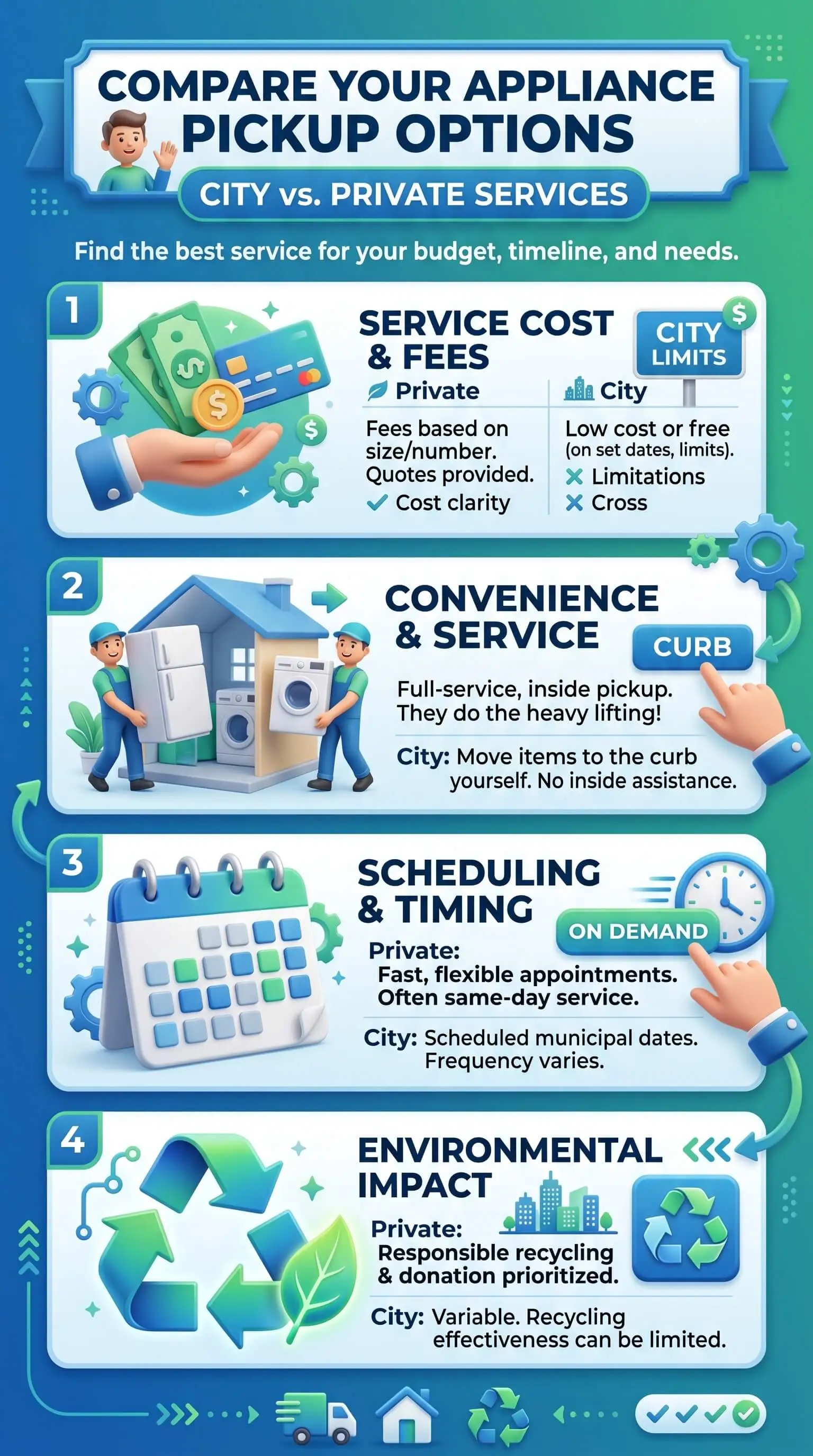
Cost — City pickup is free to low-fee (varies by city). Private pickup averages $60–$180 per item.
Scheduling — City requires advance scheduling on fixed bulk pickup days. Private services offer on-demand booking, often same-day or next-day.
Speed — City pickup runs days to weeks depending on the program schedule. Private crews arrive within hours to one business day in most metros.
Item Eligibility — City programs are limited and frequently exclude refrigerant appliances. Private services accept most appliance types including refrigerant units.
Convenience — City requires curbside placement on the designated day. Private crews load and haul from inside your home.
Eco Disposal — Municipal recycling programs vary by city. Reputable private services recycle per EPA guidelines.
Best For — City suits budget-focused, non-urgent, eligible items. Private suits time-sensitive, complex, or refrigerant-containing units.
When City Pick Up Is the Right Call
Four conditions make city pickup the practical choice: your appliance has no refrigerant, the next bulk pickup day falls within a reasonable window, curbside staging is accessible, and avoiding any out-of-pocket cost is the priority. When all four line up, use it. Specifically:
You're disposing of a washing machine, dryer, or oven — the appliance categories most programs accept without restriction.
Your city's next bulk pickup day is within a week and you have a safe spot to stage the appliance at the curb.
You're not working around a delivery or move-in deadline that needs the old unit gone on a fixed date.
You've confirmed your specific appliance and address are covered under your program's eligibility rules.
When Private Pick Up Makes More Sense
Private pickup wins in five clear situations. If any of these describe your circumstances, pay for the service:
Your appliance contains refrigerant and your city program won't take it without prior draining.
You need it gone within 24 hours because a new appliance is being delivered.
You're clearing multiple appliances at once and want a single crew to handle all of them.
You live in an apartment or condo with no practical curbside access.
You want the job handled start to finish by a crew that manages professional appliance pick up — including loading, hauling, and certified disposal.
How to Prepare Your Appliance Before Pick Up
Prep takes under 30 minutes and prevents the most common delays on pickup day. Work through this before your crew or city truck arrives:
Unplug the appliance from the wall at least 24 hours before pickup.
Shut off and disconnect water lines for washing machines and dishwashers. Gas dryers and ranges need the line capped by a qualified technician before removal.
Defrost refrigerators and freezers completely and drain any standing water from the compartment. Mold and moisture cause problems for both city programs and private crews.
Clear the path from the appliance to the door. Full-size refrigerators sometimes require door panel removal to fit through a frame.
Check refrigerant requirements. If you're using city pickup, confirm whether your program requires documentation of refrigerant removal before they'll accept the unit.
"Most people default to calling the city because it sounds free, and then they’re surprised when the program excludes their refrigerator, or the next available pickup date is three weeks out. City pick up works well for a narrow set of appliances. Private services have gotten competitive enough that the cost difference is smaller than people expect. I’ve covered both options across dozens of markets. The situations where private pick up is the right call are far more common than homeowners realize, especially for anything with refrigerant, anything in a building with no street-level curbside access, or anything happening on a move-in or delivery timeline. One thing I’d always say before choosing: confirm your city program’s refrigerant rules. It’s the single most common reason a free pick up stops being free."
7 Essential Resources
1. EPA Safe Disposal Requirements for Refrigeration Equipment
This is the authoritative source on Section 608 of the Clean Air Act. It explains what legal requirements apply to the final disposer of a refrigerator, air conditioner, or dehumidifier, and why refrigerant must be recovered before any of those units are picked up or scrapped.
EPA: Stationary Refrigeration Safe Disposal Requirements
2. EPA Homeowner FAQ: Disposing of Appliances with Refrigerants
A plain-language FAQ written directly for homeowners. Covers what you're allowed to handle yourself versus what requires a Section 608-certified technician, including the rules on venting refrigerants when a unit is being serviced or disposed of.
EPA: Homeowners and Consumers Frequently Asked Questions
3. Angi: How Much Does Appliance Removal Cost?
Angi’s 2026 pricing dataset covers per-item appliance removal, full junk removal loads, and the cost factors that move the number up or down: appliance weight, access difficulty, and refrigerant handling. Worth checking before you call for a quote.
Angi: How Much Does Junk Removal Cost? (2026 Data)
4. Thumbtack: Junk Removal Cost Guide
Thumbtack’s national data breaks down removal costs by job type. The furniture, appliance, and electronics category averages around $255 per job. Useful for cross-referencing quotes and understanding where your project lands on the cost range.
Thumbtack: Junk Removal Cost Guide
5. EPA Durable Goods: Product-Specific Data (Major Appliances)
The EPA’s national dataset on appliance generation, metal recovery, and landfill tonnage. Documents the 3.1 million tons of ferrous metals recovered from shredded appliances annually, which is the concrete case for choosing services that recycle rather than landfill.
EPA: Durable Goods Product-Specific Data
6. Jiffy Junk: Appliance Pick Up Service
On-demand appliance pickup with upfront pricing, Section 608-certified refrigerant handling, and same-day or next-day availability in most metros. A practical reference for understanding what a full-service private removal actually includes.
Jiffy Junk: Appliance Pick Up Service
7. Wikipedia: Home Appliance
Covers appliance categories, expected service lifespans, and how major household appliances are classified. Useful when you’re trying to identify what disposal rules apply to a specific unit or deciding whether a repair is worth the cost.
3 Statistics
Over 18 million large appliances are discarded annually in the United States.
Source: Statista / Greenpeace / EPA / United Nations University via scoop.market.us (January 2026). View source
Eighteen million units a year means your city’s bulk waste program is fielding a lot of competing requests. That’s the structural reason scheduling windows run long and certain appliance types get cut from eligible lists. Your refrigerator isn’t special-cased — it’s one of millions, and municipal capacity has limits.
In 2018, major appliances generated 5.3 million tons of municipal solid waste, with 3.1 million tons of ferrous metals recovered — leaving 2.1 million tons landfilled.
Source: U.S. EPA, Durable Goods Product-Specific Data (updated October 2025). View source
Steel recovery from old appliances is one of the highest-performing material streams in U.S. waste management. But it only works when the appliance reaches a shredder. Of the 5.3 million tons generated in 2018, 2.1 million tons went to a landfill instead. When you’re choosing a private service, asking where the appliance ends up is worth the 30 seconds it takes.
Professional appliance removal costs an average of $60 to $180 per item, with full junk removal jobs averaging $241 nationally.
Source: Angi, How Much Does Junk Removal Cost? (updated 2026). Thumbtack puts the furniture, appliance, and electronics category at approximately $255 per job. View source
A single appliance removal frequently lands under $150. Multi-item pickups cost more per truck visit but less per unit once the load fills out. Before you write off the private option on price, check what your city program’s scheduling window actually costs you in time and logistics.
Final Thoughts and Opinion
Use city pickup when four things are true: your appliance has no refrigerant, the next bulk pickup day falls within a reasonable window, curbside staging is accessible, and avoiding any out-of-pocket cost is the priority. When all of that lines up, the free option is the right option. Municipal programs recover millions of tons of steel annually that would otherwise sit in a landfill.
Most disposal situations don’t check all four boxes. The refrigerator has refrigerant. The building doesn’t run curbside access to the units. The new appliance arrives Thursday and the delivery crew won’t set it up until the old one is out. When real conditions get in the way, a private service isn’t a backup plan. It’s the plan.
My recommendation: before you book either option, spend five minutes on your city program’s eligibility page. Find out whether your appliance qualifies and when the next available date is. If both answers work for your private home care situation, use the free service. If one of them doesn’t, call a private crew and get a quote. The price will likely be lower than you’re expecting.
The expensive mistake isn’t choosing the wrong service. It’s assuming city pickup will work, staging the appliance at the curb, and finding out on pickup day that it’s excluded. Three weeks of rescheduling from that point is a real cost that doesn’t show up in the pricing comparison.
Frequently Asked Questions
Is city appliance pick up really free?
In most cities, yes, but not always. Some municipalities charge a fee for bulk appliance pickup, particularly for units containing refrigerants. A few programs require a bulk waste sticker. Check your local sanitation department’s current fee schedule before assuming no cost.
How long does it take to schedule city appliance pick up?
Most municipal programs require 3 to 14 business days of advance notice. Some cities run bulk pickup once a month per neighborhood, which can push the wait to several weeks depending on timing. If your appliance needs to go sooner, a private service is worth pricing out.
Can private pick up services take any appliance?
Most reputable private services accept refrigerators, washing machines, dryers, dishwashers, ovens, HVAC units, and chest freezers. They manage refrigerant recovery for applicable units in-house or through certified partners. Confirm hazardous material handling with any service before you book.
How much does a private appliance pick up cost?
Based on current national data from Angi and Thumbtack, appliance removal averages $60 to $180 per item. Full junk removal jobs average around $241. Costs vary by appliance type, weight, location, and access. Get an itemized quote before booking.
What should I do before my appliance gets picked up?
Disconnect power at least 24 hours in advance. Shut off water lines for washing machines and dishwashers. Defrost refrigerators and freezers completely. Clear a path to the nearest exit. If your appliance contains refrigerant and you’re using city pickup, confirm whether your program requires documentation of refrigerant removal.
Ready to Schedule Your Appliance Pick Up?
Jiffy Junk handles on-demand appliance pickup with upfront pricing, Section 608-certified refrigerant handling, and crews available in most major metros. No waiting weeks for a city truck. No hauling it to the curb yourself.
Get a quote for professional appliance pick up from Jiffy Junk and see what same-day or next-day removal looks like in your area.