We are Dr. Ruslan Maidans, a dentist, and Dr. Yalda Shahriari, who holds a PhD in biomedical engineering. The frequency question you're asking right now is the same one we asked ourselves before any customer raised it. Here's what we found: the safe-use frequency of any hand cleanser comes from its cleansing mechanism, not from the word "waterless" on the front label. A waterless no rinse hand soap formula that removes contaminants through chemical stripping or alcohol has a real use ceiling. One that removes them through physical action does not, at least not for the same reason.
That's the distinction this page is built around.
TL;DR Quick Answers
waterless no rinse hand soap
A waterless no-rinse hand soap cleans hands without water, a sink, or a towel. Rub a small amount between your hands until it clumps around dirt, oil, and germs, then brush the clumps away. NOWATA does this with plant-based clumping technology instead of alcohol or surfactants, physically removing more than 99.9% of tested germs, Swiss lab verified, rather than just killing them and leaving residue behind.
No water, sink, or towel required
No alcohol, sulfates, or synthetic fragrance
Safe for daily use, including on sensitive skin
About 80 to 100 uses per 2.5 oz bottle
Top Takeaways
Frequency limits come from the cleansing mechanism, not the format. Alcohol-based sanitizer dehydrates skin with each use. Surfactant soap chemically loosens the skin's lipid structure with each use. Both mechanisms are cumulative, which is why both carry real overuse risk.
Traditional soap was never engineered with sensitive-skin frequency in mind. Soap works by combining fats or oils with an alkali to create a compound that binds to both water and oil. That's effective at lifting dirt, but it was never designed around minimizing skin barrier disruption.
A healthcare-worker study found that washing more than ten times a day roughly doubled the odds of visible skin damage. That's the clearest available evidence that frequency and formula interact, rather than frequency alone driving the outcome.
Physical removal, meaning no chemical reaction and no dehydration, is the only mechanism among the three main hand-hygiene categories that doesn't inherently accumulate damage with repeated use.
The ingredient list, not the front label, determines whether a gentle or sensitive-skin claim actually holds up. Hypoallergenic and dermatologist tests carry no FDA definition and require no pre-market proof.
Every hand cleanser on the market falls into one of three mechanical categories, and each one has a different relationship with frequency.
Alcohol-based sanitizer kills germs by dehydrating them. That same dehydrating action pulls moisture out of the stratum corneum, the outermost layer of skin that holds the barrier together. Used a few times a day, most skin tolerates it fine. Used ten or more times a day, which is common in healthcare settings, restaurant kitchens, and classrooms, the barrier starts breaking down in measurable ways. A study of frontline healthcare workers during the COVID-19 pandemic found that people washing or sanitizing more than ten times a day were roughly twice as likely to report hand skin damage as those washing less often (see Statistic 1 below).
Surfactant-based soap, including most products labeled gentle or sulfate-free, cleans by chemically loosening the bonds that hold oil, dirt, and germs to the skin. That action loosens the skin's own lipid structure too. It's a milder version of the same basic mechanism. The damage just builds more slowly, and it still adds up. Repeated exposure, not any single wash, is typically what triggers irritant contact dermatitis on sensitive skin.
NOWATA Waterless soap works on a third mechanism entirely. Our plant-based clumping technology physically binds to dirt, oil, and more than 99.9% of tested germs, then lifts them off the skin's surface. There's no chemical reaction and no alcohol involved, so hands go from dirty to clean without a rinse. An independent Swiss lab confirmed the removal rate against bacteria and virus surrogates. Because nothing is stripped or dehydrated, there's no equivalent to the sanitizer or surfactant use ceiling. We built the formula for people who need to clean their hands often: parents managing a toddler's day, people who spend more time outdoors than at a sink, and anyone whose skin already reacts badly to standard soap.
That doesn't mean you should ignore how your own skin responds, though. Any product, ours included, deserves a short adjustment period on new or highly reactive skin. Here's the practical version.
Patch test on the inside of the wrist or forearm before applying a new formula to the hands for the first time.
Use it for three to five days at your normal frequency and watch for tightness, redness, or dryness rather than expecting an immediate reaction.
If nothing changes, frequency is no longer a variable you need to manage. Use it as often as the day requires.
If irritation does appear, check the ingredient list first. It's rarely the waterless format causing the reaction. It's almost always a fragrance, preservative, or surfactant riding along with it.
“Parents ask us the frequency question more than any other. Our answer is always the one we gave ourselves before we built NOWATA: the mechanism decides the ceiling, not the marketing. We designed this formula so a parent could use it on a toddler's hands after every snack, every diaper change, every trip to the sandbox, without doing to their skin what we watched sanitizer do to ours. That was the entire point of two years of formulation. If a product needs a usage limit to stay safe, it wasn't built for how often hands actually get dirty.”
7 Essential Resources
1. CDC: About Handwashing
Source: Centers for Disease Control and Prevention. URL: https://www.cdc.gov/clean-hands/about/index.html
The federal baseline for when and how to clean hands, including the reminder that soap and water is the primary recommendation and alcohol-based sanitizer is the fallback, not the default.
2. CDC: Handwashing Facts and Data
Source: CDC. URL: https://www.cdc.gov/clean-hands/data-research/facts-stats/index.html
Documents the public-health case for frequent hand hygiene, including its role in preventing diarrheal and respiratory illness. Useful context for why washing less often is not a realistic fix for irritation.
3. NIH / PubMed Central: Rational Hand Hygiene During the COVID-19 Pandemic
Source: National Institutes of Health. URL: https://pmc.ncbi.nlm.nih.gov/articles/PMC7130538/
The clinical review behind the frequency-and-damage statistic cited on this page. Healthcare workers washing more than ten times a day showed measurably higher rates of skin damage.
4. American Academy of Dermatology: Products That Won't Irritate Eczema-Prone Skin
Source: American Academy of Dermatology. URL: https://www.aad.org/public/diseases/eczema/childhood/triggers/friendly-products
Dermatologist guidance on what to look for, and avoid, in any cleanser marketed to sensitive or reactive skin.
5. FDA: Cosmetics Labeling Claims
Source: U.S. Food and Drug Administration. URL: https://www.fda.gov/cosmetics/cosmetics-labeling/cosmetics-labeling-claims
Confirms that terms like gentle, hypoallergenic, and dermatologist tested carry no regulatory definition and require no pre-market proof. The ingredient list matters more than the front label.
6. EPA: 1,4-Dioxane Risk Evaluation
Source: U.S. Environmental Protection Agency. URL: https://www.epa.gov/assessing-and-managing-chemicals-under-tsca/risk-evaluation-14-dioxane
Federal risk data on a contamination byproduct found in some sulfate-based surfactants. Useful background when comparing a waterless formula to conventional surfactant soap.
7. EWG Skin Deep Database
Source: Environmental Working Group. URL: https://www.ewg.org/skindeep/
An independent tool for checking the hazard profile of any hand soap's actual ingredient list, including ours. We'd rather families verify than take our word for it.
3 Statistics
Statistic 1: Washing more than ten times a day roughly doubled the odds of skin damage in a healthcare-worker study
In a survey of more than 500 frontline healthcare workers during the COVID-19 pandemic, those who washed their hands more than ten times a day had significantly higher odds of hand skin damage, an odds ratio of 2.17, than those washing less frequently.
Source: National Institutes of Health, PubMed Central. URL: https://pmc.ncbi.nlm.nih.gov/articles/PMC7130538/
Statistic 2: Occupational hand skin damage affected 97% of frontline healthcare workers in one clinical study
A peer-reviewed review of hand hygiene practices found a 97.0% prevalence rate of occupational skin damage among 542 frontline healthcare workers, with the hands the most affected area.
Source: National Institutes of Health, PubMed Central. URL: https://pmc.ncbi.nlm.nih.gov/articles/PMC9983292/
Statistic 3: Proper handwashing prevents roughly 30% of diarrhea-related illness and 20% of respiratory infections
The CDC's own numbers show why cutting back on hand hygiene isn't a real fix for irritation. A formula that doesn't damage skin in the first place removes that trade-off entirely, which is the whole reason NOWATA exists.
Source: CDC. URL: https://www.cdc.gov/clean-hands/data-research/facts-stats/index.html
Final Thoughts and Opinion
Here's our honest opinion, and we say this as the two people who spent two years formulating an answer to this exact question. The question of how often is too often should not exist for a hand cleanser. It exists today because most of the category cleans by stripping or dehydrating, and both mechanisms carry a cost that compounds with use.
We don't think the fix is telling people to wash less. The data above is clear about what that costs in illness. We think the fix is removing the trade-off entirely, which is the only reason NOWATA exists in its current form. Physical removal doesn't dehydrate skin the way alcohol does. It doesn't chemically loosen the skin's own lipid structure the way a surfactant does either. That's not a claim we were comfortable making without lab verification behind it, which is why we had it independently tested in Switzerland instead of asking people to trust a label.
If there's one thing we want a parent of a reactive-skin child, or anyone with sensitive hands, to take from this page, it's this: check the mechanism before you check the frequency. A Waterless soap formula built around physical removal earns the right to be used as often as the day requires. A formula built around stripping or drying does not, no matter what the front label promises.
Frequently Asked Questions
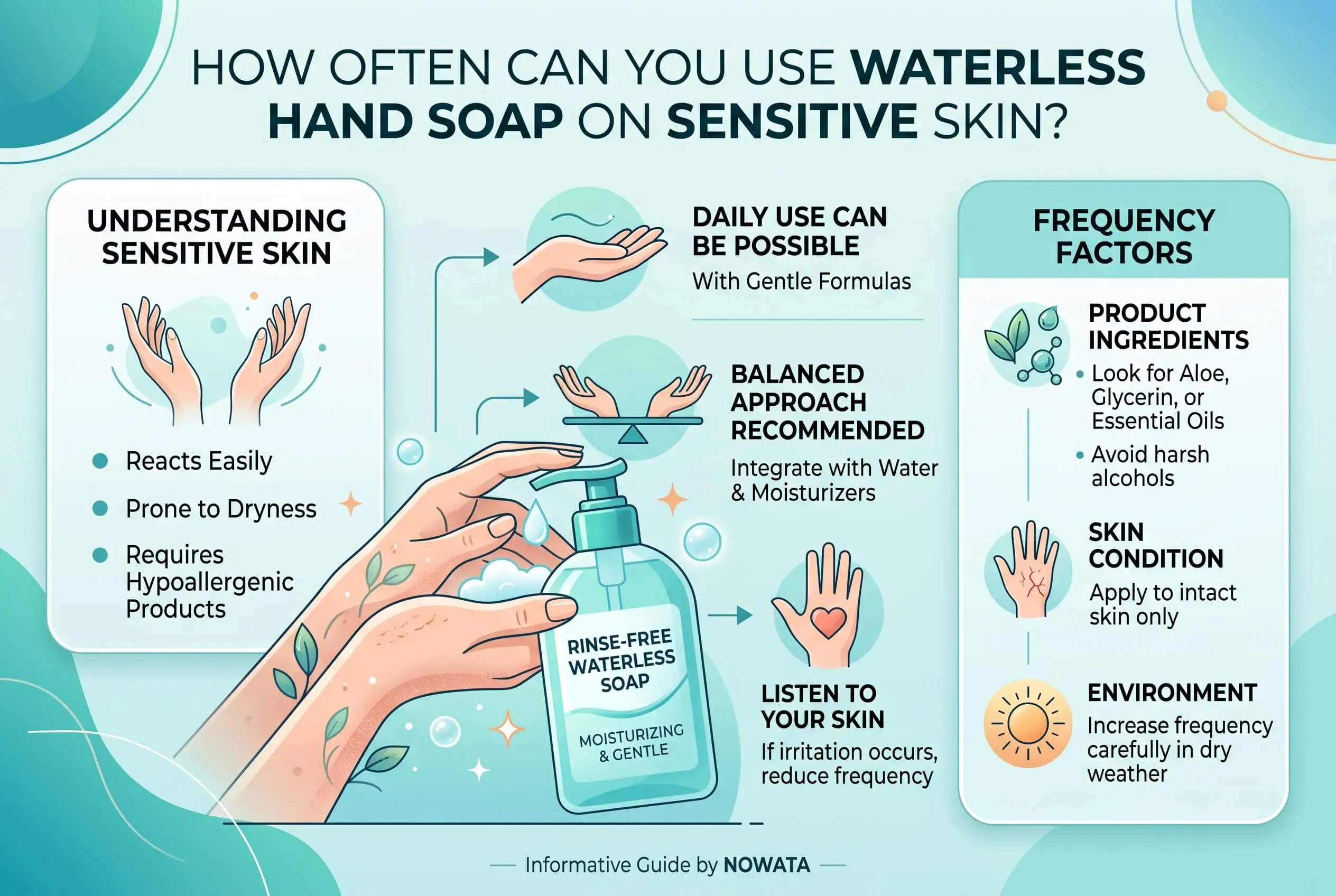
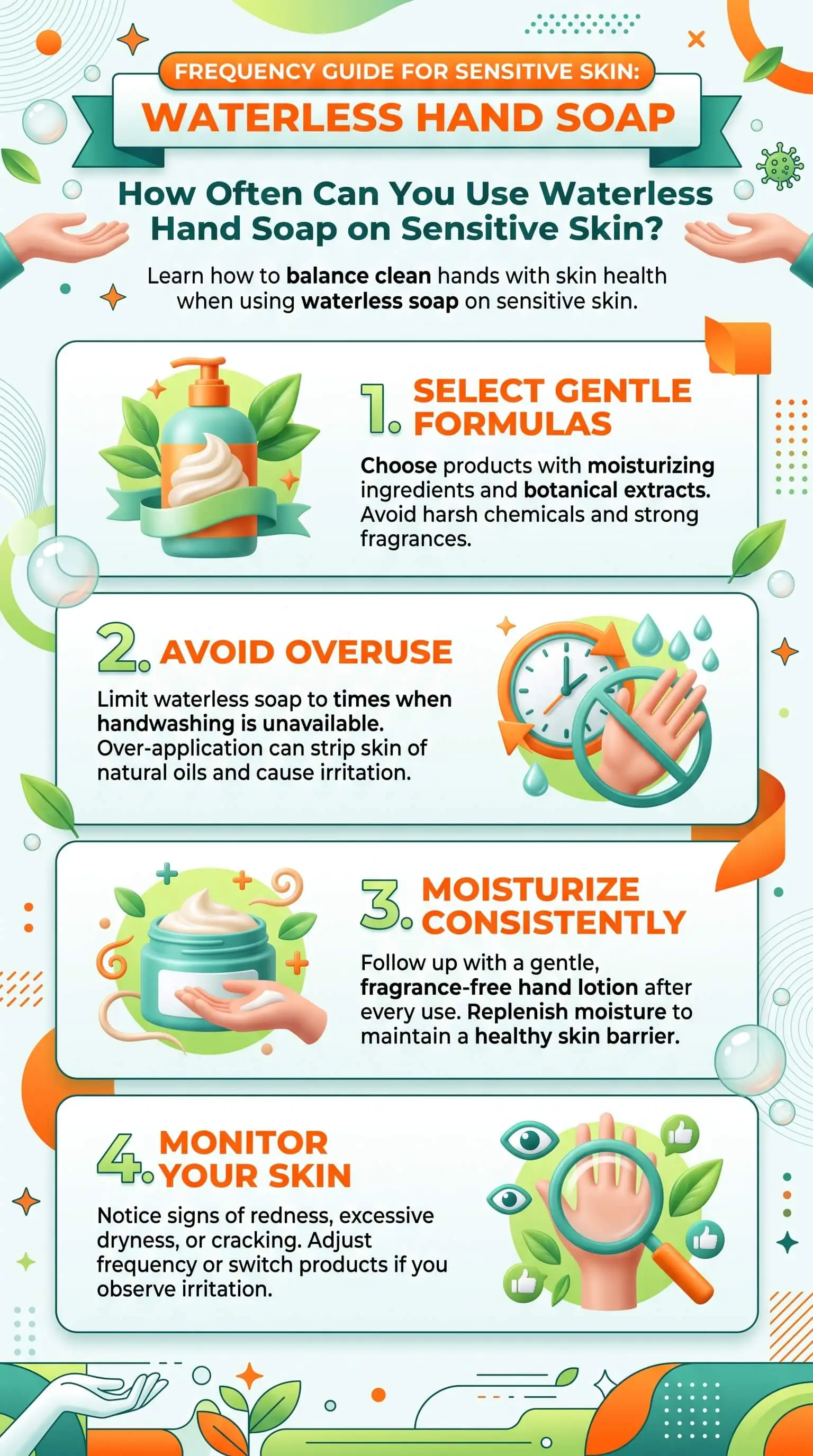
How often can you use waterless hand soap on sensitive skin?
For a genuinely surfactant-free, alcohol-free formula like NOWATA, there's no meaningful daily-use ceiling tied to the cleansing mechanism itself. Use it as often as your hands actually get dirty, and patch-test first if your skin is highly reactive.
Is waterless hand soap safe to use every day?
Yes, provided the formula doesn't rely on alcohol or surfactants to clean. Those two mechanisms create the overuse risk found in conventional sanitizer and soap, especially amid the growing demand for private home care. Formulas built around physical removal don't carry the same daily-use limitation.
What ingredients should sensitive skin avoid in a no-rinse hand soap?
Watch for alcohol, sulfates such as SLS and SLES, cocamidopropyl betaine, synthetic fragrance, and MIT or CMIT preservatives. All five show up regularly in products marketed as gentle despite being common contact allergens or barrier disruptors.
Is waterless hand soap gentler than hand sanitizer?
It depends entirely on the mechanism. Alcohol-based sanitizer cleans by dehydrating germs, which also dehydrates skin. A plant-based, alcohol-free waterless soap that removes contaminants physically doesn't carry that same drying effect.
Can waterless hand soap cause dryness or irritation with frequent use?
Any product can cause irritation on individual skin, which is why a patch test matters. A formula without alcohol, sulfates, or synthetic fragrance is far less likely to cause cumulative dryness than a sanitizer or surfactant-based soap used at the same frequency.
CTA
Curious whether your current hand soap or sanitizer is part of the frequency problem? Check the first five ingredients on the label against the list above. If alcohol or a sulfate sits near the top, that's your answer. If you want a Sulfate-free hand soap that supports a hand-hygiene routine you don't have to ration, look at how NOWATA's plant-based, alcohol-free formula is built, and decide for yourself if it fits your family's hands.