Booking junk removal takes ten minutes. Undoing a bad booking can take considerably longer. The companies in this space range from fully licensed operations with transparent pricing to unlicensed individuals working out of a pickup truck who'll disappear if something goes wrong on your property.
In our experience reviewing home service providers, the homeowners who avoid those situations aren't especially lucky. They just check a few things first. This guide covers exactly what to look at — licensing, pricing structure, reviews, scheduling, and disposal practices — so you can book junk removal with confidence instead of crossing your fingers.
TL;DR Quick Answers
How to Book Junk Removal
The fastest way to book junk removal is online. Find a licensed, insured company in your area, confirm the price in writing, and pick a pickup window that works for your schedule. Most online booking platforms deliver immediate confirmation — no phone tag, no waiting on a callback.
What to have ready before you book:
Your ZIP code
A general description of what's going on (furniture, appliances, debris, full cleanout, etc.)
Your preferred pickup date and window
What a legitimate booking confirmation should include:
The all-in price — not an estimate that can change at the curb
The crew's arrival window
A contact number if anything changes
Same-day and next-day availability exists in most metro areas. Book early in the day for the best odds of getting the slot you want.
Top Takeaways
Confirm licensing and general liability insurance before booking — ask for documentation, not just a verbal yes.
Get your quote in writing. An estimate that can change at the curb is not the same as a confirmed price.
Read recent reviews, not just the star average. Sort by date and look for patterns in the last ten.
Check how the company responds to complaints. Engagement and resolution matter more than a perfect rating.
Use online booking tools when available — they provide scheduling confirmation, pricing transparency, and a record of what you agreed to.
Ask about disposal practices before you commit. A company that can't tell you where your items go may not have a process worth trusting.
77% of consumers already check reviews before booking — if you're skipping that step, you're in the minority for a reason. Check the BBB profile for any company you're considering before you hand over a deposit.
Check Licensing and Insurance Before Anything Else
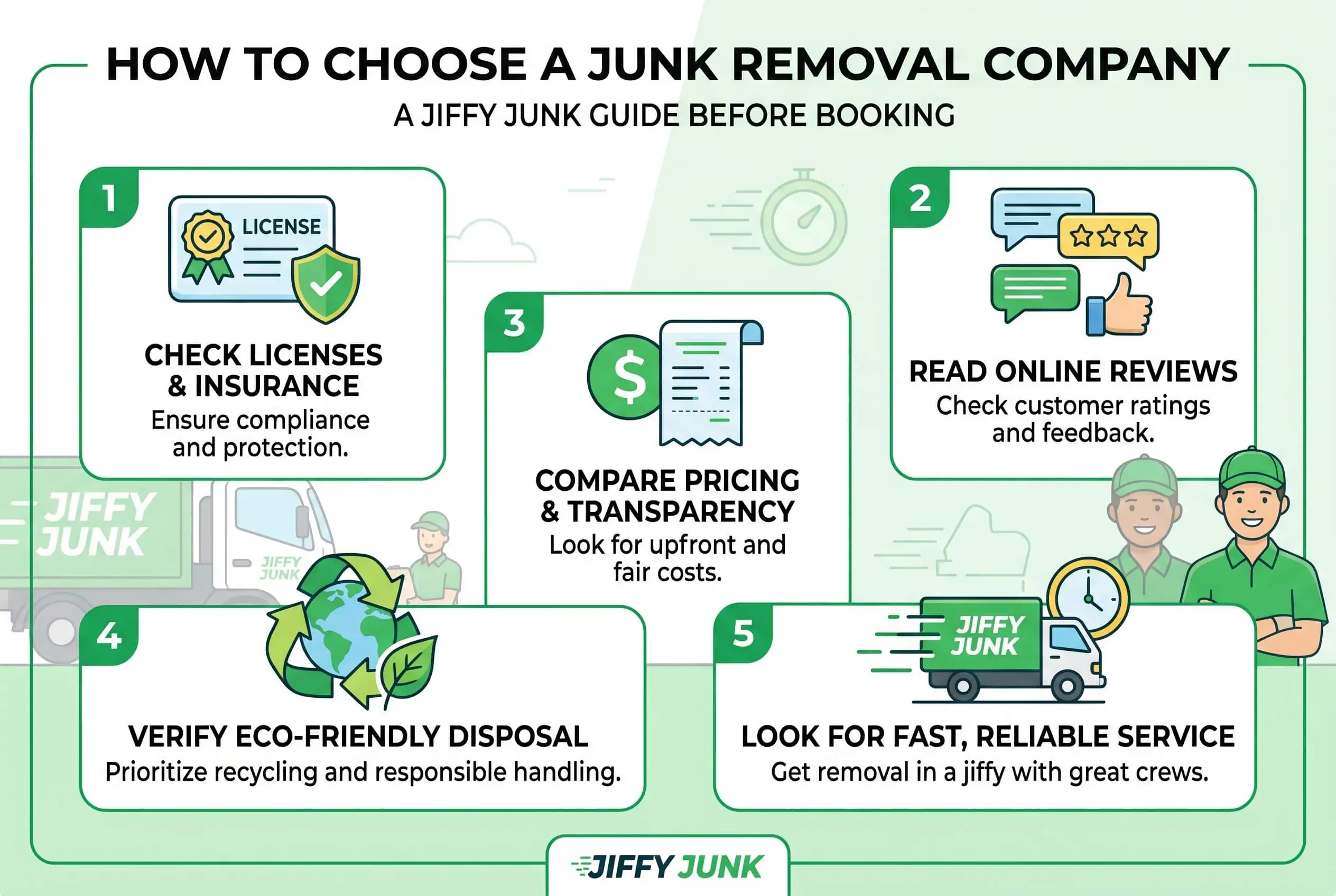
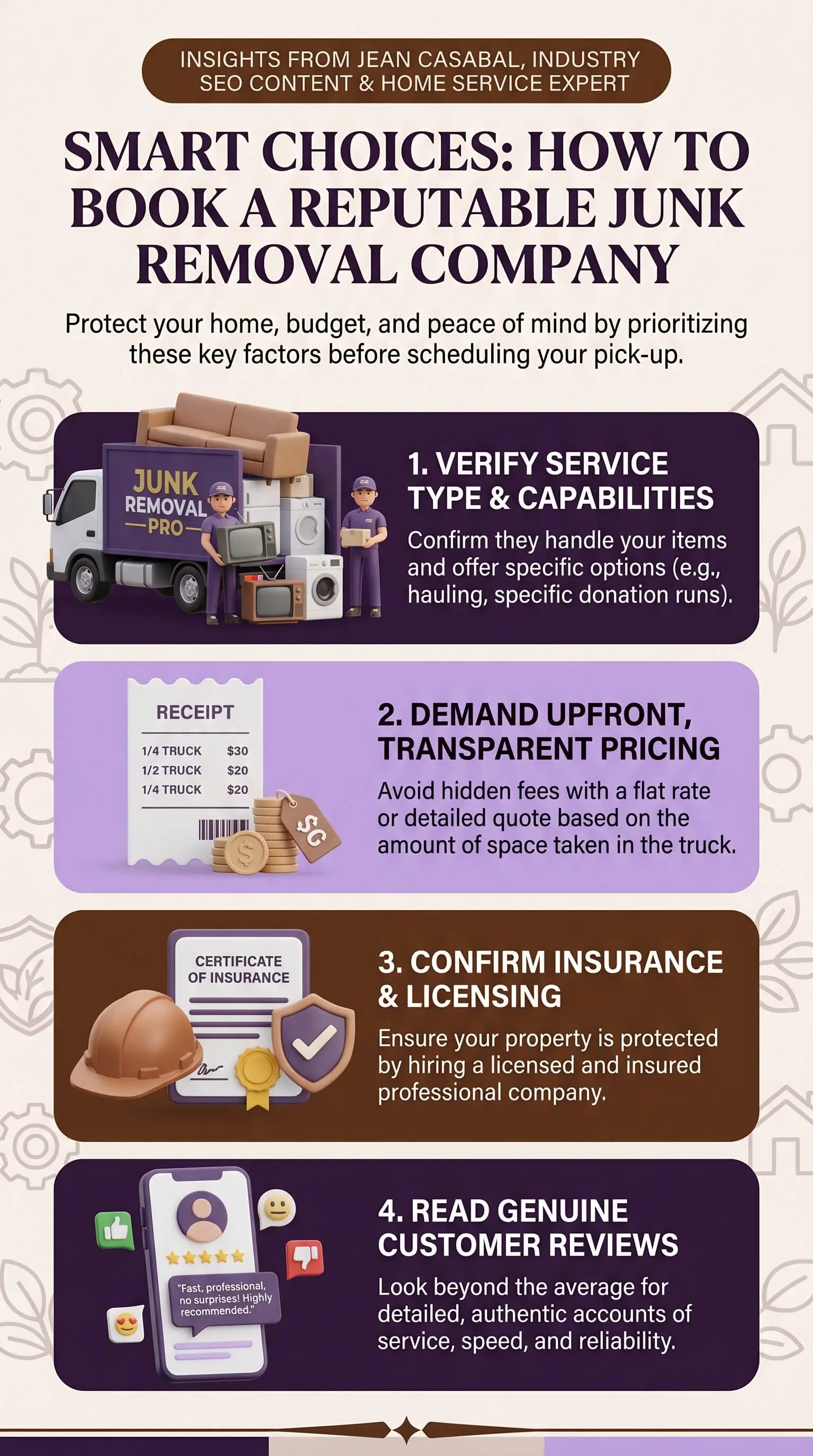
This is the single most important step, and it takes less than five minutes. A legitimate junk removal company should carry general liability insurance and operate under a valid local business license. Ask for both before booking — any reputable provider will share that information without hesitation.
The reason this matters more than it might seem: if an uninsured crew member is injured on your property during a pickup, or if your driveway gets damaged during loading, you could be financially exposed. Your homeowner's insurance may not cover incidents involving unlicensed contractors, depending on your policy.
You can verify a company's business standing through your state's business registry or through BBB.org, which maintains licensing information alongside customer reviews and complaint history. If a company is evasive about providing proof of insurance, that's a firm reason to move on.
Get a Firm Quote — Not Just an Estimate
There's a real difference between a quote and an estimate, and it matters when it's time to pay. An estimate is a rough figure that can change at pickup. A quote is a written, confirmed price tied to the scope of work you've described. Always push for the second one.
Watch for fuel surcharges, dump fees, stair fees, and same-day booking premiums that don't appear in the initial number. These aren't always disclosed upfront unless you ask directly. The FTC has specifically flagged undisclosed add-on fees as a deceptive practice — consumers have the right to know the full price before any service begins.
Before confirming a booking, ask: Is this price all-in? What triggers additional charges? Get the answer in writing, even if it's just an email confirmation.
Read Recent Reviews — Not Just the Star Rating
A 4.8-star average looks reassuring until you sort by date and notice the last three reviews mention the crew being hours late and leaving items behind. Recency matters more than the aggregate number.
Look for patterns in how the company responds to negative reviews. A company that acknowledges problems and resolves them publicly is generally more trustworthy than one with a perfect average and no engagement. Check Google Reviews for volume and recency, and cross-reference with the BBB profile to see if any formal complaints have been filed and how they were resolved.
A useful benchmark: if a company has fewer than 20 reviews, ask for references directly. Any legitimate operation doing consistent volume should be able to provide them.
Confirm Scheduling Flexibility and Same-Day Availability
If you're dealing with a move, an estate cleanout, or storm debris, timing isn't flexible. Before booking, confirm whether the company can hit your window — and what happens if they're late or need to reschedule.
Companies that offer online booking typically provide the most scheduling transparency. You can see available time slots, receive confirmation immediately, and get reminders without playing phone tag. This is particularly useful for same-day or next-day pickups where back-and-forth delays can cost you the slot.
Online appointment tools have become standard across home services because they reduce miscommunication and no-shows for both sides. The Wikipedia overview on online appointment scheduling lays out how these systems work and why they've become the default for service businesses that need reliable booking confirmation.
Ask What Happens to Your Items After Pickup
This one separates companies that have thought through their operations from those that haven't. Responsible junk removal providers have established relationships with donation centers, recycling facilities, and transfer stations. They can tell you, at least in general terms, where your items go.
If you're disposing of furniture, appliances, or electronics, ask whether the company partners with any nonprofits for donation or if recyclable materials are diverted from landfill. Some companies publish diversion rates — the percentage of materials that don't end up in a landfill — as a differentiator. It's a reasonable question, and a company that can't answer it at all may not have a structured disposal process.
"After reviewing hundreds of home service contracts over the years, the pattern is consistent: homeowners who get burned by junk removal companies skip one of three things. They didn't confirm insurance, they accepted a verbal estimate instead of a written quote, or they booked based on price alone without reading a single recent review. None of those checks takes more than ten minutes combined — but people skip them because booking feels urgent at the moment. The companies that prey on that urgency are counting on exactly that. Slow down for five minutes before you confirm, and you'll filter out 90 percent of the bad actors in this space."
7 Essential Resources
These seven resources give you everything you need to vet, compare, and book junk removal with confidence. Each link is verified and opens directly to the relevant page.
1. BBB: How to Hire a Reliable Contractor
The Better Business Bureau's contractor vetting guide applies directly to junk removal companies. Covers insurance verification, licensing checks, and red flags to watch for when requesting quotes. Use it alongside any company's BBB Business Profile to cross-reference reviews and complaint history.
2. FTC: Trade Regulation Rule on Unfair or Deceptive Fees
The FTC's official rulemaking document on hidden and deceptive pricing. Relevant for any homeowner who wants to understand their rights when a junk removal company adds fees at pickup that weren't disclosed upfront. The rule requires full price disclosure before service begins.
3. Wikipedia: Online Appointment Scheduling
A solid overview of how online scheduling systems work, why they've become standard across service industries, and what to expect from a modern booking experience. Useful context for evaluating whether a junk removal company's scheduling infrastructure is built for reliability.
4. BBB: 10 Common Mistakes to Avoid for Your Home Improvement Project
Several of the top mistakes homeowners make when hiring contractors directly apply to junk removal bookings — particularly around skipping written contracts and accepting verbal price agreements. Worth reading before you confirm any booking over the phone.
5. JiffyJunk: Book Junk Removal Online
A direct online booking platform for junk removal with confirmed scheduling, upfront pricing, and same-day availability in most service areas. If you've done your vetting and you're ready to book junk removal online, this is a straightforward place to start.
6. Consumer Reports: Hidden Junk Fees Survey
Consumer Reports' nationally representative survey data on hidden fees across service industries. While the report covers multiple sectors, the findings are directly applicable to junk removal: nearly 50,000 consumers signed petitions citing unexpected fees as a primary pain point with home service companies.
7. BBB: Contracting with Confidence
A practical checklist-style guide from the BBB covering license verification, insurance requirements, and how to evaluate quotes across multiple contractors. The red flags section is particularly useful for identifying companies that use pressure tactics or refuse to provide written documentation.
Supporting Statistics
The numbers behind this industry tell a clear story: demand is surging, consumers increasingly expect digital booking, and pricing transparency has become a defining issue.
77% consumers check reviews before booking a junk removal company — making review research the single most common pre-booking step in the industry.
Source: Gitnux: Junk Removal Industry Statistics (2026)
$15.3B The global junk removal market is projected to reach $15.3 billion in 2025, growing at a 5.1% annual rate through 2035 — reflecting sustained consumer demand for professional hauling services.
Source: Wise Guy Reports: Junk Removal Business Market
70% customers prefer to book junk removal services online, citing convenience and ease of scheduling as the primary reasons — up from a minority preference just a few years prior.
Source: Kales Junk & Trash Hauling: 100 Junk Removal Statistics (2025)
Final Thought & Opinion
The Companies That Make This Easy Are the Ones Worth Booking
Here's an honest observation after spending time in the home services space: the best junk removal companies don't make you work hard to vet them. They have their licensing information ready. Their quotes come in writing. Their recent reviews are detailed and current. When you ask about disposal practices, they give you a real answer.
The friction of vetting isn't random — it's informative. A company that stumbles over basic questions about insurance or gets vague when you push for an itemized quote is telling you something before the job even starts.
The industry is growing fast. The 70% of consumers who now prefer to book junk removal online aren't just looking for convenience — they're looking for transparency. Digital booking systems force pricing into the open. Confirmation emails create a paper trail. Scheduling tools reduce the he-said-she-said dynamic that used to make home services frustrating.
Our recommendation: choose full service junk removal for a smoother, more reliable experience — do the five-minute check on licensing and insurance, get your quote in writing, read the last ten reviews sorted by date, and book through a platform that gives you confirmation you can reference. That process won't guarantee a perfect experience, but it will help you choose a company that handles the job professionally from start to finish.
Frequently Asked Questions
How do I know if a junk removal company is legitimate?
Start with two concrete checks: ask for proof of general liability insurance and verify their business license with your state's registry or through BBB.org. A legitimate company will share both without hesitation. You can also check their BBB Business Profile for customer reviews, complaint history, and how long they've been in operation. If a company can't or won't provide insurance documentation before you book, that's a clear reason to move on.
What's a fair price to book junk removal for a single room?
Pricing typically runs from $150 to $400 for a single-room cleanout, depending on volume, item type, and your location. Most companies price by truck space — a quarter-load versus a half-load versus a full truck. Get at least two written quotes on the same scope of work. Be cautious of estimates that don't account for disposal fees, fuel surcharges, or stair charges, which can show up at the door if not discussed in advance.
Can I book junk removal online the same day?
Yes, in most metro areas. Companies with online booking platforms typically show real-time availability, including same-day slots. You'll receive a confirmation immediately rather than waiting for a callback. That said, same-day availability depends on your location and the company's current schedule — it's not guaranteed. Book early in the day for the best odds of a same-day pickup window.
What items do junk removal companies typically not take?
Most standard junk removal companies won't accept hazardous materials — paint, solvents, pesticides, propane tanks, asbestos, and medical waste all fall outside what a typical crew is licensed to handle. Some companies have restrictions on tires, certain electronics, or refrigerants. Ask about exclusions before the crew arrives so you're not caught off guard. Hazardous materials require separate disposal through your county's hazardous waste program.
Do junk removal companies take items to donation centers?
Many do, though it varies by company and item condition. Companies with active donation partnerships — typically furniture, appliances in working condition, and clothing — will often divert eligible items before anything goes to a transfer station. Ask specifically whether the company has nonprofit partnerships and what their diversion rate looks like. This is also a useful signal: a company that has thought through its disposal process is generally more organized overall.
Ready to Book Junk Removal?
You've done your homework. Check licensing and insurance, confirm your quote in writing, and read at least five recent reviews before you commit. When you're ready to move forward with trusted junk removal locations, book junk removal online at JiffyJunk and get a confirmed pickup on your schedule.