For most owners of a home services company, the business is both the retirement plan and the family's largest asset. That arrangement holds up fine until a private equity group calls about the HVAC company you started with one van and a borrowed ladder. By Friday you have more questions than any single advisor can answer. Your CPA wants to model the taxes and your attorney wants to redo the will, while your spouse just wants to know what any of it means for the kids.
Family office trust and business transition services for business owners coordinate the tax, trust, estate, investment, and family decisions surrounding a privately held business, so you work from one plan while your CPA and attorney keep doing what they do well. You stop playing telephone between them.
Most owners of home services companies, home care agencies, and trade businesses have never pictured themselves as family office clients. Yet many are sitting on one illiquid asset worth more than everything else they own combined. That's exactly the owner family office trust and business transition services for business owners are built for, and the planning window opens earlier than most people expect.
TL;DR Quick Answers
Family Office Trust and Business Transition Services for Business Owners
Family office trust and business transition services give a privately held business owner one coordinated plan for taxes, trusts, estate documents, investments, and family decisions. Start before a buyer or successor is in the picture.
What good family office support looks like:
One point of accountability. A Personal CFO keeps your CPA, attorneys, and bankers aligned.
Pre-sale planning. Tax modeling, entity cleanup, and trust review happen before a Letter of Intent.
Trust and estate coordination. Your documents match what the business is worth today.
Succession support. You'll have a clear plan whether you sell, recapitalize, or pass the business to your family.
A plan for the proceeds. Tax reserves, a cash policy, and a written investment policy are in place before the wire lands.
Family governance. The next generation knows what to expect and how decisions get made.
Straight answers. You'll hear it plainly when a simpler setup will do the job.
Top Takeaways
A family office gets your tax, trust, estate, investment, and family decisions working from one plan.
Most private business owners use a multi-family office instead of building their own.
The most valuable planning happens before a Letter of Intent is signed.
Trusts and succession tools need legal and tax review, and they only protect you once they're funded.
Complexity tells you more than net worth about whether you've outgrown a single advisor.
The first year after a sale is when rushed, expensive decisions are most likely.
What Is a Family Office, in Plain Terms?
A family office manages a family's entire financial life, and the investment portfolio is only one piece of it. The model is more than a century old, and a family office can serve one family or several.
A single-family office works for one household and carries its own staff, systems, and overhead. A multi-family office shares that infrastructure across a small group of client families. For most private business owners, the multi-family route makes more sense, since you get the coordination without putting a whole team on your own payroll.
What a Family Office Does for a Privately Held Business Owner
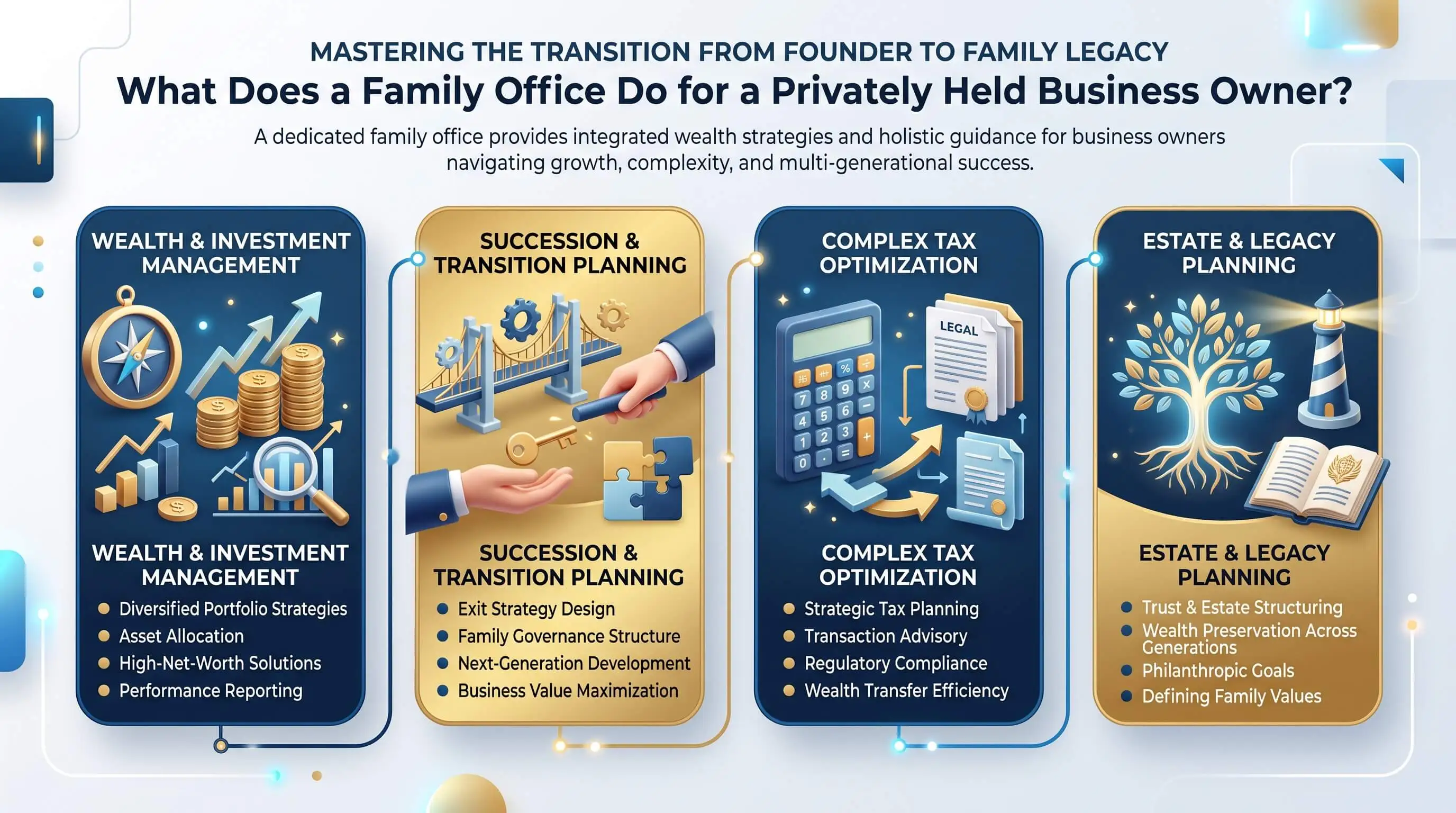
Think about everything your company quietly handles for you right now. There's a bookkeeper, maybe a controller, a tax plan built around the entity, and someone watching cash every week. Your personal balance sheet usually has none of that. A family office gives it the same support:
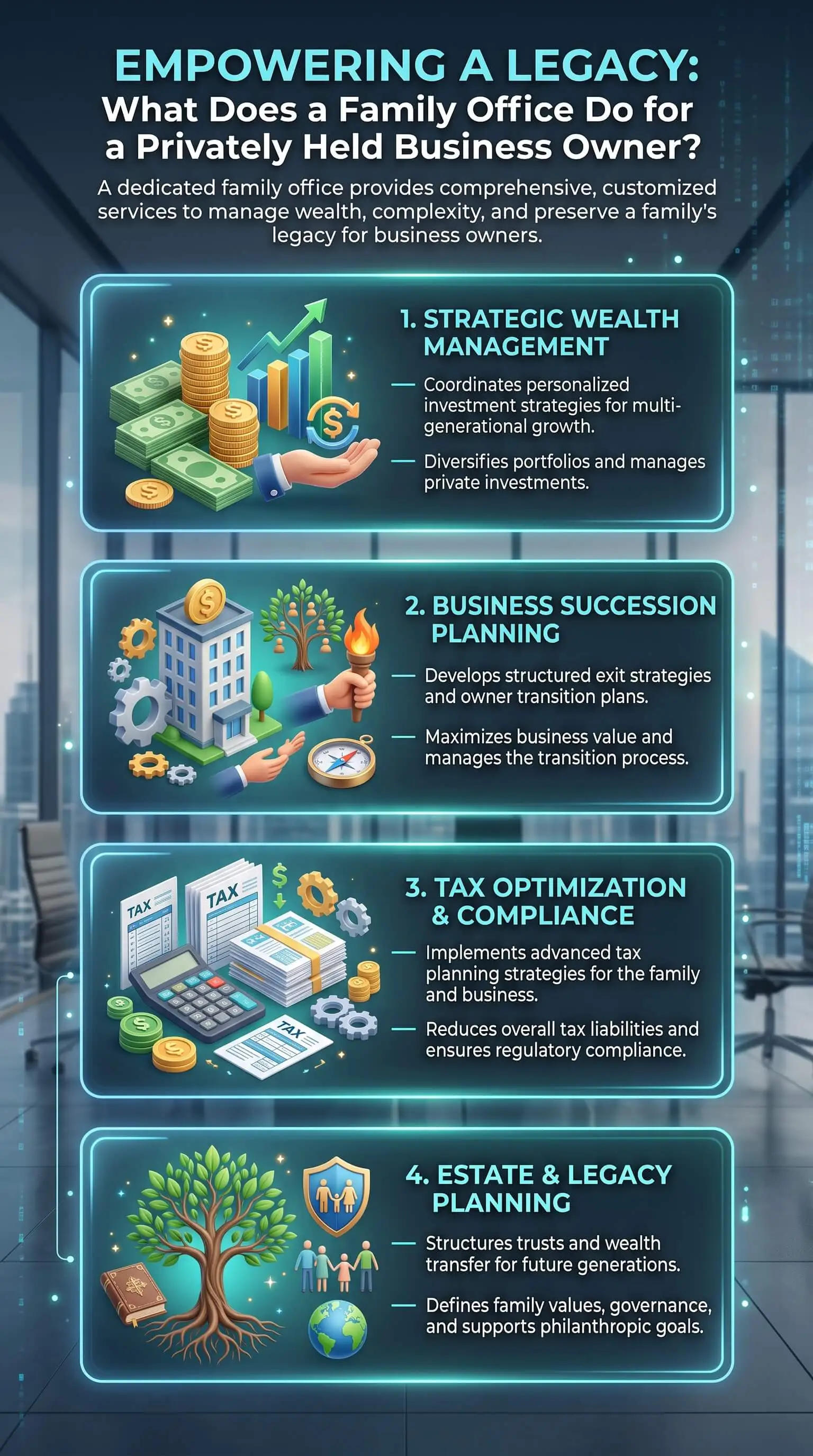
Advisor coordination. A Personal CFO acts as your quarterback, so your CPA, estate attorney, M&A attorney, banker, and insurance advisor all work from one plan.
Tax strategy. The family office models federal and state exposure before a transaction, then keeps you on a tax calendar after it.
Estate and trust planning. Your attorney drafts the documents, and the family office makes sure ownership, trusts, and beneficiary designations match what the business is worth today.
Business transition and succession planning. This covers a sale, a recapitalization, or handing the keys to a son or daughter.
Investment policy. You'll have a written plan for what the proceeds need to do before the wire lands.
Family governance. Spouses and the next generation get clear expectations and honest conversations.
Philanthropy and reporting. Giving follows your values, and you can see everything in one place.
Before, During, and After a Sale
The work shifts as a deal moves forward. Here's roughly how it breaks down.
Before the sale. Clean up entity records, operating agreements, and buy-sell provisions. Model after-tax proceeds, work through trust funding and transfer strategies with counsel, and settle state tax domicile questions early.
During the sale. Your attention belongs to the deal. The family office keeps the personal plan moving, lines up the M&A attorney, CPA, estate attorney, and banker, and flags personal tax or estate issues buried in the deal terms.
After the sale. Set tax reserves and a cash policy first. Then write an investment policy statement, update estate documents and insurance, and agree on how the family will make decisions from here.
The first year after closing catches plenty of owners off guard. The calls stop. The calendar empties, and the pressure to do something with the money arrives all at once. Some owners jump into real estate or a friend's private deal, while others park everything in cash for three years. Neither one is a plan.
Trusts and Business Transition: Where Timing Matters Most
Most of the valuable planning happens before a buyer shows up. Time is leveraged here. Once you sign a Letter of Intent, the company's value is effectively on paper, deadlines compress, and some options close fast.
Before that point, your estate attorney may look at structures such as grantor trusts, spousal lifetime access trusts, family limited partnerships, and buy-sell agreements. Whether any of them fit depends on your facts, and each needs review from qualified tax and legal counsel. A family office won't draft these documents, but it will make sure they're considered early, sized correctly, and actually funded. An unfunded trust protects nothing.
Keeping the business in the family raises the same timing issue, along with harder questions about who runs the company, who owns it, and what's fair to the siblings who never worked there. Those conversations go better with someone neutral in the room, which is where outsourced family office executive services can help keep the discussion organized and the decision-making process coordinated.
Family Office vs. Wealth Manager vs. CPA
Each one plays a different role, and most owners end up needing all of them at some point.
CPA. Handles tax preparation, compliance, and tax advice. Usually doesn't manage investments or coordinate your other advisors.
Wealth manager. Focuses on your investment portfolio and asset allocation, often with limited involvement in trusts, entities, and family governance.
Family office. Look after the full family balance sheet and the advisors around it, working with your CPA and attorneys instead of replacing them.
To be fair, a traditional wealth manager is plenty for some owners. If the business has already sold, the estate plan is current, and your main need is managing a portfolio, you may not need more. Family-office support starts paying for itself when complexity, more than net worth, outgrows what one advisor can hold.
Signs Your Business Has Outgrown a Single Advisor
In our experience, owners rarely wake up and decide they need a family office. They notice the symptoms first:
A buyer, competitor, or private equity group has started calling
A son, daughter, or key manager might take over, and nothing is in writing
Your CPA and attorney have never been on the same call
Your estate documents were signed when the business was worth a fraction of today's value
There's no written plan for the proceeds
If you're still cleaning up the numbers, start there. Clean books sit underneath everything above, and our guide to finding a reliable remote QuickBooks bookkeeper walks through that first step.
"The owners who worry me aren't the ones with messy situations. They're the ones who assume planning starts after closing. By the time a Letter of Intent is on the table, the owner is running the company, answering diligence requests, and relaying messages between advisors who've never been in the same room. Things slip. A trust that should have been funded sits empty, and a state tax question nobody asked turns into a real bill. The best-prepared owners I've worked with started this conversation a year or two before anyone called about buying. They built the personal structure first, so when the offer came, the hard decisions were already behind them."
7 Essential Resources
We opened every link below, and each one goes straight to the page described.
A plain overview of what family offices handle, from investments and accounting to governance and succession. It also explains why single-family offices tend to serve much larger fortunes, which is a handy context before your first meeting.
Walks through how directed and discretionary trusts can hold a family company. Read it if you want to keep the business in the family but haven't settled who should run it.
Practical questions about who leads after you, plus the tools owners use to phase a transition over time. Good prep for the family conversation you've been putting off.
Lines up the main exit routes side by side, including employee ownership, family succession, private equity, and selling to a family office. Useful if you haven't picked a path yet.
Breaks down what "ready to exit" means for the business, for you personally, and for your finances. The survey data shows how many owners are heading toward a transition at the same time.
The official page for current federal estate and gift tax thresholds. Check it before any trust or giving conversation so everyone is working from this year's numbers.
Shows how planning changes before, during, and after a major liquidity event, and where owners tend to be most exposed. A solid benchmark for what coordinated tax, estate, and family planning should include.
Between them, these seven pages give a privately held business owner a clear starting point on family offices, trusts, succession, exit readiness, current tax rules, and virtual outsourced finance and accounting services before choosing an advisory team.
Supporting Statistics
73% of privately held U.S. companies plan to transition ownership within the next 10 years, according to the Exit Planning Institute's owner readiness research. With that many owners heading for the door in the same decade, the ones who start early keep more room to choose their timing and terms.
Source: Exit Planning Institute
$1.5 million a year is where Whittier Trust puts the starting cost of setting up or running a single-family office. That's why most private business owners get family-office-level coordination through a multi-family office rather than building their own.
Source: Whittier Trust
$15 million is the federal basic exclusion amount for estate and gift tax in 2026, the level Public Law 119-21 set. A higher threshold doesn't remove the need to plan. If your company has grown faster than your estate documents, it's a good reason to revisit trusts and gifting with counsel while the rules are clear.
Source: Internal Revenue Service
Final Thought and Opinion
Build the Personal Structure Before Anyone Asks to Buy
We'd tell any owner the same thing: talk to a family office before the phone rings. A buyer may never call, and the planning still pays off. Owners who wait for the offer end up making permanent decisions about trusts, taxes, and family roles on someone else's timeline.
You already know how to build structure. You hired the dispatcher and made sure payroll runs whether you're on a job site or not. Your personal balance sheet deserves the same discipline, because right now the company is quietly doing your finance, tax, and decision-making work. After a sale or a handoff, that work has to live somewhere else.
That's the purpose of family office trust and business transition services for business owners. You get one coordinated plan, and a family that understands what the wealth is meant to do.
If the business has become the biggest thing you own, plan like it.
Frequently Asked Questions
What does a family office do for a business owner?
A family office manages the financial life surrounding your business. It coordinates your CPA, attorneys, and bankers, models taxes before a transaction, and keeps trusts and estate documents in line with what the company is worth. It also sets an investment plan for the proceeds and helps your family prepare for what's ahead, working alongside your existing advisors.
How much wealth do you need to use a family office?
Complexity matters more than any fixed number. Many owners start considering family-office-level support around $10 million, especially when a sale, trust planning, or more than one generation is involved. A dedicated single-family office usually only pencils out for much larger fortunes, so most owners work with a multi-family office.
When should a business owner start transition planning?
Ideally a year or more before any sale or handoff, and always before a Letter of Intent is signed. Starting early keeps more options open around trusts, entity structure, and state tax domicile. Once a deal is moving, deadlines tighten and some strategies get harder to use or disappear entirely.
Can a family office help if I plan to pass the business to my kids?
Yes. Handing a business to the next generation raises questions about leadership, ownership, fairness to siblings who don't work there, estate taxes, and sometimes private home care needs for older family members. A family office does not replace the family's attorney, CPA, or care providers; it coordinates their work, keeps the succession plan and financial decisions aligned, tracks agreed-upon actions, and helps structure family discussions so everyone understands the plan before it takes effect.
What is the difference between a family office and a wealth manager?
A wealth manager focuses mainly on your investment portfolio. A family office looks at the whole family balance sheet, including taxes, trusts, entities, insurance, philanthropy, and governance, and keeps every advisor aligned. In simpler situations a wealth manager may be enough. When the business and family picture gets complicated, broader coordination usually pays off.
Do I need a trust to transfer my business?
Not always, though trusts are one of the most common ways to transfer ownership, manage estate taxes, and keep control of a family company. Whether one fits depends on your goals, your family, and how the business is structured. Your estate attorney drafts it, and a family office makes sure it's sized, funded, and tied into the rest of your plan.
Ready to Plan Your Business Transition?
You built the business one job and one hire at a time, through more than a few hard years. What comes next deserves the same care. If a sale, a succession, or a fast-growing company has you wondering whether your advisors are on the same page, schedule a private consultation with Legacy Bridge. You'll leave with a clear view of where your tax, trust, and estate planning stand, and what to address before key decisions become harder to change.